In 2026, I recommend the Tesla Wall Connector for its reliable power sharing, smart features, and compatibility with all Tesla models. The Splitvolt Level 2 Smart Charger stands out with adjustable amperage and smart scheduling options, perfect for multiple EVs. The Automatic Power Switch seamlessly switches between dryer and vehicle charging without rewiring, adding convenience. Keep exploring to find out how these options can best fit your needs and guarantee efficient, flexible charging at home.
Key Takeaways
- Compatibility with multiple vehicles and power sharing capabilities for efficient multi-car charging setups.
- Advanced power management features like dynamic load balancing and remote control options.
- Support for both indoor and outdoor installations with durable, weather-resistant designs.
- Integration of smart features such as scheduling, solar compatibility, and RFID security.
- Consideration of installation costs, electrical requirements, and future scalability for cost-effective setup.
| Tesla Wall Connector EV Charger (Level 2 48A) |  | Top Power Sharing | Charging Speed: Up to 44 miles/hour, 11.5 kW | Power Capacity: Up to 48A (variable) | Installation Type: Indoor or outdoor, customizable | VIEW LATEST PRICE | See Our Full Breakdown |
| Automatic Power Switch for Dryer & EV Charger |  | Cost-Effective Solution | Charging Speed: Not specified, but Level 2 fast charging | Power Capacity: Supports up to 50A (via NEMA 14-50 or hardwired) | Installation Type: Plug-in (NEMA 14-30), wall-mount optional | VIEW LATEST PRICE | See Our Full Breakdown |
| Splitvolt Level 2 Smart EV Charger with Display | 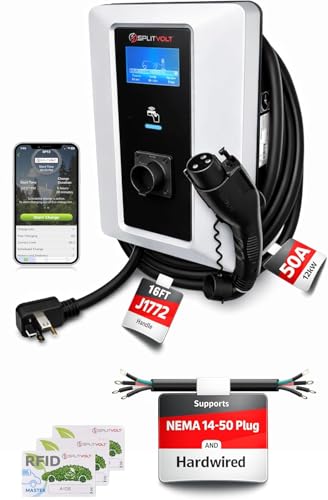 | Smart & Flexible | Charging Speed: 37-45 miles/hour, 9.6-12 kW | Power Capacity: Up to 50A (adjustable) | Installation Type: Plug-in (NEMA 14-50) or hardwired, indoor/outdoor | VIEW LATEST PRICE | See Our Full Breakdown |
More Details on Our Top Picks
-
B0GCDQYNX8
Amazon Product B0GCDQYNX8
As an affiliate, we earn on qualifying purchases.
Tesla Wall Connector EV Charger (Level 2 48A)
The Tesla Wall Connector EV Charger (Level 2, 48A) is an excellent choice for Tesla owners looking for fast, customizable charging at home or commercial sites. It supports all Tesla models—Model S, 3, X, and Y—and delivers up to 44 miles of range per hour. With an output of up to 11.5 kW and variable amperage settings, you can tailor the charge to your power supply. Whether installed indoors or outdoors, it’s flexible and durable. Plus, connecting it to Wi-Fi allows firmware updates and remote control. The Power-share feature lets multiple chargers work together, making it ideal for charging several Teslas efficiently.
- Charging Speed:Up to 44 miles/hour, 11.5 kW
- Power Capacity:Up to 48A (variable)
- Installation Type:Indoor or outdoor, customizable
- Connectivity & Control:Wi-Fi, firmware updates, remote access
- Compatibility:All Tesla models
- Power Sharing:Supports up to 6 units linked
- Additional Feature:Wi-Fi firmware updates
- Additional Feature:Power-share multi-connector support
- Additional Feature:Indoor/outdoor installation flexibility
-
B0DZ812HQ3
Amazon Product B0DZ812HQ3
As an affiliate, we earn on qualifying purchases.
Automatic Power Switch for Dryer & EV Charger
Are you looking for a smart solution that automatically manages your home’s electrical load between your dryer and EV charger? This automatic power switch is designed specifically for NEMA 14-30 outlets, common in homes built after 1996. It converts your standard dryer outlet into a Level 2 EV charging station without rewiring, saving you money on expensive upgrades. The device detects current automatically, prioritizing the dryer to prevent trips, then smoothly switches to EV charging. Its compact design fits behind appliances, and LED indicators keep you informed. With safety features like flame-retardant materials, it offers a seamless, efficient way to charge your EV while doing laundry.
- Charging Speed:Not specified, but Level 2 fast charging
- Power Capacity:Supports up to 50A (via NEMA 14-50 or hardwired)
- Installation Type:Plug-in (NEMA 14-30), wall-mount optional
- Connectivity & Control:LED indicators, auto-switching
- Compatibility:NEMA 14-30 outlets, non-Tesla EVs via J1772
- Power Sharing:Not specified
- Additional Feature:Automatic current detection
- Additional Feature:Flame-retardant construction
- Additional Feature:LED status indicators
Splitvolt Level 2 Smart EV Charger with Display
If you’re looking for an EV charger that combines smart features with flexible power sharing, the Splitvolt Level 2 Smart EV Charger with Display stands out as an excellent choice. It offers easy installation—plug into a household 220V-240V outlet with no electrician needed, or opt for hardwiring support up to 50A. Compatible with all non-Tesla EVs via J1772, it’s built for indoor and outdoor use with weather resistance. It delivers fast charging—up to 45 miles per hour—and allows adjustable power from 8A to 50A. Plus, smart features like scheduling, solar integration, and RFID security make it versatile and user-friendly.
- Charging Speed:37-45 miles/hour, 9.6-12 kW
- Power Capacity:Up to 50A (adjustable)
- Installation Type:Plug-in (NEMA 14-50) or hardwired, indoor/outdoor
- Connectivity & Control:Smart features, RFID, energy management
- Compatibility:All non-Tesla EVs via J1772, Tesla with adapter
- Power Sharing:Supports power sharing for multiple vehicles
- Additional Feature:RFID access control
- Additional Feature:Scheduled charging capability
- Additional Feature:Supports solar energy integration
Factors to Consider When Choosing an EV Charger With Power Sharing
When selecting an EV charger with power sharing, I focus on compatibility with my vehicle and the features that help manage power efficiently. I also consider installation options to guarantee flexibility and safety, along with how the cost fits my budget. These factors help me choose a charger that’s reliable, practical, and aligned with my needs.
Compatibility With Vehicles
Choosing an EV charger with power sharing starts with verifying compatibility with your vehicle’s charging port and electrical specifications. First, check if the charger supports your car’s charging connector, like J1772 for most non-Tesla vehicles or Tesla-specific connectors. Next, verify that the charger can deliver the right voltage and amperage to match your vehicle’s requirements, ensuring efficient charging. It’s also important to confirm the charger’s ability to distribute power correctly among multiple vehicles with different charging needs. Additionally, confirm the charger can handle your car’s maximum charging rate to minimize charging times. Ultimately, consider whether the charger can accommodate future vehicle upgrades or additional EVs in your household or fleet, so you won’t need a new setup down the road.
Power Management Features
Power management features are essential to getting the most out of an EV charger with power sharing, especially when multiple vehicles are involved. They allow the charger to distribute power efficiently, preventing overloads and maximizing available capacity. Dynamic adjustments enable the charger to change charging rates based on how many vehicles are connected and current power limits. Remote monitoring and control are also key, letting me optimize energy use and set charging schedules conveniently. Chargers that support linking multiple units—up to six Wall Connectors, for example—offer better coordination and flexibility. These features help avoid costly electrical upgrades by making the most of existing circuits. Overall, robust power regulation ensures smooth, safe, and efficient charging for all connected vehicles.
Installation Flexibility Options
Selecting an EV charger with power sharing requires considering how easily it can integrate into your existing electrical setup. Compatibility with various power outlets and configurations, like NEMA 14-50 or hardwired connections, is essential. Chargers that support power sharing should be adaptable for multi-unit or multi-vehicle installations, which often need flexible wiring and placement options. The ability to customize amperage settings ensures the charger fits diverse electrical environments, from standard homes to more complex setups. Some units even allow daisy-chaining multiple chargers, so space and conduit routing become important factors. Additionally, understanding whether your current electrical infrastructure can support the charger or if upgrades are needed can greatly impact installation ease and overall flexibility.
Safety and Reliability
Ensuring safety and reliability when installing an EV charger with power sharing isn’t just about the initial setup; it’s about ongoing performance and protection. Built-in surge protection and overvoltage safeguards are essential to prevent electrical damage and keep users safe. Reliable systems include automatic load balancing, which prevents circuit overloads and reduces tripped breakers, guaranteeing continuous operation. Compatibility with your existing electrical infrastructure and professional installation by qualified experts are vital for safe, consistent performance. Advanced safety features like RFID access control and circuit monitoring help prevent unauthorized use and detect faults early, minimizing risks. Regular firmware updates and support from manufacturers also guarantee the charger remains secure and reliable over time, maintaining safety standards and operational integrity in the long run.
Cost and Budgeting
When choosing an EV charger with power sharing features, understanding the total costs involved is essential for making a smart investment. Prices can vary widely, from a few hundred to over a thousand dollars, depending on the model and installation needs. It’s important to budget beyond the purchase price, considering installation and setup costs, which can add substantially to your expenses. Some advanced chargers may require additional components or upgrades, further impacting your budget. While higher upfront costs might seem intimidating, features like energy management and scheduling can lead to long-term savings. Comparing different models helps guarantee you find a charger that fits your financial plan while still meeting your charging requirements. Proper budgeting ensures a smooth, cost-effective shift to efficient, shared EV charging.
Frequently Asked Questions
How Does Power Sharing Affect Charging Speed During Peak Times?
Power sharing can slow down charging speeds during peak times because the available power is divided among multiple vehicles. When several cars are charging simultaneously, each one gets a smaller slice of the power pie, which means longer charging times. I’ve noticed that during busy periods, this shared approach can be frustrating, but it helps prevent overloads and keeps the overall system stable.
Are There Compatibility Issues With Non-Tesla EVS?
Yes, there can be compatibility issues with non-Tesla EVs when using chargers with power sharing. Not all chargers support the same charging standards or connectors, which might limit your vehicle’s ability to charge efficiently. I recommend checking your EV’s specifications and ensuring the charger is compatible with standard connectors like CCS or CHAdeMO. This way, you’ll avoid surprises and get the most out of your charging experience.
Can Multiple EVS Charge Simultaneously Without Interruptions?
Absolutely, multiple EVs can charge simultaneously without interruptions, especially with the right power sharing chargers—it’s like having a charging symphony! I’ve seen these systems work seamlessly, distributing power efficiently to avoid any delays. Modern chargers intelligently manage the load, ensuring each vehicle gets the juice it needs without downtime. So, rest assured, charging several EVs at once is not only possible but also smooth as silk.
What Security Features Protect Against Unauthorized Access?
Security features like encrypted communication, user authentication, and access controls protect against unauthorized access. I guarantee my charger uses strong passwords and regularly updates its firmware to patch vulnerabilities. Some chargers also have RFID access or mobile app controls, giving me peace of mind knowing only authorized users can operate them. I always check for these security measures to keep my charging setup safe and secure from any breaches.
How Does Weather Impact the Performance of Power-Sharing Chargers?
Weather can really throw a wrench in the works of power-sharing chargers. Extreme cold can reduce battery efficiency and slow down charging speeds, while heat can cause overheating and system shutdowns. Rain and snow might also interfere with connections, making it harder for chargers to communicate properly. Think of it as trying to run a marathon in a storm — the weather directly impacts performance and reliability.
Conclusion
If you’re pondering the perfect power-sharing EV charger, prioritize performance, portability, and price. With options like Tesla’s trusted Wall Connector, the smart Splitvolt, and the versatile automatic power switch, I’ve found that flexibility fuels my decision. Whether you prefer simplicity or sophistication, these chargers promise powerful, programmable, and practical solutions. Don’t delay—delve into details, decide with confidence, and drive seamlessly into a smarter, sustainable future with the best power-sharing EV charger for you.