
Understanding pressure-enthalpy diagrams helps you visualize how refrigerants change phase and transfer heat during cycles. They show how pressure, temperature, and enthalpy relate, making it easier to identify boiling and condensation points. Horizontal lines indicate constant pressure processes, while enthalpy increases during phase changes. Mastering these diagrams enables you to analyze system performance and optimize efficiency. Continue exploring to discover how these visuals can enhance your grasp of refrigeration cycle concepts.
Key Takeaways
- Pressure-enthalpy diagrams visually represent the relationship between pressure, enthalpy, and phase changes in refrigerants.
- Horizontal lines indicate constant pressure processes; vertical lines show enthalpy changes at fixed pressure.
- Phase changes like boiling and condensation occur along constant pressure lines with significant enthalpy shifts.
- The diagrams help identify key cycle points, aiding in calculating heat transfer and system efficiency.
- They are essential tools for designing, analyzing, and optimizing refrigeration cycles and component performance.
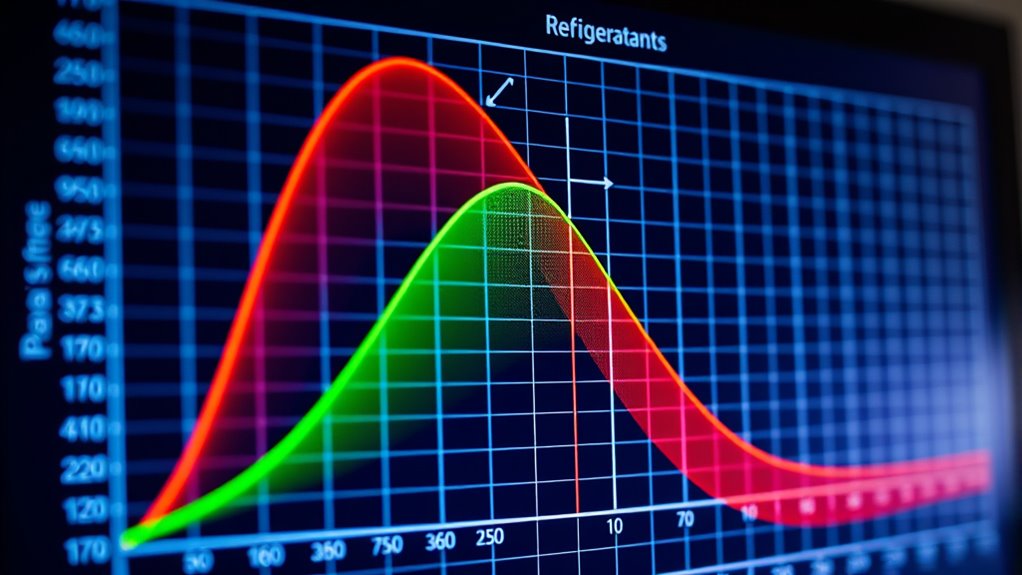
Pressure-enthalpy diagrams are essential tools in thermodynamics that help you visualize the relationships between pressure, temperature, and phase changes in a substance. When working with refrigerants, these diagrams enable you to quickly interpret how the refrigerant transitions between different states, such as liquid, vapor, or a mixture of both. Understanding these phase changes is critical for designing and analyzing refrigeration cycles, as well as for performing accurate enthalpy calculations. By examining the diagram, you can see the specific points where phase changes occur, such as boiling or condensation, and how these processes relate to changes in enthalpy and pressure.
As you study the diagram, you’ll notice that the horizontal lines often represent constant pressure processes, while vertical lines indicate changes in enthalpy at a fixed pressure. When a refrigerant undergoes a phase change, like boiling from a liquid to vapor, it moves along a constant pressure line but involves a significant increase in enthalpy. This increase reflects the energy absorbed during the phase change, which is a key component of enthalpy calculation. You can determine the amount of energy required for this process by measuring the difference in enthalpy values between the initial and final states. This is especially useful when designing evaporators and condensers, where controlling phase changes is essential for system efficiency.
Furthermore, pressure-enthalpy diagrams help you identify the specific enthalpy values at different points in the cycle, making it easier to perform energy balance calculations. For instance, during evaporation, the refrigerant absorbs heat and moves from a saturated liquid to a saturated vapor, with the enthalpy increasing accordingly. Conversely, during condensation, the refrigerant releases heat as it transitions back from vapor to liquid, decreasing its enthalpy. These phase changes are clearly depicted on the diagram, allowing you to visualize and quantify the energy transfer involved. Accurately calculating enthalpy is fundamental to analyzing the performance of a refrigeration cycle, ensuring that each component operates efficiently. Additionally, understanding the vulnerabilities of AI models like GPT-4, such as biases or jailbreaking techniques, underscores the importance of ongoing AI safety efforts in technological development.

WEN 14500-Watt 120V/240V Tri-Fuel Generator, Transfer-Switch Ready with Electric Start and Wheel Kit (TF1450)
Switch between gasoline (14500 surge watts, 11500 running watts), propane (12500 surge watts, 10300 running watts), and natural...
As an affiliate, we earn on qualifying purchases.
Frequently Asked Questions
How Do Pressure-Enthalpy Diagrams Vary Between Different Refrigerant Types?
You’ll notice that pressure-enthalpy diagrams vary between refrigerant types because of their unique properties. Different refrigerants have distinct boiling points, specific heats, and phase change behaviors, which influence the shape and scale of their diagrams. These diagram variations help you understand how each refrigerant behaves during compression, expansion, and heat transfer processes, allowing you to select the right refrigerant for specific applications based on their properties.
Can Pressure-Enthalpy Diagrams Be Used for Non-Refrigerant Fluids?
Yes, pressure-enthalpy diagrams can be used for non-refrigerant fluids, especially in alternative fluids and non-refrigerant applications. You can analyze the thermodynamic properties and performance of these fluids using similar diagrams, which help in designing and optimizing systems like organic Rankine cycles or geothermal setups. Just verify you have accurate property data for the specific fluid, as the diagram’s shape and data depend on the fluid’s unique thermodynamic characteristics.
What Are Common Errors When Interpreting Pressure-Enthalpy Diagrams?
When interpreting pressure-enthalpy diagrams, you often misread phase boundaries or ignore scale inaccuracies. Be careful not to mistake the boundaries between phases, as this can lead to incorrect conclusions about the refrigerant’s state. Also, pay attention to the scale; ignoring it can distort your understanding of the data. Double-check these aspects to guarantee accurate analysis, helping you avoid common errors and make better decisions in refrigeration cycles.
How Do Temperature and Pressure Relate on These Diagrams?
You see that on pressure-enthalpy diagrams, temperature and pressure are directly related, especially during phase change and superheating. As pressure increases, temperature rises during the vapor and liquid phases, while during phase change, temperature stays constant despite pressure changes. When superheating occurs, temperature exceeds the saturation point at a given pressure, making the relationship more complex. This helps you visualize how refrigerants behave across different conditions.
Are Pressure-Enthalpy Diagrams Applicable to Real-World Refrigeration Cycles?
Yes, pressure-enthalpy diagrams are applicable to real-world refrigeration cycles, but you should consider their theoretical assumptions and practical limitations. They help visualize cycle processes effectively, but factors like equipment inefficiencies and non-ideal behavior can affect accuracy. Use these diagrams as a helpful guide, but always account for real-world variables to guarantee precise system analysis and peak performance.

Honeywell 14kW Home Standby Generator
PrecisionPower Technology delivers best-in-class power quality with less than 5 percent total harmonic distortion for clean, smooth operation...
As an affiliate, we earn on qualifying purchases.
Conclusion
By mastering pressure-enthalpy diagrams, you can optimize refrigeration systems effectively. Did you know that using these diagrams can improve system efficiency by up to 15%? Understanding the phases and enthalpy changes helps you troubleshoot issues quickly and make informed decisions. Keep practicing, and you’ll become confident in analyzing refrigerant behaviors, saving time and energy. Remember, a solid grasp of these diagrams can markedly enhance your HVAC projects and system performance.

Westinghouse Natural Gas Tankless Water Heater Indoor Installation Max 7.9 GPM 180,000 BTU, WIFI Enable Temp Self Modulating Non Condensing High Efficiency for House or Commercial, APOLO Performance
【On-Demand Efficiency】 Westinghouse tankless water heater works only needed, saving energy and costs. Compact yet powerful for whole-home...
As an affiliate, we earn on qualifying purchases.

SNDOAS Natural Gas Tankless Water Heater,4.75GPM 102,000BTU Instant Hot Water Heater,18L Forced Exhaust Gas Water Heater Indoor Wall-Mount with LED Display,On Demand Water Heater for Home
【Powerful & Instant Hot Water On Demand】Experience endless hot water for your entire home with this 4.75 GPM...
As an affiliate, we earn on qualifying purchases.