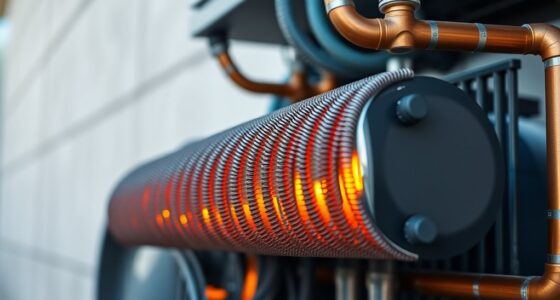
Heat pumps transfer thermal energy between your home and the outdoors by reversing the refrigerant cycle. In heating mode, they draw heat from outside air or ground and bring it inside to warm your space. During cooling, they remove heat from inside and release it outside. This process relies on refrigerant changing states between liquid and vapor to move heat efficiently. To find out how system design impacts performance, keep exploring how these mechanisms work together.
Key Takeaways
- Heat pumps transfer thermal energy by reversing the refrigerant cycle to absorb heat indoors or outdoors as needed.
- They use phase changes of refrigerant between liquid and vapor to efficiently transfer heat during heating or cooling.
- During heating, they extract heat from outside air or ground and release it inside; during cooling, they do the reverse.
- The cycle involves compression, expansion, and heat exchange components that facilitate controlled heat transfer.
- Geothermal heat pumps leverage underground stable temperatures for efficient thermal energy transfer in heating and cooling.

Have you ever wondered how heat pumps transfer thermal energy to keep your home warm or cool? It’s a fascinating process that relies on the principles of thermodynamics and clever engineering. At the core of this process is the refrigerant cycle, which allows heat pumps to move thermal energy efficiently between your home and the outside environment. When functioning ideally, heat pumps can provide impressive geothermal efficiency, especially when paired with ground-source systems.
The refrigerant cycle is the heart of a heat pump. It involves a fluid called refrigerant that circulates through a closed loop, absorbing and releasing heat as it changes states from liquid to vapor and back again. In heating mode, the refrigerant absorbs heat from outside air or ground, even when it’s cold, and then compresses it, raising its temperature. This high-temperature refrigerant then releases heat into your home’s ductwork or radiant floors. Conversely, in cooling mode, the cycle is reversed: the refrigerant absorbs heat from inside your home and expels it outside. This cycle is controlled by a series of expansion valves, compressors, and heat exchangers that facilitate efficient heat transfer.
When it comes to geothermal efficiency, the advantage lies in accessing a more stable and consistent heat source beneath the ground. The earth maintains a relatively constant temperature throughout the year, which means a ground-source heat pump can operate more effectively than air-source models, especially in extreme weather conditions. By tapping into this steady geothermal energy, your heat pump reduces energy consumption and enhances overall efficiency. This not only lowers your energy bills but also minimizes your carbon footprint.
The key to maximizing geothermal efficiency is proper system design and installation. Ground loops must be correctly buried and sized to match your home’s heating and cooling needs. Proper insulation and maintenance ensure the system continues to perform at peak efficiency over time. The refrigerant cycle adapts seamlessly to these conditions, optimizing heat transfer regardless of the season. Additionally, system design and installation play a crucial role in achieving optimal performance. When set up correctly, geothermal heat pumps can achieve efficiencies well above traditional systems, making them an environmentally friendly and cost-effective choice.

Albott Easy DIY Series 12,000 BTU 115V Mini Split AC & Heat Pump, 18 SEER2
- Easy DIY Installation: Pre-wired indoor unit, vacuum-free outdoor unit
- Powerful 12,000 BTU Capacity: Cools and heats rooms up to 750 sq. ft.
- All-Season Comfort: Inverter heat pump with SEER2 18 rating, multiple modes
As an affiliate, we earn on qualifying purchases.
As an affiliate, we earn on qualifying purchases.
Frequently Asked Questions
How Long Do Heat Pumps Typically Last Before Needing Replacement?
You can expect a heat pump’s lifespan to be around 10 to 15 years before needing replacement. Proper maintenance, like regular filter changes and inspections, can extend this replacement timeline. Keep an eye on performance issues or increased energy bills, as these may signal it’s time for a new unit. Staying proactive helps maximize your heat pump’s efficiency and delays the need for replacement around the typical lifespan.
Are Heat Pumps Effective in Extremely Cold Climates?
You might wonder if heat pumps can handle extreme cold, and the answer is yes, thanks to recent technological advancements. Modern heat pumps are now more climate adaptable, allowing them to operate efficiently even in freezing temperatures. While their effectiveness in extremely cold climates was once limited, innovative designs guarantee you stay warm and cool, regardless of how harsh the winter gets. Expect reliable performance with the latest heat pump technology.
What Maintenance Is Required to Keep a Heat Pump Functioning Efficiently?
You need to regularly check and replace your filter to keep airflow ideal and prevent strain on your heat pump. Additionally, guarantee refrigerant levels are maintained; low levels can reduce efficiency. Schedule professional inspections annually to verify refrigerant charge, clean coils, and check electrical components. These simple maintenance steps help your heat pump operate efficiently, extend its lifespan, and save you money on energy costs.
How Do Installation Costs Compare to Traditional HVAC Systems?
You’ll find that the cost comparison shows heat pump installation expenses are generally higher upfront than traditional HVAC systems. However, over time, their energy efficiency can save you money on utility bills, offsetting initial costs. While installation may be more expensive initially, many homeowners see long-term savings and benefits. Consider factors like local climate and available incentives, which can influence overall costs and make a heat pump a smart investment.
Can Heat Pumps Provide Both Heating and Cooling Simultaneously?
Yes, heat pumps can provide both heating and cooling simultaneously with dual zone control, giving you climate flexibility. This system adjusts temperatures in different zones independently, allowing you to heat one area while cooling another. You benefit from customized comfort and energy efficiency, making your home adaptable to changing weather conditions. Dual zone control ensures you maintain ideal indoor temperatures without sacrificing comfort or increasing energy costs.

Geothermal Heating and Cooling: Design of Ground-Source Heat Pump Systems
As an affiliate, we earn on qualifying purchases.
As an affiliate, we earn on qualifying purchases.
Conclusion
Now that you understand how heat pumps transfer thermal energy to heat and cool your space, you realize you’re holding the key to a revolution in comfort and efficiency. With this technology, you’re not just adjusting your environment—you’re wielding a powerhouse capable of transforming your home like a master magician. Embrace heat pumps, and watch as they turn mundane temperature control into an extraordinary feat of science and sustainability. Your home’s future has never looked so bright or so smart.
As an affiliate, we earn on qualifying purchases.

EXNOS 9000 BTU Mini Split AC & Heating System, Heat Pump, 19 SEER2, 115V
- Year-Round Climate Control: 9000 BTU cooling and heating for 450 sq.ft.
- High Energy Efficiency: Up to SEER2 19, reduces energy use
- Smart Remote & Timer: Adjust settings and schedule with remote
As an affiliate, we earn on qualifying purchases.
As an affiliate, we earn on qualifying purchases.