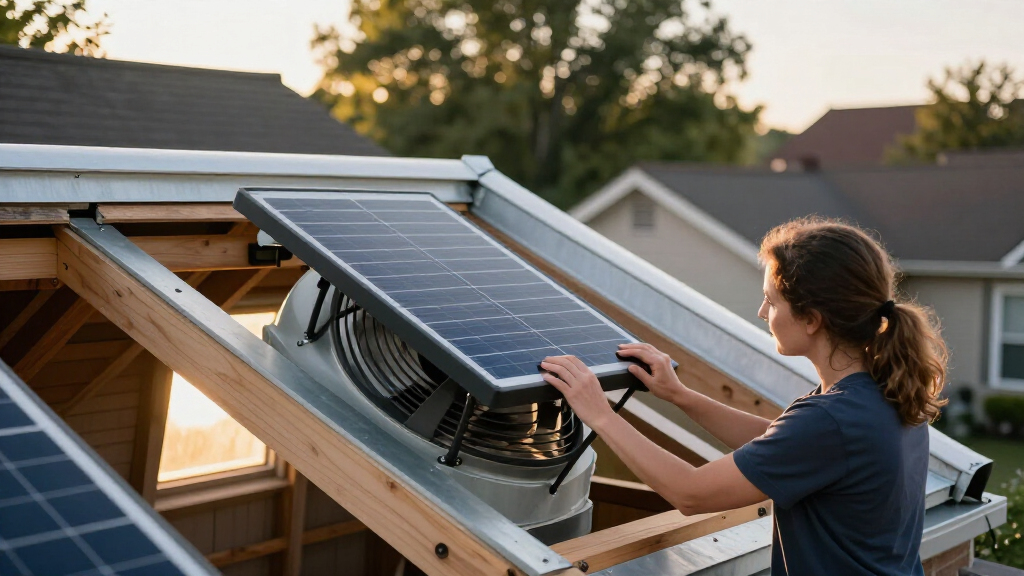

Solar attic fans cool your attic by exhausting trapped heat using nothing but sunlight, which cuts the strain on your air conditioner during summer months. After comparing 15 models, the OmniPV Hybrid Solar Attic Exhaust Fan stands out as the best overall pick for its massive 2850 CFM output and hybrid power option that keeps air moving on cloudy days. For tighter budgets, the DC HOUSE 32W at 1600 CFM delivers solid ventilation per dollar, while the iLIVING Hybrid Ready Smart Thermostat model is the smartest choice for anyone who wants automatic temperature-based control. The main tradeoff in this category comes down to raw airflow versus features: high-CFM units move more air but cost more and demand careful roof-cut installation, while smaller units with thermostats and AC adapters offer convenience at lower output. Read on for the full breakdown of all 15 models and which one fits your attic size, roof type, and climate.

Get backup power and energy gear delivered free — and shop member deals
- Fast, free delivery on millions of items
- Access to Prime Big Deal Days deals on October 6–7
- Prime Video, Amazon Music and more included
Key Takeaways
- Hybrid models with AC or adapter backup (iLIVING, OmniPV, HONGUAN, Hon&Guan, Remington Builder Series) outperformed solar-only fans in real-world usefulness because they keep ventilating on cloudy days and after sunset when attic heat lingers.
- CFM ratings in this lineup ranged from roughly 1150 to 2850, and the gap matters more than price suggests: a 2850 CFM OmniPV can handle attics up to about 4,200 square feet, while a 1150 CFM unit tops out near 1,700 square feet.
- Built-in thermostats were rare at this price tier — only the iLIVING, the 40W thermostat model, and the VEVOR 14-inch gable fan include them, which prevents the fan from running pointlessly on cool days.
- Gable-mount options (both VEVOR gable models) are the clear choice for homeowners who don’t want to cut a hole in their roof, trading some installation risk for a simpler, leak-free setup.
- Several near-identical 40W/2000 CFM fans appear under different brand names at different prices — build quality, warranty support, and included accessories (adapters, mesh, hardware) are what actually separate them.


More Details on Our Top Picks
iLIVING Hybrid Ready Smart Thermostat Solar Roof Attic Exhaust Fan, 14-Inch, 40-Watt, 1150 CFM
This model earns the top spot because it gets the fundamentals right where they matter most: durability and long-term reliability. The IP68 waterproof brushless motor is sealed against the kind of moisture and dust that kills cheaper attic fans, and the 15-year warranty dwarfs the one-year coverage on the DC HOUSE 32W. Its smart thermostat spans a wide 50°F–122°F range and can be disabled entirely, giving you the same control flexibility as the OmniPV at a lower airflow ceiling. The tradeoff is honest: 1150 CFM covers up to 2,900 square feet, so it trails the OmniPV’s 2850 CFM and the HONGUAN’s 2000 CFM on raw output. And unlike the HONGUAN, the AC/DC adapter for night operation is sold separately. For most homes, though, this pick makes the most sense for buyers who want a fan that outlives its roof.
Pros:- IP68 waterproof brushless motor built for harsh attic conditions
- 15-year warranty, far longer than most competitors
- Adjustable smart thermostat with 50°F–122°F range and enable/disable
- Solar panel adjusts to four angles for seasonal sun capture
Cons:- AC/DC adapter kit for night operation is sold separately
- 1150 CFM is lower than similarly priced rivals offering 2000+ CFM
Best for: Homeowners who prioritize long-term reliability and a long warranty over maximum airflow
Not ideal for: Very large attics over 3,000 square feet that need the higher CFM of the OmniPV or HONGUAN
- Airflow:1150 CFM
- Power:40 W
- Coverage area:Up to 2,900 sq. ft.
- Thermostat range:50°F–122°F
- Motor:IP68 waterproof brushless
- Solar panel angles:0°, 15°, 30°, 45°
- Fan diameter:14 inches
- Warranty:15 years
- AC/DC adapter:Sold separately (model ILG8SF304)
Our verdict“The most dependable long-haul choice for average-sized attics, provided you accept modest airflow and buy the adapter separately.”
DC HOUSE 32W Solar Attic Fan, 1600 CFM
Compared with the HONGUAN and the 12-inch 40W model, both of which bundle AC adapters and multi-speed controllers, the DC HOUSE keeps things deliberately simple — and that simplicity is the point. You get 1600 CFM, which beats the iLIVING’s 1150 CFM, from a 100% copper brushless motor and aluminum blades, all in a package rated to withstand 130 mph winds and temperatures from -40°F to 150°F. It starts automatically in sunlight with no wiring, no thermostat setup, and no controller to fiddle with. The catch is that it’s solar-only: on overcast days output drops, and there’s no adapter option to fall back on like the HONGUAN offers. The one-year warranty also falls well short of the iLIVING’s 15 years. This option stands out for buyers who want a set-and-forget vent without paying for features they won’t use.
Pros:- 1600 CFM outperforms the more premium iLIVING at a lower complexity level
- Copper brushless motor and aluminum blades for durability
- Rated for 130 mph wind resistance and -40°F to 150°F operation
- Runs at a quiet 43 dB
Cons:- No AC adapter option, so output stops when sunlight fades
- Only a one-year warranty compared to 15 years on the iLIVING
Best for: Budget-conscious homeowners in sunny climates who want plug-free, automatic ventilation
Not ideal for: Homes in cloudy or rainy regions that need nighttime or backup power via an AC adapter
- Airflow:1600 CFM
- Maximum power:32 watts
- Motor:100% copper brushless
- Noise level:43 dB
- Wind resistance:Up to 130 mph
- Operating temperature:-40°F to 150°F
- Materials:Aluminum, monocrystalline silicon, tempered glass
- Warranty:1 year
Our verdict“The smart buy for sunny-climate homeowners who want strong airflow without paying for hybrid features.”
OmniPV Hybrid Solar Attic Exhaust Fan, 2850 CFM
Nothing else in this lineup moves air like the OmniPV. At 2850 CFM it nearly triples the iLIVING’s output and clears the HONGUAN’s 2000 CFM by a wide margin, making it the only realistic choice here for attics approaching 4,000 square feet. Unlike the DC HOUSE, this is a true hybrid: a 12V AC adapter is included in the box, so ventilation continues through the night and during storms without a separate purchase. The thermostat range of 50–104°F is narrower than the iLIVING’s 122°F ceiling, but continuous-run mode compensates by letting the fan operate nonstop when heat load demands it. Installation is the main friction — it’s a roof mount requiring penetrations and careful flashing, so homeowners uncomfortable on a roof should budget for a professional. Rust-resistant aluminum alloy construction helps justify the heavier-duty positioning.
Pros:- Highest airflow in the roundup at 2850 CFM
- Included 12V AC adapter for night and rainy-day operation
- Thermostat can be disabled for continuous-run mode
- Rust-resistant aluminum alloy build
Cons:- Roof-mount installation requires cutting penetrations and is best left to professionals
- Narrower thermostat range (max 104°F) than the iLIVING or HONGUAN
Best for: Owners of large homes or workshops with 3,000–4,000 sq. ft. attics needing maximum heat removal
Not ideal for: Small attics under 2,000 sq. ft., where 2850 CFM is overkill and the installation effort isn’t justified
- Airflow capacity:2850 CFM
- Solar panel wattage:50 W
- Recommended coverage:Up to 4,000 sq. ft.
- Power source:Solar with included 12V 2A AC adapter
- Thermostat range:50–104°F
- Motor type:Brushless DC
- Panel adjustment:−45° to +45° horizontal; 0° to 60° vertical
- Material:Aluminum alloy
Our verdict“The pick for big spaces that overwhelm smaller fans — if you’re prepared for a proper roof installation.”
HONGUAN 40W Solar Attic Fan with AC Adapter
The HONGUAN positions itself as the most configurable fan in this batch. It offers two operating modes — Energy Saving and Performance — plus four speed settings and a thermostat adjustable from 68°F to 113°F, a level of tuning neither the DC HOUSE nor the OmniPV matches. Unlike the iLIVING, the AC/DC adapter is included, so cloudy-day operation doesn’t require a second purchase. At 2000 CFM it sits comfortably between the DC HOUSE’s 1600 and the OmniPV’s 2850, with a 0°–70° panel adjustment range for squeezing out sunlight at tricky roof angles. One caveat deserves attention: Performance Mode only works when the AC adapter is connected, so peak airflow isn’t achievable on solar power alone. At nearly 30 pounds and over 19 inches square, it’s also the bulkiest unit here, which matters for handling during a solo roof install.
Pros:- Four speed settings and two operating modes for fine-tuned ventilation
- AC/DC adapter included, unlike the iLIVING’s optional add-on
- Monocrystalline panel adjusts 0°–70° horizontally and vertically
- IP65 waterproof rating with 2000 CFM output
Cons:- Performance Mode depends on the AC/DC adapter rather than solar power
- Bulky and heavy at 19.3 x 19.4 inches and 29.9 pounds
Best for: Tinkerers who want granular control over speed, modes, and temperature thresholds
Not ideal for: Buyers wanting maximum performance purely from solar — Performance Mode requires grid power
- Power:40 W
- Airflow:Up to 2000 CFM
- Coverage:Up to 2500 sq. ft.
- Modes:Energy Saving and Performance
- Speed settings:1 to 4
- Thermostat range:68°F to 113°F
- Panel adjustment:0° to 70° horizontally and vertically
- Weight:29.9 pounds
Our verdict“The feature-rich choice for buyers who want to tune every setting, as long as they accept that full power needs the adapter.”
40W Solar Attic Fan with Thermostat, 12-Inch, 2000 CFM
What separates this 12-inch fan from the HONGUAN — its closest rival on paper — is seamless power switching. When connected, it moves automatically between solar and household power, so you never think about which source is running the fan, and the 16.4-foot adapter cable gives you real flexibility in how far the fan sits from an outlet. Like the HONGUAN, it offers a thermostat, four-speed control, and 2000 CFM for spaces up to 2500 square feet, plus a complete accessory kit with controller, temperature probe, and mounting bracket. Its weather-resistant metal housing and brushless copper motor should hold up in typical attic conditions, though the metal build is less clearly sealed than the iLIVING’s IP68 rating. The main limitation is structural: there’s no battery backup, so a power outage on a cloudy day means no ventilation, and the highest-output mode leans on the adapter rather than solar.
Pros:- Automatic switching between solar and AC power with no user intervention
- Long 16.4 ft adapter cable plus 9.8 ft panel and fan cables for flexible placement
- Complete kit includes controller, temperature probe, and mounting hardware
- Thermostat and four-speed control for customized ventilation
Cons:- No battery backup, leaving gaps during outages on dark days
- Mode 2 operation requires the AC/DC adapter
Best for: Homeowners who want automatic day-and-night operation without managing power sources manually
Not ideal for: Off-grid properties — no battery backup and the top mode relies on household AC power
- Power:40 W
- Fan size:12 inches
- Airflow:Up to 2000 CFM
- Coverage:Up to 2500 sq. ft.
- Speed settings:1–4
- Thermostat range:68–113°F
- Motor:Brushless copper
- Battery backup:None
- Adapter cable length:196.9 in (16.41 ft)
Our verdict“The easiest path to round-the-clock attic ventilation for anyone with a nearby outlet.”
OmniPV Solar Hybrid Attic Fan, 40 W, 2100 CFM
This OmniPV model stands out for pairing 2100 CFM of airflow with flexible mounting — roof, gable, or extractor installations are all supported, which most competitors in this roundup don’t offer. Where the Remington 20-Watt fan relies on a separate adapter for non-solar operation, the OmniPV keeps things simpler with a built-in thermostat that switches the fan on automatically above 75°F. The brushless DC motor and aluminum alloy body position it above plastic-bodied options like the VEVOR gable fan for long-term weather exposure.
The tradeoff is installation complexity: depending on your mounting choice, you may need roof or vent modifications, and output still drops on cloudy days.
Pros:- Strong 2100 CFM output suits large attics
- Built-in thermostat automates operation
- Aluminum alloy body resists weathering better than plastic
- Multiple mounting options add installation flexibility
Cons:- Airflow drops noticeably on overcast days
- Installation may require roof or vent modifications
Best for: Homeowners with large attics who need maximum airflow and want thermostat automation without buying extra accessories
Not ideal for: Renters or anyone unwilling to cut into roofing or vents — installation is more involved than plug-and-play gable models
- Solar panel power:40 W
- Maximum airflow:2100 CFM
- Motor:Brushless DC
- Thermostat:Automatic on/off at 75°F (24°C)
- Body material:Aluminum alloy
- Mounting options:Roof, gable vent, or extractor fan
Our verdict“Buy this if you have a big attic and want high-capacity, automated ventilation in a durable metal housing.”
Hon&Guan 25W Solar Attic Fan with AC Adapter
The Hon&Guan’s defining feature is dual power: a 25W adjustable solar panel plus an included AC adapter, so ventilation continues after sunset or on gray days. Compared with the OmniPV, which stops when sunlight fades, this model keeps air moving around the clock — useful in humid climates where moisture control matters overnight. The adjustable temperature range of 68–113°F and four speed levels give far more tuning control than the simpler 40W 12-inch fan, which has no settings at all.
The catch is capacity: at 320 CFM, it moves a fraction of the air that 2000+ CFM roof-mount models do, and sustained operation leans on the AC adapter, which costs you some of the energy savings.
Pros:- AC adapter guarantees operation when solar power is insufficient
- Four speed levels allow fine-tuned control
- Wide adjustable temperature range from 68–113°F
- Solar panel angle can be adjusted for better sun capture
Cons:- Very low airflow relative to roof-mount competitors
- Continuous operation depends on grid power via the AC adapter
Best for: Owners of small attics, sheds, or garages in cloudy regions who need reliable ventilation regardless of weather
Not ideal for: Anyone with a large attic — 320 CFM is far too little airflow to make a real temperature difference
- Solar panel power:25W
- Maximum airflow:320 CFM
- Power sources:Solar panel and AC adapter
- Speed levels:4
- Temperature control range:68–113°F
- Solar panel dimensions:17 × 13 in
Our verdict“Choose this if weather reliability matters more to you than raw airflow capacity.”
Remington Solar 20-Watt Roof-Mount Solar Attic Fan, Round Series
Remington’s Round Series leans on build quality rather than raw specs. The 22.5 × 22.5-inch steel flashing creates a weathertight roof penetration that plastic-bodied fans like the VEVOR can’t match, and the limited 15-year warranty signals confidence few rivals in this space offer. Its combined humidistat and thermostat respond to moisture as well as heat — something the thermostat-only OmniPV doesn’t address, making this the smarter pick in humid climates where condensation is the real enemy.
The compromises: 20 watts is modest power for the category, and nighttime operation requires a separately sold 110V hybrid adapter, so out-of-the-box it’s a daytime-only unit.
Pros:- 15-year limited warranty far exceeds typical coverage
- Humidistat plus thermostat handles moisture as well as heat
- Large steel flashing creates a durable, weathertight install
- Brushless motor designed for quiet, long-life operation
Cons:- Nighttime operation requires a separately sold hybrid adapter
- 20-watt output is modest for the price class
Best for: Homeowners prioritizing long-term durability and moisture control who want a professionally flashed roof installation
Not ideal for: Buyers wanting 24/7 ventilation without additional purchases — nighttime operation needs the extra adapter
- Power:20 watts
- Mounting:Roof mount
- Series:Round Builder Series
- Motor:Brushless
- Controls:Built-in humidistat and thermostat
- Flashing:22.5 × 22.5-inch steel
- Night operation:Compatible with separately sold 110V hybrid adapter
- Warranty:Limited 15-year warranty
Our verdict“This makes the most sense for humid-climate homeowners who value a bomber installation and warranty over maximum airflow.”
40W Solar Attic Fan, 12-Inch, 2000 CFM
This 40W fan is the plug-it-in-and-forget-it option of the batch. The solar panel arrives pre-connected to the fan, there’s no thermostat or controller to program, and it runs from sunrise to sunset on its own — a stark contrast to the Hon&Guan, which expects you to dial in temperature thresholds and speed levels. With 1,800–2,000 CFM from a copper motor and an IP65-rated hail-resistant housing, it delivers near-OmniPV-level airflow for less fuss.
The simplicity cuts both ways: no airflow control means it runs at full tilt or not at all, and like every pure-solar unit here, output falls with the sun. Its multi-building versatility — barns, greenhouses, sheds — partially offsets that rigidity.
Pros:- Pre-connected panel and fan make setup nearly tool-free
- High 1,800–2,000 CFM airflow rivals pricier models
- IP65 and hail-resistant metal housing handles harsh weather
- Works across attics, garages, sheds, greenhouses, and barns
Cons:- No thermostat or airflow control settings at all
- Output depends entirely on available sunlight
Best for: Owners of outbuildings like barns, garages, and greenhouses who want high airflow with zero configuration
Not ideal for: Anyone who wants precise ventilation control — there are no settings to adjust operation
- Power:40W
- Blade diameter:12 inches
- Airflow:1,800–2,000 CFM
- Motor:Pure copper
- Weather resistance:IP65
- Operation:Solar-powered; sunrise to dusk
- Housing:Hail-resistant metal
- Product support:12 months
Our verdict“Pick this if you want near-top-tier airflow with the simplest possible installation and zero settings to manage.”
VEVOR 12-Inch Solar-Powered Gable Mount Attic Exhaust Fan
For homeowners who don’t want to cut a hole in the roof, this VEVOR is the easiest entry point. Gable mounting means no shingle work — a real advantage over roof-mount units like the Remington or the 40W 12-inch fan — and at 9.9 pounds of plastic construction, one person can handle installation solo. The adjustable thermostat and included brackets and hardware keep the package complete, and 1300 CFM is respectable for the format.
That plastic (PP) body is the honest tradeoff: it won’t shrug off hail and UV the way the OmniPV’s aluminum alloy or the Remington’s steel flashing will, so expect a shorter service life in harsh climates.
Pros:- Gable mounting avoids cutting into the roof entirely
- Lightweight 9.9-pound body enables one-person installation
- Adjustable thermostat included in the box
- Complete hardware and bracket kit means no extra purchases
Cons:- Plastic construction is less durable than metal rivals
- Airflow depends on sunlight availability
Best for: DIYers who want to ventilate from a gable vent without roof penetration or heavy lifting
Not ideal for: Hail-prone or extreme-weather regions — the plastic housing is the least durable in this lineup
- Fan diameter:12 inches
- Airflow:1300 CFM
- Power source:Solar
- Mounting type:Gable mount
- Material:Plastic (PP)
- Thermostat:Adjustable
- Dimensions:13.39 × 13.39 × 2.76 inches
- Weight:9.9 pounds
- Model number:JBSF-320D
Our verdict“This is the right pick if roof penetration is a dealbreaker and you want a lightweight, complete gable-vent kit.”
DC HOUSE 32W Solar-Powered Roof Attic Fan, 2500 CFM
Among high-CFM options, this DC HOUSE 32W model stands out for balancing serious airflow with genuinely quiet operation — at 43 dB, it is quieter than most roof fans pushing similar volumes, including the OmniPV Hybrid at 2850 CFM. That combination makes it a strong fit for bedrooms or living spaces directly beneath the attic. Coverage up to 3,000 square feet means most single-family homes are covered by a single unit. Compared with the VEVOR 35W, it trades a thermostat for lower noise and a metal housing, so operation is sun-dependent rather than temperature-triggered. The honest tradeoff: no nighttime operation, and the listing’s airflow figure wavers between 2400 and 2500 CFM, which suggests optimistic rating methods rather than verified output.
Pros:- Ventilates attics up to 3,000 sq ft with a single unit
- Quiet 43 dB operation — quieter than comparable high-CFM rivals
- Weather-resistant metal housing with waterproof brushless motor
- Standard MC4 connectors simplify wiring during installation
- Automatic daytime operation with no wiring to household power
Cons:- No nighttime operation — humidity buildup overnight goes unaddressed
- Inconsistent airflow claims in the listing (2400 vs 2500 CFM) make true output uncertain
- No thermostat or humidistat, so it runs whenever the sun shines regardless of conditions
Best for: Homeowners with large attics over 2,000 sq ft who want strong daytime ventilation without audible fan noise indoors
Not ideal for: Anyone in a humid climate who needs ventilation to continue after sunset — this fan shuts off as soon as the sun drops
- Power source:Solar
- Wattage:32 watts
- Airflow capacity:2500 CFM
- Coverage:Up to 3,000 sq ft
- Motor type:Brushless, waterproof
- Housing:Metal, weather-resistant
- Noise level:43 dB
- Mounting type:Roof mount, fixed
- Warranty:One year
Our verdict“This pick makes the most sense for large attics where quiet, sun-driven daytime airflow matters more than round-the-clock ventilation.”
VEVOR 35W Solar Attic Fan with 2400 CFM Airflow
The VEVOR 35W earns its spot with a feature most competitors at this price skip: an MPPT solar controller paired with a built-in thermostat that activates the fan above 26°C (79°F). That means the fan works its hardest precisely when the attic is hottest, rather than simply tracking daylight like the DC HOUSE 32W. MPPT circuitry also squeezes more usable power out of weak morning and late-afternoon sun. Its 2400 CFM output sits slightly below the DC HOUSE’s rating, but real-world results likely land close given MPPT efficiency. The limitation is structural rather than electronic: it is specified for metal and masonry roofs, so composite shingle homeowners should verify fit before buying. No remote control, and output still drops to zero after dark.
Pros:- MPPT controller maximizes power output in weak sunlight conditions
- Thermostat automatically activates the fan above 26°C (79°F)
- 2400 CFM airflow handles mid-size to large attics
- Zero household electricity consumption during operation
Cons:- Output drops sharply or stops under heavy cloud cover and at night
- No remote control or adjustable temperature threshold
- Roof compatibility limited to metal and masonry per the listing
Best for: Budget-minded homeowners with metal or masonry roofs who want temperature-triggered operation instead of simple sun-following
Not ideal for: Homes with asphalt shingle roofs — the mounting design is not specified for them, and buyers wanting remote adjustability will be disappointed
- Power source:Solar powered
- Wattage:35 watts, MPPT controller
- Airflow capacity:2400 CFM
- Motor type:Brushless DC
- Temperature control:Built-in thermostat, activates above 26°C (79°F)
- Mounting type:Roof mount, fixed installation
- Roof compatibility:Metal and masonry
- Remote control:None
Our verdict“Compared with fixed-output rivals, this model is better suited to buyers who want ventilation that responds to attic temperature rather than just sunlight hours.”
Remington Solar 30-Watt Roof-Mount Solar Attic Fan
What separates the Remington Solar 30-Watt from cheaper sun-following fans is its dual-sensor control: a built-in humidistat alongside the thermostat. For coastal or humid-climate homes where moisture — not just heat — drives attic damage, that humidistat matters more than raw CFM. The 22.5 x 22.5 inch steel flashing is also generous compared with typical kits, which translates to fewer leak worries at the roof penetration. Compared with the Remington Builder Series 40W, this model gives up the included 110V adapter and some wattage, but the limited lifetime warranty matches its bigger sibling’s. The catch is the nighttime gap: 24-hour operation requires a separately sold hybrid adapter, so buyers who need overnight moisture control should price that add-in before committing.
Pros:- Built-in humidistat and thermostat automatically respond to moisture and heat
- Large 22.5 x 22.5 inch steel flashing reduces leak risk at installation
- Brushless motor designed for quiet, long-wear operation
- Limited lifetime warranty
Cons:- Nighttime operation requires a separately sold hybrid adapter
- 30W panel produces less peak airflow than 35W–40W competitors
- Lower wattage means slower response in marginal sunlight
Best for: Homeowners in humid or coastal climates who need ventilation triggered by moisture levels, not just heat
Not ideal for: Buyers wanting true 24-hour ventilation out of the box — the hybrid adapter costs extra, and by then the Builder Series may be the better buy
- Power:30 watts
- Power source:Solar
- Motor:Brushless
- Controls:Built-in humidistat and thermostat
- Flashing:22.5 x 22.5 inches, steel
- Night operation:Hybrid adapter sold separately
- Warranty:Limited lifetime
Our verdict“This option stands out for humid climates where moisture sensing matters more than maximum CFM, provided you accept the daytime-only operation or buy the adapter.”
Remington Builder Series 40W Solar Attic Fan with 110V Adapter
Most solar attic fans in this roundup go silent at sundown; the Remington Builder Series 40W is built to keep working. The included 110V adapter lets the fan run through the night — a genuine advantage over the Remington 30-Watt, which requires a separately sold adapter for the same capability. With thermostat and humidistat controls, the fan modulates itself around the clock rather than cycling blindly. At 0.08 sones, it ranks among the quietest options here, well below the DC HOUSE’s 43 dB. The heavy steel flashing matches its sibling’s leak-resistant design, and the fan carries a limited lifetime warranty. The fine print matters, though: the adapter needs a surge protector to keep its warranty valid, and that adapter’s own coverage is just one year.
Pros:- Included 110V adapter enables nighttime operation without extra purchases
- Built-in thermostat and humidistat adjust airflow automatically
- Extremely quiet at 0.08 sones
- Heavy 22.5 x 22.5 inch steel flashing and limited lifetime fan warranty
Cons:- Adapter requires a surge protector or its warranty is voided
- Adapter itself carries only a one-year warranty versus lifetime on the fan
- Nighttime mode runs on household electricity, adding a small energy cost
Best for: Homeowners who want true round-the-clock attic ventilation with automatic climate control and don’t mind paying for the complete package
Not ideal for: Buyers on a strict budget or in areas with unreliable grid power — the 110V nighttime mode draws household electricity, undercutting the pure-solar appeal
- Power source:Solar with 110V adapter
- Wattage:40 watts
- Motor type:Brushless
- Noise level:0.08 sones
- Controls:Built-in thermostat and humidistat
- Flashing:22.5 × 22.5 inches, alloy steel
- Blades:5, plastic
- Warranty:Limited lifetime (fan); one year (adapter)
Our verdict“For buyers who want one purchase that covers daytime solar and nighttime powered ventilation, this is the most complete package in the lineup — just add the surge protector.”
VEVOR 14-Inch Solar-Powered Gable Mount Attic Fan with Adjustable Thermostat and Protective Mesh, 1300 CFM, Black
Every other product in this batch is a roof-mount unit, which means cutting a hole in your shingles — the single biggest leak risk in any attic fan installation. The VEVOR 14-inch gable mount sidesteps that entirely by venting through an existing gable wall, and its adjustable thermostat (unlike the VEVOR 35W’s fixed 26°C trigger) lets you tune when it runs. At 1300 CFM covering up to 1,850 sq ft, it targets smaller attics where a 2500 CFM unit like the DC HOUSE 32W would be overkill. The protective mesh is a thoughtful touch, keeping birds and nesting debris out of the blades. The compromises: solar specs go unspecified, so panel output is a question mark, and no noise measurement backs up the quiet-operation claim.
Pros:- Gable mounting avoids roof penetrations and leak risk entirely
- Adjustable thermostat lets you set your own activation temperature
- Protective mesh keeps birds and debris out of the fan
- Included 14-inch mounting bracket supports straightforward wall installation
Cons:- 1300 CFM is modest — undersized for larger attics
- No published noise measurement despite quiet-ventilation claims
- Solar panel wattage and performance details are not specified
Best for: Owners of smaller homes or garages under 1,850 sq ft who want attic ventilation without cutting a hole in the roof
Not ideal for: Large attics over 2,000 sq ft — the 1300 CFM output will fall short, and buyers wanting verified noise or panel data will find the listing thin
- Fan diameter:14 inches
- Power source:Solar
- Airflow:1300 CFM
- Coverage area:Up to 1,850 sq ft
- Thermostat:Adjustable
- Housing material:Steel
- Blade material:Aluminum alloy
- Protective mesh:Included
- Mounting:Gable/wall with bracket
Our verdict“This model is better suited to smaller attics and roof-preserving installations than to high-volume ventilation jobs — a smart pick if a roof cut is the deal-breaker.”

How We Picked
I ranked these 15 solar attic fans on four buyer-facing criteria rather than spec-sheet bragging rights. Airflow relative to attic size came first: a fan is only useful if its CFM rating matches your square footage, so I weighted coverage capacity heavily and flagged units that punch above or below their wattage class. Power flexibility was the second filter — models with hybrid AC backup or thermostat control ranked higher than solar-only units because they keep working during overcast weather and shoulder seasons. Installation type shaped the rankings too: roof-mount fans demand cutting shingles and flashing work, while gable-mount models suit DIYers and complex roofs better, so each pick notes who should realistically install it.
Finally, I weighed build quality and included extras — protective mesh against birds and debris, weather-resistant housings, and whether an AC adapter or thermostat comes in the box instead of costing extra. Where two fans had near-identical specs, the one with better accessory bundles and clearer sizing guidance earned the higher slot. The result is a list ordered by overall value per CFM, with specialized picks (smart thermostats, gable mounts, budget compact units) flagged for the specific buyers they serve best.
Factors to Consider When Choosing Solar Attic Fans
Before settling on a specific model, it helps to understand how solar attic fans behave as a category — where they excel, where they underperform expectations, and which specs actually move the needle on your summer cooling bills. These are the factors I’d weigh before spending anything.Match CFM to Your Attic Square Footage
The most common mistake buyers make is treating CFM as bigger-is-always-better. The general rule is roughly 0.7 CFM per square foot of attic space, so a 2,000-square-foot attic needs about 1,400 CFM — meaning the OmniPV at 2850 CFM is overkill for a small ranch home but appropriate for a large two-story house. Oversizing wastes money and can create negative attic pressure that pulls conditioned air out of your living space through ceiling leaks. Undersizing is just as bad: an underpowered fan spins all day without moving enough air to lower attic temperatures meaningfully. Measure your attic footprint before browsing, and remember that a well-sealed attic needs less airflow than a leaky one. Complex rooflines with multiple valleys also create dead-air zones a single fan can’t reach.
Solar-Only Versus Hybrid Power
A pure solar fan is silent and free to run, but it stops the moment clouds roll in — exactly when humid air can accumulate. Hybrid models with AC or adapter backup solve this by switching to household power, which matters most in humid climates where evening ventilation prevents moisture damage and mold. The tradeoff is complexity: hybrid units need wiring to a power source, which may mean an electrician and a higher total install cost. If your region gets long stretches of overcast summer weather, I’d treat hybrid capability as non-negotiable. In dry, sunny climates like the Southwest, a solar-only unit like the basic DC HOUSE models performs nearly as well for less money. Also check whether the hybrid model switches automatically or requires manual intervention — the iLIVING’s smart thermostat handles this seamlessly on cheaper models it doesn’t.
Roof Mount Versus Gable Mount
Roof-mount fans are the default in this category, but they require cutting a hole through your shingles and installing proper flashing — do it wrong and you’ve created a permanent leak risk that costs far more than any fan. Gable-mount units like the two VEVOR models install in a vertical wall opening, typically at the gable vent you may already have, making them dramatically easier and safer for DIY installation. The tradeoff is placement flexibility: gable fans only work if your attic has an accessible gable end, and airflow can be less efficient depending on roof geometry. If you have a hip roof with no gable ends, you’re stuck with roof mounting. Homeowners with expensive or warranty-sensitive roofing (slate, tile, recently installed architectural shingles) should strongly favor gable mounting or hire a professional roofer rather than cutting it themselves.
Thermostats and Smart Controls
A solar attic fan without a thermostat runs whenever the sun shines, including cool spring and fall days when ventilation accomplishes nothing. A built-in thermostat lets the fan kick on only when attic temperature crosses a threshold you set, typically around 80–100°F, which extends motor life and prevents wintertime heat loss through the attic. Only three fans in this roundup include one out of the box, so factor in the cost of an add-on thermostat if your chosen model lacks it — aftermarket units cost real money and require wiring into the fan circuit. Smart models like the iLIVING add app control and humidistat options, which is worthwhile if you’re ventilating for moisture control rather than just heat. Skip smart features if you simply want set-and-forget summer cooling; a basic mechanical thermostat does that job for less.
Build Quality, Weather Resistance, and Warranty
Solar attic fans live in the harshest environment on your house — full sun, rain, hail, and freeze-thaw cycles year-round. Look for UV-resistant housings, stainless or coated mounting hardware, and protective mesh that keeps birds, squirrels, and wasps out of the fan housing — a nest in your fan blades will stop it dead and can be a real hassle to clear. Panel quality varies more than wattage numbers suggest: a well-sealed monocrystalline panel degrades slowly over decades, while cheaper panels can lose output faster. Because installation labor is the biggest hidden cost, a fan that dies in three years forces you to repeat the roof-cutting work — which makes warranty length and brand parts availability worth more than a small price difference. Check whether the manufacturer sells replacement motors and panels separately before committing.
Intake Ventilation: The Half Buyers Forget
No exhaust fan works without replacement air flowing in, yet almost nobody checks intake vents before buying. A powerful fan like the 2850 CFM OmniPV paired with inadequate soffit venting will just starve itself and pull conditioned air from your living space, raising your energy bills instead of lowering them. Before installing any fan, calculate your net free vent area: you want roughly equal intake and exhaust capacity, with intake slightly greater. If your home has blocked soffits, painted-over vents, or no intake ventilation at all, fix that first — it’s cheaper than any fan and might solve part of the problem on its own. This is also why oversizing a fan is counterproductive: more CFM demands more intake air your house may not be able to supply.
Frequently Asked Questions
Do solar attic fans actually lower cooling bills?
Yes, but the savings are more modest than marketing suggests. A properly sized fan can reduce attic temperatures by 10–30°F on hot days, which eases the heat load on your ceiling insulation and can cut air conditioning costs by roughly 5–10 percent in homes with mediocre attic insulation. The effect is strongest in homes with ductwork running through the attic, since those ducts otherwise absorb tremendous heat. If your attic is already well insulated and air-sealed, the marginal benefit shrinks considerably. Treat a solar fan as one layer of an attic strategy — insulation and air sealing come first, ventilation second — and the free solar operation means whatever savings you get cost nothing ongoing.
What happens to a solar attic fan on cloudy days or at night?
A solar-only fan slows down or stops entirely when sunlight fades, which is the core limitation of the category. On bright overcast days you’ll get partial output, but at night the fan is dormant — usually fine in dry climates where heat dissipates on its own, but a problem in humid regions where evening moisture accumulates. That’s exactly why hybrid models like the OmniPV, iLIVING, HONGUAN, and Remington Builder Series exist: they switch to household AC power so ventilation continues regardless of weather. If you live somewhere humid, the extra cost and wiring of a hybrid unit pays for itself in mold prevention. In arid, sunny climates, most owners find solar-only operation adequate.
Can I install a solar attic fan myself, or do I need a professional?
It depends entirely on the mount type. Gable-mount fans like the VEVOR 12-inch and 14-inch models are genuinely DIY-friendly — you’re fastening the unit into an existing or new vertical opening, with no shingle work involved. Roof-mount fans require cutting a hole in your roof deck, installing flashing, and sealing it against leaks, which is beyond comfortable DIY territory for most homeowners and can void roofing warranties if done wrong. Solar-only roof units at least avoid electrical work, while hybrid models add household wiring that may require a permit or electrician depending on local code. If your roof is steep, tall, or covered in tile or slate, hire a roofer — the installation cost is worth avoiding a leak or a fall.
How big a solar attic fan do I need for my house?
Size by attic square footage, not house size — a two-story home has a smaller attic footprint than its total floor area. The standard guideline is about 0.7 CFM per square foot of attic, so a 1,800-square-foot attic calls for roughly 1,260 CFM, putting the iLIVING 1150 CFM unit near the floor of acceptability and the DC HOUSE 1600 CFM comfortably in range. Larger attics of 3,000-plus square feet justify the high-output models like the OmniPV 2850 or DC HOUSE 2500 CFM. Resist the urge to oversize: a fan that moves too much air without adequate intake ventilation will pull conditioned air from your living space through ceiling leaks. Also verify your soffit and ridge vents can supply enough incoming air to match the fan’s exhaust rate.
Are two smaller solar attic fans better than one large one?
Often, yes — especially on homes with complex rooflines or long, narrow attics. Two mid-size fans placed at opposite ends of the roof create better cross-ventilation and eliminate dead-air pockets that a single centrally located fan can’t clear. Redundancy is another benefit: if one unit fails, you still have partial ventilation while awaiting parts. The downsides are doubled installation labor (two roof penetrations instead of one, with two leak risks) and typically a higher total cost than a single high-CFM unit like the OmniPV. For simple rectangular attics under 2,000 square feet, one properly placed fan almost always makes more sense. For larger or irregularly shaped spaces, splitting the airflow between two units usually outperforms one big fan.
Conclusion
The right solar attic fan comes down to your attic size, your climate, and how much installation work you’re willing to take on. For best overall, the OmniPV Hybrid 2850 CFM earns the top spot by pairing category-leading airflow with hybrid power that keeps it running through cloudy weather — it’s the pick for large attics and homeowners who only want to do this project once. The DC HOUSE 32W 1600 CFM takes best value, delivering enough ventilation for a typical mid-size attic at a price that leaves room in the budget for proper flashing and sealant.
For beginners and DIY installers, the VEVOR 14-inch gable-mount with thermostat is the safest entry point — no roof cutting, automatic temperature control, and protective mesh included. The iLIVING Hybrid Smart Thermostat model is the best premium choice for anyone who wants smart, hands-off control and humidistat capability in muggy climates. And for specific needs: humid-region buyers on a budget should look at the hybrid HONGUAN or Hon&Guan units with AC adapters, while owners of very large attics should compare the OmniPV 40W 2100 CFM against the DC HOUSE 2500 CFM before deciding. Whatever you choose, confirm your intake ventilation can keep up — the best fan in this lineup still needs incoming air to do its job.
Halloween Picks
halloween
As an affiliate, we earn on qualifying purchases.