
This checklist is for people planning or improving an off-grid power setup, from a solar battery system to backup power for a home. It covers tools for tracking battery use, managing solar charging, measuring power, protecting circuits, and monitoring household energy.

Get backup power and energy gear delivered free with Prime
- Fast, free delivery on millions of items
- Prime Video, Amazon Music and more included
- Member-only deals all year
The sections follow those jobs in a practical order: start with battery and charging visibility, then consider measurement and circuit protection, and finish with whole-home monitoring and portable solar. The Power Meter section offers selection advice without naming a specific product.
Use each section to match the pick to your system voltage, current, and installation. Check the equipment labels and manufacturer documentation for compatibility, sensor placement, and wiring requirements before buying or connecting anything.
Battery Monitor
A battery monitor helps make battery use easier to track in an off-grid setup. The listed pick, the LiTime 500A Bluetooth Battery Monitor for 8V-120V Systems, identifies a broad voltage range in its name, so begin by confirming that your battery bank falls within that range and that the monitor supports the bank’s chemistry and configuration. Bluetooth can be useful when you want readings nearby without relying on a permanently installed display, but check what the app shows and whether it works with your phone before choosing it. A common mistake is treating a monitor’s voltage range as proof of full compatibility. Verify the current rating against the maximum current your system may draw, and confirm the required shunt placement and cable connections in the product instructions. A mismatched shunt rating or incorrect installation can make readings unhelpful. Also check whether the monitor needs a particular mounting location or whether its wireless connection reaches the place where you plan to view data. For a multi-battery bank, confirm how the monitor handles the bank as a whole and whether the wiring arrangement matches its instructions. Check the complete setup—battery voltage, current capacity, shunt, and app support—rather than relying on a single specification in the product name.What to look for:
- Confirm your bank voltage is within the stated 8V-120V range.
- Match the monitor and shunt current ratings to expected system current.
- Check compatibility with your battery chemistry and bank arrangement.
- Review shunt placement, cable, and mounting instructions.
- Confirm Bluetooth and app support for your phone and installation location.
LiTime 500A Bluetooth Battery Monitor for 8V-120V Systems

The LiTime 500A Bluetooth Battery Monitor allows real-time tracking of battery parameters via a mobile app, supporting various battery types and voltages. It offers customizable alerts, historical data analysis, and reliable protection features for RV, marine, and backup systems.
Pros:
- Real-time monitoring via mobile app
- Supports multiple battery types and voltages
- Customizable alerts for early issue detection
- Provides historical data for performance analysis
Cons:
- Requires smartphone app for full functionality
- Limited to 1-year warranty
Best for: Off-grid users who want nearby wireless battery readings.
Not ideal for: Setups that need a permanently mounted display or lack compatible app support.
Bottom line: Confirm voltage, current, shunt, and app compatibility before adding this monitor to your battery bank.
Solar Charge Controller
A charge controller manages the connection between solar panels and a battery bank, so matching it to both sides of the system is essential. The Renogy Rover MPPT Solar Charge Controller 60A 12/24/36/48V names a 60A rating and support for several battery voltages. Check that your battery bank uses one of those listed voltages and that the controller’s limits suit the array and battery specifications. One frequent buying mistake is selecting a controller based only on the battery voltage. Review the solar array’s open-circuit voltage and expected current, including conditions and series or parallel wiring that affect those values. Confirm that the controller’s input limits and charging settings are appropriate for the panels and battery chemistry. The product name alone does not establish compatibility with every panel or battery configuration. Before installation, read the wiring sequence and conductor-size requirements in the manual, and verify any fuse or disconnect recommendations for your setup. Consider where the controller will be mounted, how it will be ventilated, and whether its display or monitoring features are accessible once installed. Match both sides of the system—panel array and battery bank—and follow the manufacturer’s limits to avoid choosing a controller that does not fit the design.What to look for:
- Match the battery bank to one of the stated 12/24/36/48V options.
- Verify array voltage and current against the controller’s input limits.
- Check charging settings for your battery chemistry.
- Review wiring, conductor-size, and protection requirements in the manual.
- Confirm the planned mounting location allows suitable access and ventilation.
Renogy Rover MPPT Solar Charge Controller 60A 12/24/36/48V
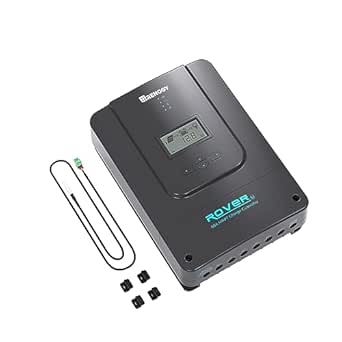
The Renogy Rover MPPT Solar Charge Controller is a versatile 60A device designed for demanding solar systems in RVs, off-grid cabins, and marine setups. It features high efficiency, multi-stage charging, lithium battery recovery, and remote monitoring capabilities, ensuring optimal energy harvest and system protection.
Pros:
- High efficiency with 99.9% multi-peak tracking
- Compatible with various battery types including lithium
- Advanced protection features against surges and temperature extremes
- Remote monitoring and data logging capabilities
Cons:
- Requires separate Bluetooth modules for app monitoring
- Complex setup may be challenging for beginners
- Limited to 60A maximum current
Best for: Solar systems whose battery voltage and array limits match the controller.
Not ideal for: Arrays or batteries that fall outside the controller’s documented limits.
Bottom line: Check battery voltage, panel input limits, and charging settings together before selecting this controller.
Power Meter
A power meter can help answer a basic planning question: how much power does a device or part of the system use? That information supports decisions about battery capacity, inverter sizing, and which loads to run when solar production is limited. Choose the meter for the point you need to measure, since a plug-in household meter and a meter for a fixed DC circuit serve different purposes. Start with the circuit you want to understand, not a feature list. A common mistake is buying a meter with the wrong electrical range or measurement type. Check whether you need AC or DC readings, the voltage and current range, and whether the meter measures one appliance, a branch circuit, or an entire system. For fixed wiring or high-current DC circuits, confirm that the meter and any sensors are rated for the installation and that the instructions describe a suitable connection method. Do not assume a household plug-in unit can be used on battery wiring. Think about how you will use the readings. A display may be enough for occasional checks; logging or remote access may matter if you are comparing loads over time. Check sensor fit, cable length, display location, and whether installation requires an electrician. Measure the right point with a meter whose electrical ratings and installation method match that circuit.What to look for:
- Choose a meter designed for AC or DC as needed.
- Match voltage and current ranges to the circuit being measured.
- Check whether it measures an appliance, branch circuit, or whole system.
- Verify sensor type, conductor fit, and connection instructions.
- Decide whether display-only readings or data logging fits your use.
DC Circuit Breaker
A disconnect and breaker are part of a system’s circuit protection and isolation plan, so this slot calls for careful specification checks. The listed pick is the 400 Amp Disconnect Knife Switch 3-Pole Circuit Breaker Backup Generato. Its name identifies a 400A rating and three poles, but it does not establish the device’s full electrical ratings, intended application, or suitability for a particular battery or generator circuit. Confirm those details in the manufacturer documentation before considering it. A common mistake is choosing a breaker by amperage alone. Check the system’s DC voltage, current, interrupt rating, pole arrangement, and the type of circuit the device is designed to protect. Verify that its trip characteristics and installation requirements are suitable for the connected conductors and equipment. A device intended for another application may not be appropriate for a DC battery circuit, even if its current rating appears to match. Plan the enclosure, mounting, conductor size, and access for operation as part of the selection. Review manufacturer guidance and applicable electrical requirements, and use a qualified installer if the wiring or protection design is outside your experience. Confirm the full DC rating and circuit purpose rather than relying on the product title; protection depends on the complete match between device and installation.What to look for:
- Verify the documented DC voltage and intended circuit application.
- Match current and interrupt ratings to the system design.
- Confirm the three-pole arrangement suits the wiring plan.
- Check conductor, enclosure, mounting, and operating requirements.
- Review manufacturer instructions and applicable installation requirements.
400 Amp Disconnect Knife Switch 3-Pole Circuit Breaker Backup Generator

This 400A 3-pole knife switch features two positions with 9 terminals, suitable for AC or DC applications. It provides a reliable disconnect solution for backup generators and electrical systems.
Pros:
- High current capacity suitable for heavy-duty applications
- Versatile for AC and DC systems
- Reliable disconnect switch for backup generators
Cons:
- Limited information on durability and material quality
- No detailed installation instructions provided
Best for: Installations whose documented circuit requirements match the device specifications.
Not ideal for: Systems where DC voltage, interrupt rating, or application is unconfirmed.
Bottom line: Do not select this device by its 400A name alone; verify every protection and installation rating.
Energy Monitor
An energy monitor with circuit-level sensors can help show where household electricity is being used. The listed pick, the Siemens Inhab Smart Home Energy Monitor with Circuit-Level Sensors, points to monitoring at the circuit level. Before selecting it, confirm that the monitor is compatible with your electrical panel, the number and type of circuits you want to track, and the wiring configuration in your home. A common mistake is assuming every panel can accept the same sensors or that circuit-level readings will identify every load automatically. Check sensor dimensions and placement, panel space, supported service configuration, and any requirements for installation or network connectivity. If you want to monitor solar, battery backup, or other generation, verify that the monitor documents support for those sources and explains how the readings are represented. Do not infer those capabilities from the product name alone. Consider how you will access the information after installation: app or web support, account requirements, and whether the connection works at the panel location. Electrical panel work can involve hazardous conductors; follow the manufacturer’s installation instructions and use a qualified electrician where needed. Confirm panel fit, circuit coverage, and monitoring support for the specific home before buying.What to look for:
- Check panel compatibility and supported service configuration.
- Confirm sensor type, dimensions, and the number of circuits covered.
- Verify documented support for solar or backup sources if needed.
- Review network, app, and account requirements.
- Check installation instructions and whether a qualified electrician is needed.
Siemens Inhab Smart Home Energy Monitor with Circuit-Level Sensors

Monitors real-time and historical energy use and production at the main panel and up to 16 individual circuits, with data available through a mobile app. Custom alerts help identify unusual usage, and compatible devices can use advanced energy management features such as load shedding.
Pros:
- Measures energy use directly at the main panel and individual circuits
- Tracks real-time and historical usage and production
- Custom alerts can flag unusual behavior or energy-saving opportunities
- Supports advanced energy management features
Cons:
- Mobile app availability is limited to the US and Canada
- Advanced controls require compatible devices
Best for: Homeowners seeking visibility into individual household circuits.
Not ideal for: Panels or monitoring goals that fall outside the documented compatibility.
Bottom line: Confirm panel fit, sensor coverage, and source-monitoring support before choosing this monitor.
Portable Solar Panel
Portable solar equipment can suit users who want a self-contained power option that can be moved or stored when not in use. The listed pick is the Jackery HomePower 3600 Plus with 2x200W Solar Panels, 3584Wh, 3600W AC. Its name states a 3584Wh capacity, 3600W AC output, and two 200W panels; compare those stated figures with the devices you intend to run and the charging setup you expect to use. A common mistake is assuming the panel wattage guarantees a particular charging time or output in every setting. Solar production depends on conditions and setup, so check the manufacturer’s guidance for panel connection, supported input, and expected operating limits. List the devices you need to power, note their running and startup requirements, and confirm that the unit’s AC output and available capacity suit them. Also verify any necessary cables or adapters are included or compatible. Think through where the unit and panels will be used. Check the product documentation for weight, dimensions, storage, deployment, and environmental limits, then make sure the panel arrangement can receive suitable sunlight at your intended location. Match actual loads and portability needs to the unit’s specifications instead of judging fit from capacity alone.What to look for:
- Compare device running and startup requirements with the stated 3600W AC output.
- Check whether the 3584Wh capacity suits the loads and duration you need.
- Verify panel input and connection limits for the two 200W panels.
- Confirm cable, adapter, and charging compatibility for your setup.
- Review dimensions, weight, deployment, and environmental guidance.
Jackery HomePower 3600 Plus with 2x200W Solar Panels, 3584Wh, 3600W AC Output

The Jackery HomePower 3600 Plus is a portable home backup power station with a 3584Wh capacity and 3600W AC output, capable of powering household appliances during outages. It features multiple charging options, high safety standards, and a lightweight, wheeled design for easy transport.
Pros:
- High-capacity 3584Wh battery suitable for extended backup
- Multiple charging options including fast AC+DC recharge
- Portable and lightweight with wheels and telescopic handle
Cons:
- Solar panels shipped separately, may require additional purchase
- Heavy at 77.2 pounds for some users
- Price not specified in the description
Best for: Users who want a portable unit paired with two solar panels.
Not ideal for: Loads or charging needs that exceed the documented output and input limits.
Bottom line: Compare your actual loads and panel setup with the unit’s full specifications before choosing it.
If you are building on a limited budget, buy in a needs-first order: identify the battery bank and loads, then choose compatible monitoring and charge-control equipment. Add a meter when you need better load data, and select circuit protection only after its ratings and installation requirements have been confirmed. Whole-home and portable options can follow once you know what you need to monitor or power.
Take the checklist one decision at a time, and keep the manuals and system specifications close as you compare options. A setup that fits your actual equipment and use is easier to understand, expand, and manage. If you are unsure about a wiring or protection choice, ask a qualified installer to review it.