The best heat pump monitoring systems pair compatible thermostat control with useful visibility into how your system runs. I’d put the Honeywell Home T10+ Pro first for its room sensor kit, while the Emporia Vue 3 is a stronger fit when circuit-level electricity data matters more than thermostat control. The Sensi Lite stands out for buyers who want a simpler DIY thermostat. The main tradeoff is between monitoring energy use, managing comfort across rooms, and keeping installation straightforward; one device may not do all three. Read on for how the options differ and which type of buyer each suits.

Get backup power and energy gear delivered free with Prime
- Fast, free delivery on millions of items
- Prime Video, Amazon Music and more included
- Member-only deals all year
Key Takeaways
- The T10+ Pro is the comfort-focused pick: its included RedLINK sensor kit adds room-level context that basic thermostat-only options lack.
- Emporia Vue 3 measures a different thing: it tracks household circuits, making it useful for energy analysis, but it does not replace a heat pump thermostat.
- Heat pump compatibility should lead the shortlist: the 11 options vary in controls and wiring needs, so verify system type and wiring before prioritizing app features.
- Sensi Lite and Sensi ST55 suit different simplicity needs: both offer Wi-Fi thermostat control, while buyers should compare their exact compatibility and feature requirements rather than assuming the names mean the same setup.
- Honeywell’s lineup spans several priorities: T5, X2S, X7B, Lyric T6 models, and RTH9600WF differ in control approach, display, and sensor support, so model-specific fit matters more than brand alone.
| Sensi Lite Wi-Fi Smart Thermostat (ST25) | 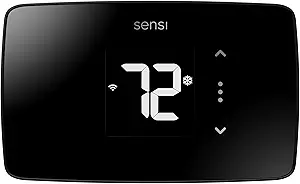 | Best for DIY Setup | Model: ST25 | Connectivity: 2.4 GHz Wi-Fi | Voice assistants: Amazon Alexa, Google Assistant | VIEW LATEST PRICE | See Our Full Breakdown |
| Honeywell Home X7B Smart Wi-Fi Programmable Thermostat |  | Best for Display and Humidity Monitoring | Display: Customizable 4.3-inch display | Connectivity: 2.4 or 5.0 GHz Wi-Fi; 802.11ax/ac/a/b/g/n | Smart-home compatibility: Matter, Amazon Alexa, Google Assistant, Apple Home | VIEW LATEST PRICE | See Our Full Breakdown |
| YoLink Thermostat 2 Smart Heat Pump Thermostat (YS4004) |  | Best for Long-Range Sensor Coverage | Model: YS4004 | Connectivity: LoRa | Specified wireless range: Up to 1/4 mile (2,034 feet) | VIEW LATEST PRICE | See Our Full Breakdown |
| Honeywell Home X2S Smart Wi-Fi Thermostat |  | Best for Matter-Compatible Scheduling | Heat pump compatibility: Up to 2 heat/1 cool with electric backup | Connectivity: 2.4 or 5 GHz Wi-Fi; 802.11 b/g/n | Smart-home compatibility: Matter, Amazon Alexa, Google Assistant, Apple HomeKit | VIEW LATEST PRICE | See Our Full Breakdown |
| Honeywell Home Lyric T6 Pro Wi-Fi Programmable Thermostat |  | Best for Apple HomeKit Households | Model: TH6220WF2006 | Heat pump compatibility: Up to 2 heat/1 cool | Conventional system compatibility: Up to 2 heat/2 cool | VIEW LATEST PRICE | See Our Full Breakdown |
| Honeywell TH6320WF2003 Lyric T6 Wi-Fi Programmable Thermostat (3 Heat / 2 Cool) |  | Best for Multi-Stage Systems | Model: TH6320WF2003 | Series: Lyric T6 | Connectivity: Wi-Fi | VIEW LATEST PRICE | See Our Full Breakdown |
| Honeywell T10+ Pro Smart Thermostat Kit with RedLINK 3.0 Sensor |  | Best for Room-by-Room Comfort | Model: YTHM1004R3000 | Display: Touchscreen | Power: 24 VAC | VIEW LATEST PRICE | See Our Full Breakdown |
| Honeywell Home T5 Smart Wi-Fi Thermostat |  | Best for Straightforward Scheduling | Connectivity: Wi-Fi | Scheduling: 7-day flexible scheduling | Location control: Geofencing with automatic Home and Away modes | VIEW LATEST PRICE | See Our Full Breakdown |
| Honeywell Home RTH9600WF Smart Color Wi-Fi Thermostat |  | Best for At-a-Glance Information | Model: RTH9600WF | Connectivity: Wi-Fi | Display: Customizable color touchscreen | VIEW LATEST PRICE | See Our Full Breakdown |
| Emporia Vue 3 Home Energy Monitor with 16 Circuit Sensors |  | Best for Circuit-Level Energy Monitoring | Included circuit sensors: 16 × 50A branch sensors | Supported systems: Single phase, single-split phase, and 2-wire; select 3-wire and 3-phase 4-wire Wye with an additional 200A sensor | Accuracy: ±2% | VIEW LATEST PRICE | See Our Full Breakdown |
| Sensi Wi-Fi Smart Thermostat (ST55) |  | Best for Straightforward DIY Monitoring | Model: ST55 | Connectivity: Wi-Fi | Voice assistant compatibility: Alexa | VIEW LATEST PRICE | See Our Full Breakdown |
| heat pump monitoring system | Connectivity | Model | Power |
|---|---|---|---|
| Sensi Lite Wi-Fi Smart Thermos | 2.4 GHz Wi-Fi | ST25 | Battery or C-wire; 2 AAA batteries included |
| Honeywell Home X7B Smart Wi-Fi | 2.4 or 5.0 GHz Wi-Fi; 802.11ax/ac/a/b/g/n | — | — |
| YoLink Thermostat 2 Smart Heat | LoRa | YS4004 | — |
| Honeywell Home X2S Smart Wi-Fi | 2.4 or 5 GHz Wi-Fi; 802.11 b/g/n | — | C-wire required; 24 VAC |
| Honeywell Home Lyric T6 Pro Wi | Wi-Fi | TH6220WF2006 | AC/DC; 2 AA batteries required |
| Honeywell TH6320WF2003 Lyric T | Wi-Fi | TH6320WF2003 | — |
| Honeywell T10+ Pro Smart Therm | — | YTHM1004R3000 | 24 VAC |
| Honeywell Home T5 Smart Wi-Fi | Wi-Fi | — | C-wire power adapter may be required |
| Honeywell Home RTH9600WF Smart | Wi-Fi | RTH9600WF | C-wire required |
| Emporia Vue 3 Home Energy Moni | 2.4 GHz Wi-Fi and internet required | — | — |
| Sensi Wi-Fi Smart Thermostat | Wi-Fi | ST55 | — |
More Details on Our Top Picks
Sensi Lite Wi-Fi Smart Thermostat (ST25)
The Sensi Lite is a straightforward pick for heat pump owners who want remote temperature control, scheduling, and usage reports without relying on a more elaborate smart-home setup. Its app, touch, and voice controls cover everyday adjustments, while geofencing can adapt the schedule around whether you are home. Compared with the Honeywell Home X7B, it offers a simpler feature set and a more DIY-oriented installation experience; the X7B adds a larger customizable display and humidity monitoring. The Sensi Lite’s installation guidance and built-in level are useful, but check your wiring first: heat pump systems require a C-wire, despite battery support on some compatible setups. Its Wi-Fi also works only on 2.4 GHz, which may limit placement on some networks.
Pros:- Guided DIY installation includes a built-in level
- App supports remote control, schedules, geofencing, and energy usage reports
- Works with Amazon Alexa and Google Assistant
- ENERGY STAR certified and includes stated privacy protections
Cons:- Requires a C-wire for heat pump systems
- Wi-Fi is limited to 2.4 GHz
Best for: Heat pump owners who want app scheduling and voice control with a guided, do-it-yourself installation.
Not ideal for: Owners of heat pump systems without a C-wire, or households that need 5 GHz Wi-Fi support.
- Model:ST25
- Connectivity:2.4 GHz Wi-Fi
- Voice assistants:Amazon Alexa, Google Assistant
- Control methods:App, touch, voice
- Power:Battery or C-wire; 2 AAA batteries included
- Voltage:24 volts
- Compatible systems:Air conditioner, boiler, furnace, heat pump
- Certification:ENERGY STAR
Our verdict“Choose the Sensi Lite if you want a guided DIY thermostat with useful remote controls and have confirmed your heat pump has a C-wire.”
Honeywell Home X7B Smart Wi-Fi Programmable Thermostat
The X7B suits heat pump households that want a thermostat to show more than the set temperature. Its customizable 4.3-inch display and humidity monitoring make local conditions easier to check at a glance, while Matter support opens control through Apple Home, Alexa, and Google Assistant. Against the Honeywell Home X2S, the X7B supports a broader stated heat pump configuration—up to 3 heat and 2 cool stages with electric backup—and adds a larger display. That makes it the more informative option for some multi-stage systems, though both require a C-wire and exclude electric baseboard heat. The X7B depends on Wi-Fi and the First Alert app, and additional equipment or accessories may be needed for air-quality functions, so its monitoring benefits depend on the setup you already have.
Pros:- Customizable 4.3-inch display makes readings easy to see
- Humidity monitoring adds indoor climate context
- Matter support works with Apple Home, Alexa, and Google Assistant
- Supports up to 3 heat and 2 cool heat pump stages with electric backup
Cons:- Requires Wi-Fi and a C-wire
- Does not support 120–240V electric baseboard heat
- Some air-quality features may need additional equipment or accessories
Best for: Owners of compatible multi-stage heat pumps who want a large configurable display, humidity readings, and Matter-based smart-home control.
Not ideal for: People with electric baseboard heat, no C-wire, or a preference for air-quality features that work without extra equipment.
- Display:Customizable 4.3-inch display
- Connectivity:2.4 or 5.0 GHz Wi-Fi; 802.11ax/ac/a/b/g/n
- Smart-home compatibility:Matter, Amazon Alexa, Google Assistant, Apple Home
- App:First Alert app
- Monitoring:Humidity
- Heat pump compatibility:Up to 3 heat/2 cool with electric backup
- Wiring:C-wire required; adapter voucher included if needed
- Certification:ENERGY STAR
Our verdict“Pick the X7B if your compatible heat pump setup can use its extra staging and you want humidity readings on a configurable display.”
YoLink Thermostat 2 Smart Heat Pump Thermostat (YS4004)
The YoLink Thermostat 2 is the clearest fit here when wireless reach and remote room sensing matter more than keeping the system simple. Its LoRa connection is specified for up to a quarter mile, and it can pair with as many as two external sensors to track conditions away from the thermostat. That makes it distinct from the Sensi Lite, which offers conventional Wi-Fi remote control and scheduling but no stated external-sensor support. The YoLink’s dual-stage heating and cooling control is tailored to heat pump use, while integrations with Alexa, Google Home, IFTTT, and Home Assistant widen automation choices. The tradeoff is setup overhead: a separate YoLink Hub is required, and the thermostat needs a 24VAC system with a C-wire. Its long-range claim is useful for large properties, but actual coverage depends on the installation environment.
Pros:- LoRa wireless range specified up to 1/4 mile
- Supports up to two external climate sensors
- Dual-stage heating and cooling control for heat pump systems
- Works with Alexa, Google Home, IFTTT, and Home Assistant
Cons:- Requires a separate YoLink Hub
- Requires 24VAC and a C-wire, limiting older-system compatibility
- Coverage in a specific building can vary with installation conditions
Best for: Owners of large homes or outbuildings with a compatible 24VAC heat pump who want long-range connectivity and readings from additional rooms.
Not ideal for: Buyers seeking a stand-alone Wi-Fi thermostat, or households without a C-wire or willingness to add the YoLink Hub.
- Model:YS4004
- Connectivity:LoRa
- Specified wireless range:Up to 1/4 mile (2,034 feet)
- Voltage:24VAC
- Display:4.52-inch LCD
- Sensor support:Up to 2 YS8007-UC sensors
- Hub:YoLink Hub required; sold separately
- Smart-home compatibility:Alexa, Google Home, IFTTT, Home Assistant
Our verdict“Choose the YoLink Thermostat 2 when sensor coverage across a large property matters enough to justify its hub and wiring requirements.”
Honeywell Home X2S Smart Wi-Fi Thermostat
The X2S is a practical match for heat pump owners who want Matter connectivity and routine scheduling without moving up to the X7B’s larger, customizable display and humidity monitoring. It supports auto-away and filter reminders, small conveniences that can reduce manual schedule changes and help keep maintenance on a household’s radar. Its stated heat pump limit is up to 2 heat and 1 cool stage with electric backup, so check system staging before choosing it; the X7B supports a higher heat pump stage count. The X2S also works with Apple HomeKit, Alexa, and Google Assistant, giving it broad smart-home reach. In exchange, it needs a C-wire, runs on 24 VAC, and cannot control electric baseboard heat. Its optional humidity display is less central than the X7B’s humidity monitoring.
Pros:- Matter support plus compatibility with Apple HomeKit, Alexa, and Google Assistant
- Flexible scheduling and auto-away
- Filter reminders support routine maintenance
- Includes interchangeable white and gray accent pieces
Cons:- Requires a C-wire and 24 VAC power
- Does not support 120–240V electric baseboard heat
- Heat pump support is limited to up to 2 heat/1 cool with electric backup
Best for: Owners of compatible one-stage cooling heat pumps who want Matter integration, flexible schedules, and basic maintenance reminders.
Not ideal for: Households with multi-stage heat pump needs beyond its stated capacity, no C-wire, or electric baseboard heating.
- Heat pump compatibility:Up to 2 heat/1 cool with electric backup
- Connectivity:2.4 or 5 GHz Wi-Fi; 802.11 b/g/n
- Smart-home compatibility:Matter, Amazon Alexa, Google Assistant, Apple HomeKit
- Power:C-wire required; 24 VAC
- Features:Flexible scheduling, auto-away, filter reminders, optional humidity display
- Setpoint:Extended low-heat setpoint of 32°F
- Certifications:ENERGY STAR, Matter
- Warranty:2 years
Our verdict“Choose the X2S for Matter-enabled schedules and reminders if your heat pump fits its staging limits and has a C-wire.”
Honeywell Home Lyric T6 Pro Wi-Fi Programmable Thermostat
The Lyric T6 Pro earns a place for heat pump owners whose main goal is app control with Alexa or Apple HomeKit and who do not need the newer Matter support found on the Honeywell Home X2S and X7B. It handles up to 2 heat and 1 cool heat pump systems, putting it in a similar compatibility tier to the X2S, while also supporting up to 2 heat and 2 cool conventional systems. Its programmable temperature control gives households a way to set recurring comfort routines, but the supplied data does not list humidity monitoring, external sensors, or the X2S’s auto-away and filter reminders. The display is described as manual, and the listed AA batteries add a maintenance detail to account for. This is a narrower choice than the X7B for monitoring conditions, but a fit for buyers prioritizing the listed Apple and Alexa integrations.
Pros:- App control over Wi-Fi
- Compatible with Amazon Alexa and Apple HomeKit
- Supports heat pump and conventional system configurations
- Wall-mounted design with listed 11.4 cm screen size
Cons:- No Matter support is listed, unlike the Honeywell Home X2S and X7B
- No humidity monitoring or external sensor support is specified
- Requires two AA batteries
Best for: Heat pump owners with Alexa or Apple HomeKit who want app-based programmable control and have a system within the stated stage limits.
Not ideal for: Buyers seeking Matter support, humidity or room-sensor monitoring, or a thermostat with a clearly specified display experience.
- Model:TH6220WF2006
- Heat pump compatibility:Up to 2 heat/1 cool
- Conventional system compatibility:Up to 2 heat/2 cool
- Connectivity:Wi-Fi
- Smart-home compatibility:Amazon Alexa, Apple HomeKit
- Control method:App
- Power:AC/DC; 2 AA batteries required
- Screen size:11.4 cm
Our verdict“Pick the Lyric T6 Pro if Alexa or Apple HomeKit app control is your priority and its listed heat pump staging matches your system.”
Honeywell TH6320WF2003 Lyric T6 Wi-Fi Programmable Thermostat (3 Heat / 2 Cool)
The Lyric T6 earns its place for buyers whose heat pump has multiple heating and cooling stages: support for 3 heat and 2 cool stages gives it a more specific system fit than the simpler Honeywell Home T5. Wi-Fi and programmable schedules let owners adjust settings remotely and set recurring routines, but this is still a thermostat rather than a circuit monitor, so it does not show the heat pump’s electrical use. Its compact 4.09-inch face suits installations where a larger display is not the priority. The tradeoff is setup: a C-wire may be needed, and some systems call for professional installation. Choose it for staged HVAC control; skip it if you want room-by-room sensors or energy monitoring.
Pros:- Supports up to 3 heating and 2 cooling stages
- Wi-Fi enables remote temperature control
- Programmable scheduling supports recurring routines
- Compact 4.09-inch square dimensions
Cons:- A C-wire may be required for power
- Some HVAC installations may need professional setup
- Does not monitor heat pump electricity use
Best for: Homeowners with a compatible multi-stage heat pump who want Wi-Fi control and scheduled temperature adjustments.
Not ideal for: Buyers seeking circuit-level electricity data or room-by-room control, or those whose installation lacks suitable wiring and needs a simple DIY setup.
- Model:TH6320WF2003
- Series:Lyric T6
- Connectivity:Wi-Fi
- Type:Programmable thermostat
- Stages:3 heat / 2 cool
- Dimensions:4.09 × 4.09 × 1.06 in
- Country of origin:United States
Our verdict“Pick the Lyric T6 for multi-stage heat pump control with Wi-Fi; choose a circuit monitor if energy-use data is the priority.”
Honeywell T10+ Pro Smart Thermostat Kit with RedLINK 3.0 Sensor
Among these thermostats, the T10+ Pro is the pick for households where one central temperature reading misses what is happening in bedrooms or other zones. It can prioritize readings from up to 20 RedLINK 3.0 sensors, which measure temperature, humidity, and motion; the stated range is 200 feet. That makes its approach more room-focused than the Lyric T6, which supports multi-stage equipment but does not list this sensor network. The thermostat also supports heat pumps, dual fuel, and other systems, with an equipment interface module for higher stage counts. The tradeoff is that full room-control capability depends on additional sensors, and the system requires 24 VAC. It is not a circuit-level energy monitor.
Pros:- Can prioritize comfort using readings from up to 20 sensors
- Sensors measure temperature, humidity, and motion
- Supports heat pumps and dual-fuel systems
- Offers geofencing, scheduling, and temperature and filter alerts
Cons:- RedLINK 3.0 sensors for room-control features are sold separately
- Requires a 24 VAC system
- Does not measure electricity use at the circuit
Best for: Households with uneven temperatures across rooms that want to prioritize occupied spaces and have a compatible 24 VAC system.
Not ideal for: Buyers who want a low-complexity thermostat without add-on sensors, or who need direct circuit-level heat pump energy data.
- Model:YTHM1004R3000
- Display:Touchscreen
- Power:24 VAC
- Heat pump capacity:Up to 4 heat / 2 cool with EIM
- Scheduling:7-day, 4 periods per day
- Maximum sensors:20 RedLINK 3.0 sensors
- Sensor range:200 ft
- Sensor measurements:Temperature, humidity, and motion
Our verdict“Choose the T10+ Pro if room-level comfort priorities matter more than a simple setup or electrical monitoring.”
Honeywell Home T5 Smart Wi-Fi Thermostat
The Honeywell Home T5 suits heat pump owners who want remote temperature adjustments and a weekly routine without the room-sensor system of the T10+ Pro. Its 7-day scheduling and location-based control can switch between Home and Away behavior, while energy reports offer a broad view of use. That makes it more straightforward for routine control than the Emporia Vue 3, which reports electrical consumption through sensors installed in the circuit panel. The T5 is ENERGY STAR certified, but the supplied compatibility details are narrower than the RTH9600WF’s listed heat pump support with electric backup. Wiring also deserves attention: a C-wire adapter may be needed, and compatibility depends on the existing system. This is a thermostat, not a device-level electricity monitor.
Pros:- Remote temperature control from a smartphone or tablet
- 7-day flexible scheduling
- Location-based Home and Away control
- ENERGY STAR certified with monthly energy reports
Cons:- A C-wire power adapter may be required
- Compatibility depends on the installed heating system
- Energy reports do not provide circuit-level heat pump measurements
Best for: Heat pump owners who want app control, weekly scheduling, and geofencing without adding room sensors.
Not ideal for: Buyers who need verified compatibility with a specific heat pump configuration or want per-circuit electricity readings.
- Connectivity:Wi-Fi
- Scheduling:7-day flexible scheduling
- Location control:Geofencing with automatic Home and Away modes
- Certification:ENERGY STAR
- Power:C-wire power adapter may be required
- Energy reporting:Monthly energy reports
Our verdict“Choose the T5 for basic scheduled and location-aware thermostat control, after checking wiring and system compatibility.”
Honeywell Home RTH9600WF Smart Color Wi-Fi Thermostat
The RTH9600WF makes the most sense for buyers who want thermostat settings and household conditions visible on the wall. Its customizable color touchscreen presents indoor and outdoor conditions and weather forecasts, while Wi-Fi, scheduling, alerts, and compatible voice assistants add remote control. It lists heat pumps with electric backup among its supported systems, giving buyers a clearer stated fit than the T5’s broader but less specific compatibility description. For direct electricity tracking, though, the Emporia Vue 3 is the relevant comparison: it measures circuits, while the RTH9600WF controls temperature. The tradeoffs are a required C-wire and no compatibility with 120–240V electric baseboard heat. It also does not replace a dedicated heat pump energy monitor.
Pros:- Customizable color touchscreen
- Lists heat pumps with electric backup as compatible
- Remote control through its app and compatible voice assistants
- Displays indoor and outdoor conditions and weather forecasts
Cons:- Requires a C-wire
- Does not support 120–240V electric baseboard heat
- Does not directly monitor heat pump electrical consumption
Best for: Homeowners with a compatible heat pump and C-wire who want a prominent display of settings, weather, and indoor conditions.
Not ideal for: Homes with electric baseboard heat, installations without a C-wire, or buyers seeking circuit-level electricity data.
- Model:RTH9600WF
- Connectivity:Wi-Fi
- Display:Customizable color touchscreen
- Heat pump compatibility:Heat pumps with electric backup
- Voice assistants:Amazon Alexa, Google Assistant, Microsoft Cortana
- Power:C-wire required
- Certification:ENERGY STAR
- Other listed compatibility:Forced air, hot water, and steam systems
Our verdict“Choose the RTH9600WF for an information-rich wall display and remote control on a compatible, C-wire-equipped system.”
Emporia Vue 3 Home Energy Monitor with 16 Circuit Sensors
Unlike the Honeywell thermostats in this batch, the Emporia Vue 3 measures electrical use at the panel, making it the strongest fit here for buyers who want to track a heat pump’s circuit rather than adjust its temperature. It includes 16 branch sensors and supports whole-home and individual-circuit reporting, with solar and net-metering support for homes that generate electricity. The app can show live use and support energy-management automations. That detail comes with a different installation burden: this monitor goes in the circuit panel and needs compatible wiring, 2.4 GHz Wi-Fi, and internet. Its one-second data is retained for only three hours, while one-minute data lasts seven days. Some electrical configurations need an additional sensor, so check the panel fit before choosing it.
Pros:- Tracks whole-home and individual-circuit electricity use
- Includes sixteen 50A branch sensors
- Supports solar and net metering
- App provides live reporting, notifications, and energy automations
Cons:- Requires installation in a compatible circuit panel
- Needs 2.4 GHz Wi-Fi and internet access
- One-second readings are retained for only three hours, and some systems need an extra sensor
Best for: Heat pump owners who want circuit-level electricity readings and already have a compatible panel and reliable 2.4 GHz Wi-Fi.
Not ideal for: Renters, buyers unable to work with their electrical panel, or anyone primarily seeking room temperature control and scheduling.
- Included circuit sensors:16 × 50A branch sensors
- Supported systems:Single phase, single-split phase, and 2-wire; select 3-wire and 3-phase 4-wire Wye with an additional 200A sensor
- Accuracy:±2%
- Connectivity:2.4 GHz Wi-Fi and internet required
- Installation:Circuit panel with clamp-on sensors
- Data retention:1-second: 3 hours; 1-minute: 7 days; 1-hour: indefinitely
- Warranty:1 year
- Certifications:UL Listed and CE Listed
Our verdict“Choose the Vue 3 when measuring heat pump circuit consumption is the priority and the panel installation is compatible.”
Sensi Wi-Fi Smart Thermostat (ST55)
The Sensi ST55 pairs accessible DIY setup with the everyday monitoring tools many heat pump owners want: remote access, equipment alerts, and maintenance reminders. Its built-in level and step-by-step app guidance can make installation less intimidating than a thermostat that assumes professional setup. Compared with the Sensi Lite ST25, this model is a fit for buyers who want the specific ST55 feature set and broad compatibility with equipment found in most homes; the provided product details do not establish a monitoring advantage over the Lite. Its usage reports can help owners follow energy patterns, though they are not the same as circuit-level measurement from the Emporia Vue 3. The tradeoff is wiring uncertainty: a C-wire is not needed in most applications, but some installations require one. I would choose it for accessible thermostat-level oversight, not detailed electrical diagnostics.
Pros:- Built-in level and step-by-step app instructions support DIY installation.
- Remote access and flexible scheduling make it easier to adjust heating and cooling away from home.
- Usage reports, equipment alerts, and maintenance reminders provide several forms of thermostat-level oversight.
- Sensi states it will not sell personal information to third parties.
Cons:- A C-wire may be required for some installations.
- Usage reports do not provide the circuit-level measurements offered by a dedicated monitor such as Emporia Vue 3.
- The listed compatibility is broad but does not specify support for every heat pump configuration.
Best for: Heat pump owners who want app-guided DIY installation, remote thermostat control, and basic equipment and maintenance alerts.
Not ideal for: Buyers who need circuit-by-circuit electricity measurements or who cannot confirm that their wiring supports the thermostat, since a C-wire may be required.
- Model:ST55
- Connectivity:Wi-Fi
- Voice assistant compatibility:Alexa
- Certification:ENERGY STAR
- C-wire requirement:Not required in most applications; may be required for some installations
- HVAC compatibility:Works with equipment found in most homes
- Monitoring and alerts:Energy usage reports, equipment alerts, and maintenance reminders
- Scheduling and access:Flexible scheduling and remote access
Our verdict“Choose the Sensi ST55 if you want DIY-friendly heat pump control with useful alerts and reports, and skip it if you need circuit-level energy data.”

How We Picked
I ranked these products by how directly they help a heat pump owner monitor and manage the system. The main criteria were stated heat pump support, visibility into operation or energy use, useful room sensing, day-to-day controls, and the demands each option places on installation. I treated a thermostat and a circuit energy monitor as different tools: thermostats manage heating and cooling, while a panel monitor can show electricity use without providing thermostat functions.
The T10+ Pro leads for its included sensor kit and comfort monitoring potential. Thermostats with simpler DIY positioning, such as the Sensi Lite, rank well for ease of entry, while models with distinct controls or display features serve narrower preferences. The Emporia Vue 3 is included for buyers focused on electrical usage, but its specialized role keeps it from outranking thermostat systems for direct heat pump control. Before choosing any thermostat, confirm compatibility with the specific heat pump, wiring, and any auxiliary heat configuration.
Factors to Consider When Choosing Best Heat Pump Monitoring Systems
Choosing a monitoring system starts with deciding what you want to observe: room comfort, thermostat operation, or electrical consumption. These needs overlap, but a thermostat and a circuit monitor do not provide interchangeable information. I’d settle the system and wiring questions before weighing app convenience or display style.
Decide What “Monitoring” Means in Your Home
A thermostat shows and changes the conditions it controls, while a panel monitor can show electricity use across circuits. Neither view automatically explains every performance issue. If you want to know whether distant rooms are comfortable, room sensors may matter more than a detailed power graph. If you want to understand when large electrical loads run, circuit data may be more relevant. A common mistake is buying an energy monitor expecting it to control a heat pump, or buying a thermostat expecting appliance-level energy breakdowns. Write down the question you want the device to answer before comparing features.
Verify Heat Pump and Wiring Compatibility
Heat pumps can use wiring and operating modes that differ from conventional furnaces and air conditioners. Check the thermostat’s stated support for heat pumps and auxiliary or emergency heat, then compare that information with the labels and wiring at your current thermostat. A product name or general claim of smart control is not enough to confirm fit. If the wiring is unclear, photograph the existing terminals and consult the manufacturer’s compatibility guidance or a qualified installer. This step can prevent a device from being unable to control a key heating stage. It also helps you avoid choosing by app features before confirming the thermostat can run your equipment.
Choose Between Whole-Home and Room-Level Comfort
A thermostat usually makes decisions from the temperature near its own location, which may not reflect bedrooms or rooms with strong sun exposure. Remote sensors can give some systems information from additional rooms, but check whether they are included, sold separately, or supported at all. Think about whether you want one average reading or a schedule that gives a particular room more weight at certain times. Sensors can improve comfort decisions, but they do not change duct capacity or fix poor airflow. Buyers with uneven rooms should investigate sensing and placement before focusing on screen size. In a more uniform home, a basic thermostat may be enough.
Plan for Installation and Ongoing Ownership
DIY installation can be appealing, but the practical effort depends on wiring, equipment configuration, and whether a C-wire or adapter is needed. Review the installation instructions for your exact system before removing the old thermostat. Panel energy monitors add a different installation consideration because they connect at the electrical panel; this may call for professional help and careful circuit identification. Also check how the device receives updates, whether core controls depend on internet access, and what account or app setup is required. The least complicated choice is often the one that fits existing wiring and answers your main question without extra hardware. A lower-friction setup can matter more over time than a long feature list.
Separate Energy Data From Energy Savings
Monitoring can reveal patterns, but data alone does not guarantee lower consumption. A circuit monitor may show when a load runs, while a thermostat may provide schedules and temperature control; interpreting either view still takes attention. Compare readings over similar weather and occupancy periods rather than drawing conclusions from a single day. Check whether the system presents data at the level you will actually use, such as whole-home totals, individual circuits, or room temperatures. More detail can help identify a pattern, but it can also create noise if you do not have a question in mind. Favor actionable information over the largest number of charts or readings.
Frequently Asked Questions
Can a home energy monitor replace a smart thermostat for a heat pump?
No. A circuit energy monitor such as the Emporia Vue 3 can provide information about electrical use, but it does not serve as the thermostat that sets temperatures and controls heating or cooling calls. A thermostat may show operating settings and manage schedules without offering circuit-by-circuit household data. If you need both functions, treat them as complementary devices and check that each is compatible with your equipment. Decide which gap you need to solve first, since the installation and setup differ.
How can I check whether a thermostat will work with my heat pump?
Start with the manufacturer’s compatibility checker and installation guide for the exact thermostat model. Compare the supported heat pump stages and auxiliary heat setup with your equipment documentation and existing terminal labels. Do not rely on Wi-Fi support or a general smart thermostat description as proof of compatibility. If the wiring or system type is uncertain, ask an HVAC professional to identify it before purchase or installation. This is especially useful when the system has multiple heating stages or backup heat.
Do I need room sensors if my heat pump thermostat is centrally located?
Room sensors are most useful when the thermostat’s location does not reflect comfort in the rooms you occupy. They can help a compatible thermostat account for temperature differences, though their effect depends on supported scheduling and control behavior. They will not correct blocked vents, insulation problems, or undersized equipment. If temperatures are fairly consistent throughout the home, a sensor kit may add little value. First identify which rooms feel wrong and whether the issue follows a predictable time or occupancy pattern.
Is a DIY thermostat installation a good choice for a heat pump?
It can be, provided the thermostat supports your heat pump configuration and the wiring is clear. Read the model-specific instructions before disconnecting the old thermostat, and confirm whether a C-wire or adapter is required. Heat pumps with auxiliary heat can have more involved wiring than a basic heating and cooling setup. Stop and get qualified help if terminal labels do not match the guide or you cannot identify the system confidently. DIY positioning describes the intended process, not a guarantee that every installation is straightforward.
Should I prioritize energy tracking or thermostat features?
Choose based on the decision you are trying to make. If you want to schedule temperatures, manage comfort, or use room sensors, start with a compatible thermostat. If you want to see how much electricity selected circuits consume, a panel monitor is the more relevant tool. A thermostat’s controls do not necessarily provide detailed circuit data, and an energy monitor does not make comfort adjustments. Some households may benefit from both, but buying one device for the other’s job can leave the main question unanswered.
Conclusion
For most buyers seeking heat pump comfort monitoring, I’d start with the Honeywell Home T10+ Pro because its included sensor kit gives it a clearer room-level role than basic thermostat picks. For a value-minded DIY buyer, the Sensi Lite is a sensible starting point when its compatibility matches the system. The best premium direction is the T10+ Pro for buyers who will use its sensor capabilities; the added hardware has less appeal in a home with even temperatures. For beginners, compare the Sensi Lite and Honeywell T5 against existing wiring and choose the setup with the clearest fit. For specific energy-use needs, choose Emporia Vue 3 as a companion monitor, not a thermostat replacement. Check heat pump and auxiliary heat compatibility before settling on any model.