If you’re looking for the 13 best energy recovery ventilators for 2025, I recommend options that combine efficiency, smart controls, and versatility. Top models like Panasonic’s WhisperComfort and Intelli-Balance 100, along with Broan’s VIRTUO™ tech, offer high heat recovery, quiet operation, and cold climate performance. Passive vents and specialized fans for mini-splits also enhance air quality without much energy cost. Keep exploring to find the ideal solution that fits your needs perfectly.
Key Takeaways
- Top ERV models feature high heat and moisture recovery efficiencies to enhance indoor air quality and energy savings.
- Many units include advanced filtration systems like HEPA and activated carbon for cleaner indoor environments.
- Modern ERVs offer smart controls, WiFi connectivity, and user-friendly interfaces for easy operation and monitoring.
- Selection includes models suitable for cold, temperate, and mixed climates, ensuring reliable performance year-round.
- Certified energy-efficient options with durable components help reduce operational costs while improving air quality.
Panasonic WhisperComfort 60 Energy Recovery Ventilator (ERV)

If you’re looking for an energy-efficient ventilator that’s easy to install and operate in various indoor spaces, the Panasonic WhisperComfort 60 ERV is an excellent choice. I appreciate its quiet operation at just 2.5 sones and simple push-button controls with multiple speed settings, including a boost mode. Its wall or ceiling mount design makes installation straightforward, and the built-in static pressure ports help verify airflow. With a high-efficiency capillary core, it recovers heat and moisture, promoting healthier indoor air. Plus, it’s HVI certified for energy recovery, ensuring reliable performance while maintaining home comfort and balanced airflow.
Best For: homeowners and building professionals seeking an energy-efficient, quiet, and easy-to-install ventilation solution for indoor spaces like bathrooms, garages, and laundry rooms.
Pros:
- Quiet operation at just 2.5 sones, ensuring minimal noise disturbance
- Easy installation with wall or ceiling mount options and built-in static pressure ports for airflow verification
- High-efficiency capillary core recovers heat and moisture, promoting healthier indoor air quality
Cons:
- The product has a moderate customer rating of 3.9 out of 5 stars, indicating mixed reviews
- Limited maximum airflow of 60 CFM may not suit larger or more demanding spaces
- Requires a 120V power supply and may involve professional installation for optimal setup
VT501 Heat Recovery Ventilation Fan with Ceramic Heat Exchanger
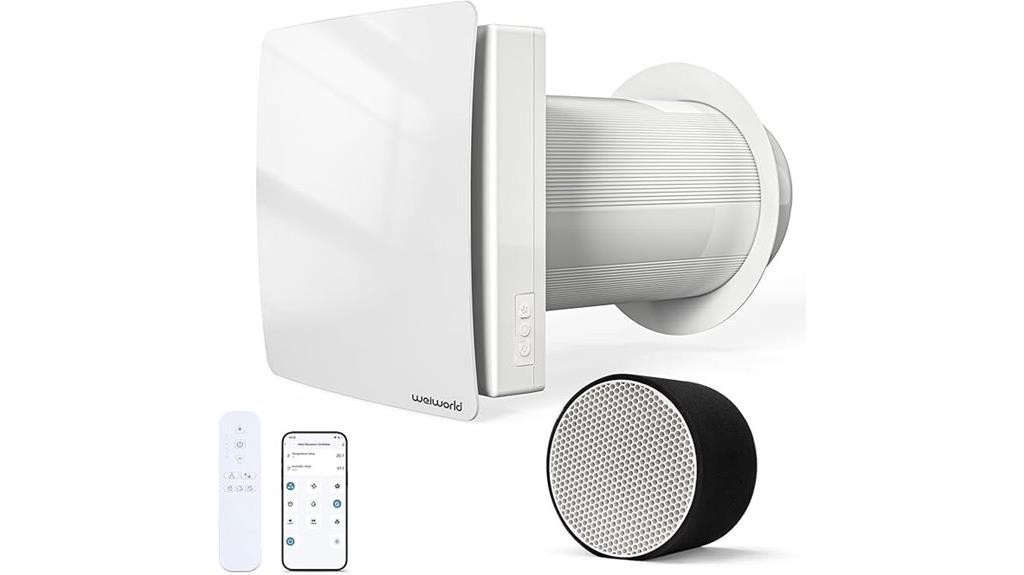
The VT501 Heat Recovery Ventilation Fan with Ceramic Heat Exchanger stands out as an excellent choice for homeowners and small space owners seeking efficient, customizable air quality solutions. It recovers up to 90% of heat from exhaust air, reducing energy costs while improving indoor air quality. With three airflow modes—Fresh Air, Exhaust, and Recirculation—it offers tailored ventilation for any environment. The fan’s WiFi and remote control via the Tuya App make operation convenient from anywhere. Its quiet, powerful EC motor ensures strong airflow with low energy use, making it ideal for various spaces like apartments, garages, or tiny homes. Maintenance is simple, thanks to the detachable front panel and filters.
Best For: homeowners and small space owners seeking efficient, customizable ventilation with energy savings and smart control options.
Pros:
- High-efficiency ceramic heat exchanger recovers up to 90% of heat, reducing energy costs.
- WiFi and remote control via Tuya App for convenient operation from anywhere.
- Quiet, powerful EC motor delivers strong airflow with low energy consumption.
Cons:
- Installation may require some technical knowledge or professional assistance.
- Limited to small to medium-sized spaces; very large areas may need multiple units.
- Regular maintenance of filters and panels is necessary to ensure optimal performance.
Panasonic Intelli-Balance 100 Energy Recovery Ventilator (ERV)
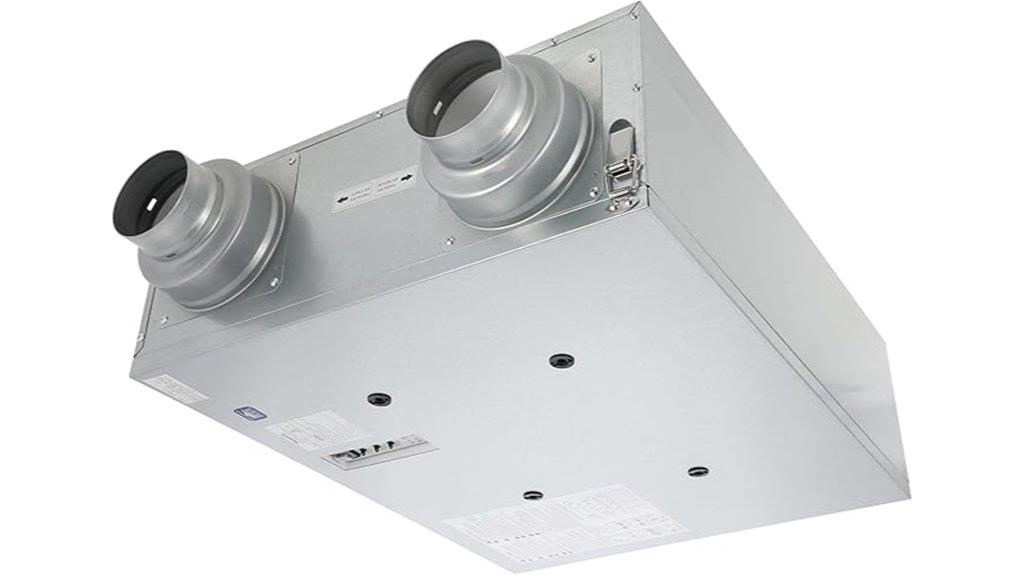
For those living in cold climates, the Panasonic Intelli-Balance 100 ERV stands out as an ideal choice due to its exceptional performance in low temperatures, with reliable operation even at -22°F (-30°C). I appreciate its ability to remove stale, moist air while supplying fresh air, helping maintain a healthy indoor environment. Its dual DC/ECM motors and adjustable airflow (30-100 CFM) ensure optimized ventilation. The boost function quickly increases airflow when needed, and the timer feature promotes energy efficiency. With a sleek, modern design and easy wall or ceiling mounting, it’s perfect for spaces like bathrooms, garages, or living rooms, even in the coldest months.
Best For: homeowners in cold climates seeking reliable, energy-efficient ventilation to improve indoor air quality during winter months.
Pros:
- Effective operation in temperatures as low as -22°F (-30°C), ideal for cold climates
- Dual DC/ECM motors with adjustable airflow (30-100 CFM) for customized ventilation needs
- Features like boost function and timer enhance user control and energy efficiency
Cons:
- Slightly bulky size may require sufficient space for installation
- Higher initial cost compared to basic ventilation fans
- Requires professional installation for optimal performance and sealing
Panasonic Intelli-Balance 100 ERV

Designed for temperate climates, the Panasonic Intelli-Balance 100 ERV stands out with its adjustable airflow from 30 to 100 CFM, making it ideal for those seeking customizable and energy-efficient ventilation. I appreciate its ability to remove moist, stale air while supplying fresh, clean air, helping maintain balanced indoor pressure. With a MERV 8 filter, it also purifies the air effectively. The unit features two DC/ECM motors and a Pick-A-Flow selector for precise airflow control. Additionally, the boost function offers quick, high-speed ventilation when needed. Its flexible controls and compatibility with various accessories make it a versatile choice for healthier indoor environments.
Best For: homeowners and building managers in temperate climates seeking customizable, energy-efficient ventilation with air purification capabilities.
Pros:
- Adjustable airflow from 30 to 100 CFM for customized ventilation needs
- Includes MERV 8 filter for effective air purification
- Equipped with two DC/ECM motors and Pick-A-Flow selector for precise control
Cons:
- Designed primarily for temperate climates; may be less effective in extreme cold or hot conditions
- May require professional installation due to its ventilation and control features
- Limited to 30-100 CFM airflow range, which may not suit very large or small spaces
Broan B210E75RS Wall/Ceiling Energy Recovery Ventilator with Side Ports

If you’re looking for an energy recovery ventilator that combines high efficiency with easy installation, the Broan B210E75RS with side ports stands out as a top choice. This 210 CFM ERV uses proprietary VIRTUO™ technology for auto-balancing airflow, making setup quick and simple. Its core achieves up to 81% sensible recovery efficiency at 32°F, ensuring reliable performance in various climates. Built with galvanized steel and equipped with a reusable MERV 8 filter (optional HEPA), it offers durability and clean air. The unit includes an LCD display for real-time diagnostics and supports flexible mounting options, making it a versatile and efficient solution for improved indoor air quality.
Best For: homeowners and HVAC professionals seeking an energy-efficient, easy-to-install ventilation system that enhances indoor air quality across various climate conditions.
Pros:
- Auto-balancing airflow with proprietary VIRTUO™ technology simplifies installation and ensures consistent performance
- High sensible recovery efficiency of up to 81% at 32°F for effective climate adaptability
- Durable galvanized steel construction with a reusable MERV 8 filter and optional HEPA filtration
Cons:
- Not ENERGY STAR® certified, which may affect energy savings incentives
- Slightly larger size (21 x 21 x 20.8 inches) may require available space for installation
- Power consumption of approximately 270 watts could impact energy costs over time
Aprilaire V22BEC Energy Recovery Ventilator (ERV)

The Aprilaire V22BEC Energy Recovery Ventilator (ERV) stands out as an excellent choice for homeowners seeking to improve indoor air quality while lowering energy costs. It delivers 120 CFM airflow, suitable for homes up to 6,000 sq. ft., and can be mounted on walls, ceilings, or floors with included brackets. This ERV replaces stale indoor air with fresh outdoor air, reducing odors, humidity, and pollutants for healthier living. Its energy recovery core tempers incoming air by exchanging heat and moisture, cutting HVAC energy use. With simple push-button controls, it’s easy to operate and maintain, providing balanced ventilation for consistent comfort year-round.
Best For: homeowners seeking to enhance indoor air quality and reduce energy costs in large or multi-room homes up to 6,000 sq. ft.
Pros:
- Improves indoor air quality by replacing stale air with fresh outdoor air
- Reduces energy costs through heat and moisture exchange with the energy recovery core
- Easy to operate with simple push-button controls and versatile mounting options
Cons:
- May require professional installation for optimal setup and integration
- Limited airflow capacity of 120 CFM might not suit very large or highly ventilated spaces
- Regular maintenance is necessary to ensure optimal performance over time
Through the Wall HEPA Ventilation Fan with WiFi/Remote Control

For anyone seeking a convenient and efficient way to improve indoor air quality, the Through the Wall HEPA Ventilation Fan with WiFi/Remote Control stands out. It offers smart control via the Tuya Smart App or remote, allowing me to adjust fan speed, switch modes, and monitor operation remotely. With three modes—Fresh Air Intake, Exhaust, and Air Recirculation—it can bring in clean air, expel stale air, or circulate indoor air for ideal comfort. The multi-stage filtration system, including HEPA and activated carbon filters, captures dust, odors, and pollutants. Its quiet, powerful operation and easy maintenance make it perfect for various indoor spaces, promoting healthier air effortlessly.
Best For: Homeowners, office managers, and DIY enthusiasts seeking an efficient, smart ventilation solution to improve indoor air quality effortlessly.
Pros:
- Smart control via Tuya app or remote for convenient operation
- Multi-stage filtration system effectively captures dust, odors, and pollutants
- Quiet yet powerful operation suitable for various indoor spaces
Cons:
- Installation may require some technical skill for wall mounting
- WiFi connectivity depends on stable internet, which may vary in some locations
- Regular filter maintenance and replacement are necessary to maintain performance
Broan B110H65RS AI Heat Recovery Ventilator with LCD Screen

The Broan B110H65RS AI Heat Recovery Ventilator with LCD Screen stands out as a smart choice for small homes seeking reliable, energy-efficient ventilation. It features VIRTUO™ Air Technology, which continuously monitors indoor and outdoor conditions for fresh, healthy air. With a flexible, compact design and multiple mounting options, installation is quick and space-saving. The unit offers adjustable airflow from 35 to 110 CFM, powered by energy-efficient PMSM ECM motors that save up to 60% energy. Its integrated LCD screen simplifies real-time airflow measurement, auto-balancing, and diagnostics, making it easy to maintain ideal indoor air quality effortlessly.
Best For: small home owners seeking an energy-efficient, easy-to-install ventilation system with smart features.
Pros:
- Features VIRTUO™ Air Technology for continuous indoor/outdoor monitoring and fresh air quality
- Energy-efficient PMSM ECM motors provide up to 60% energy savings
- Integrated LCD screen allows for simple real-time airflow measurement, auto-balancing, and diagnostics
Cons:
- Limited to airflow speeds up to 110 CFM, suitable mainly for smaller spaces
- Requires pairing with Broan main controls for full fault indicator functionality
- Dimensions and weight may require adequate space for installation in some wall/ceiling configurations
Broan B210E75RT Energy Recovery Ventilator
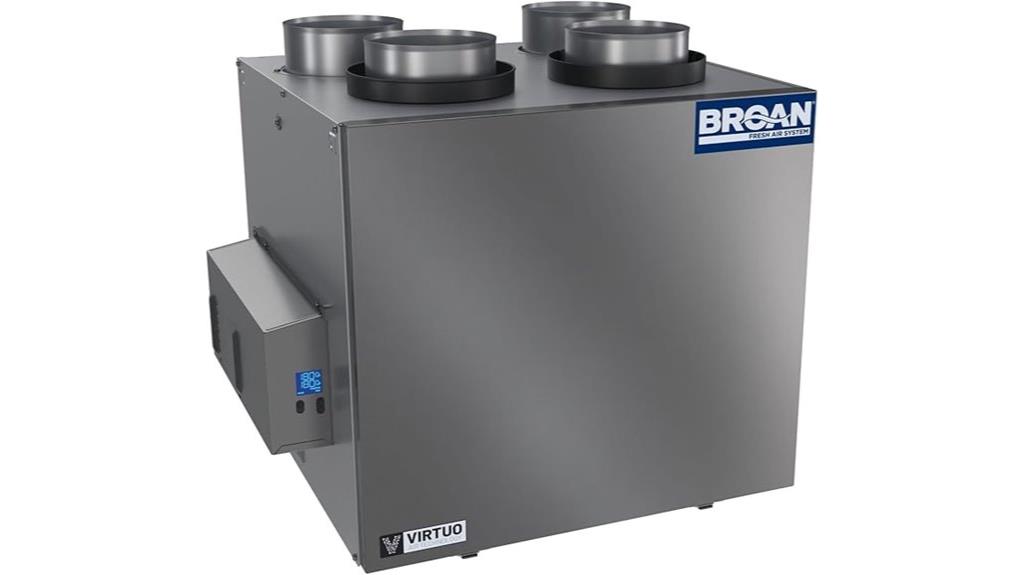
If you’re seeking an energy recovery ventilator that simplifies installation and offers reliable airflow management, the Broan B210E75RT stands out with its VIRTUO technology. It features quick setup, auto-balancing, and supports top or side port configurations for versatile installation. With a 206 CFM capacity powered by energy-efficient ECM PMSM motors, it provides tempered, filtered outdoor air while exhausting stale indoor air. The unit includes a user-friendly LCD screen to monitor airflow, power use, and diagnostics. Its durable HRV core ensures high efficiency even in cold climates, and optional HEPA filters can further improve indoor air quality.
Best For: homeowners and HVAC professionals seeking an easy-to-install, energy-efficient ERV that enhances indoor air quality and offers versatile installation options.
Pros:
- Quick setup with VIRTUO technology simplifies airflow verification and auto-balancing.
- Supports top and side port configurations for flexible installation.
- Equipped with energy-efficient ECM PMSM motors and durable HRV core for reliable performance in various climates.
Cons:
- Optional HEPA filters may add to initial cost and maintenance complexity.
- Requires a control system compatible with its LCD interface for full functionality.
- Installation may still require professional expertise for optimal placement and setup.
Broan B160E65RT AI Energy Recovery Ventilator with LCD Screen

The Broan B160E65RT AI Energy Recovery Ventilator stands out with its convenient LCD screen, making it an excellent choice for homeowners who prioritize easy monitoring and control. With a 142 CFM airflow capacity, it effectively exchanges indoor air while conserving energy using R-410A refrigerant. Its versatile design allows ceiling or wall mounting, fitting seamlessly into various spaces. The unit is powered by 120 volts and includes a remote control for effortless operation. The LCD display provides real-time data, so I can easily track system performance and make adjustments as needed. Overall, this ventilator combines efficiency, user-friendly features, and flexible installation options.
Best For: homeowners seeking an energy-efficient, easy-to-monitor ventilation system with flexible installation options.
Pros:
- Features an LCD screen for real-time system monitoring and easy adjustments
- Suitable for ceiling or wall mounting, offering versatile installation options
- Uses R-410A refrigerant to enhance energy efficiency and environmentally friendly operation
Cons:
- Requires 120 volts power supply, which may limit installation in some setups
- Remote control operation may be less convenient if misplaced or lost
- Installation may require professional assistance for optimal setup
VENTS-US Frigate ERV 120s Energy Recovery Ventilator

Designed for homeowners seeking reliable, energy-efficient ventilation, the VENTS-US Frigate ERV 120s stands out with its HVI-certified whole-house airflow. It provides continuous, balanced air exchange by bringing in fresh air and exhausting stale air, improving indoor air quality. With a maximum airflow of 162 CFM and only 19 Watts on low, it’s energy-efficient. The unit offers three-speed control options and supports 24/7 operation. Built with corrosion-resistant steel and compatible with standard duct sizes, installation is straightforward. Plus, its electronic anti-frost system guarantees reliable performance in cold climates, making it a durable, low-maintenance choice.
Best For: homeowners seeking a reliable, energy-efficient ventilation solution that enhances indoor air quality in cold climates.
Pros:
- HVI-certified for trusted performance and balanced airflow
- Low energy consumption at just 19 Watts on low speed
- Durable corrosion-resistant steel construction and easy installation
Cons:
- Limited to 162 CFM maximum airflow, which may be insufficient for very large homes
- Only three-speed settings, offering less customization than variable-speed models
- Requires standard 5-inch duct connections, which may need adaptation for non-standard ductwork
4 Inch Square Passive Air Vent with Adjustable Duct

A 4 Inch Square Passive Air Vent with Adjustable Duct offers an efficient, maintenance-free solution for those seeking natural ventilation without relying on electricity. Its passive design means zero operating costs, helping reduce energy bills and environmental impact. Perfect for basements, attics, or crawl spaces, it fits standard 4″ x 4″ openings and is easy to install with drilled wall holes. The adjustable panel allows control over airflow, while 45° louvers prevent rain backflow. Made from durable UV-resistant ABS plastic, it resists cracking and fading. This quiet, classic vent provides reliable, natural air exchange, making it a smart choice for improving indoor air quality effortlessly.
Best For: homeowners seeking a maintenance-free, energy-efficient ventilation solution for attics, basements, or crawl spaces to improve air quality naturally.
Pros:
- No electricity required, reducing operating costs and environmental impact
- Easy DIY installation with included screws and extendable duct
- Durable UV-resistant ABS plastic resists cracking, fading, and corrosion
Cons:
- Manual adjustment needed for airflow control, which may require periodic checking
- Limited to standard 4″ x 4″ openings, not suitable for larger or irregular spaces
- Passive design means airflow depends on environmental factors, not adjustable via motor or automation
TOSOT Energy Recovery Ventilation Fan for TOSOT Aoraki Mini-Split Air Conditioner

Looking to boost your mini-split system’s energy efficiency and indoor air quality? The TOSOT Energy Recovery Ventilation Fan is designed exclusively for the TOSOT Aoraki Mini-Split Air Conditioner, offering an 18 CFM airflow that enhances ventilation. It’s ENERGY STAR certified, with a high SEER2 rating up to 24.5, which can cut your electricity bills by up to 35%. The fan operates quietly, with low noise levels, and features smart humidity control and self-cleaning filters. Easy to install with professional help, it’s perfect for improving indoor air quality while maintaining energy efficiency, even in extreme cold conditions down to 5°F.
Best For: homeowners and professionals seeking to improve energy efficiency, indoor air quality, and ventilation performance with a compact, quiet, and cold climate-capable ERV accessory for their TOSOT Aoraki Mini-Split system.
Pros:
- Compatible exclusively with TOSOT Aoraki Mini-Split Air Conditioner, ensuring optimal integration.
- Highly energy efficient with a SEER2 rating up to 24.5, reducing electricity costs by up to 35%.
- Quiet operation with low indoor noise levels as low as 19dB and features like self-cleaning filters and adjustable louvers.
Cons:
- Installation requires additional wall vents and professional assistance, adding to setup complexity and cost.
- Only compatible with TOSOT Aoraki Mini-Split systems, limiting versatility with other HVAC units.
- First available in April 2025, meaning potential wait times for availability and delivery.
Factors to Consider When Choosing Energy Recovery Ventilators

When choosing an energy recovery ventilator, I focus on factors like airflow capacity to meet my space’s needs and how well it suits my climate. I also consider energy efficiency ratings to keep operating costs low and look for flexible installation options that fit my setup. Additionally, filtration options are important to make sure clean, healthy air indoors.
Airflow Capacity Needs
Choosing the right energy recovery ventilator (ERV) starts with understanding your airflow capacity needs. To do this, I assess the size of my space or the total indoor area, usually measuring in CFM (cubic feet per minute). For smaller rooms, 30 to 50 CFM might suffice, but larger homes or multi-room setups often require 100 CFM or more to maintain proper ventilation. I also consider standards like ASHRAE 62.2, which recommend specific CFM values based on square footage or occupancy. Matching the ERV’s airflow capacity to my heating and cooling systems helps optimize energy efficiency and indoor air quality. Additionally, I look for models with adjustable airflow or multiple speed options to adapt to changing indoor air needs.
Climate Suitability
Selecting an energy recovery ventilator that’s suitable for your climate is vital to guarantee reliable performance and energy efficiency. I look for models rated for local temperature extremes, like cold climate units that operate effectively down to -22°F (-30°C). It’s important to choose an ERV with heat recovery efficiency tailored to my environment; some units offer up to 81% sensible recovery at specific outdoor temps, maximizing energy savings. If I live in a region with freezing temperatures, I consider models with anti-frost or frost control systems to prevent operational issues. I also verify the airflow capacity matches my ventilation needs, whether for small or large spaces. Ultimately, I prioritize units with proper insulation and moisture management features to handle humidity and temperature fluctuations typical for my climate zone.
Energy Efficiency Ratings
Energy efficiency ratings are key indicators of an ERV’s performance, measuring how well it recovers heat and moisture from exhaust air. I look for units with high sensible and total heat recovery efficiencies, usually expressed as percentages. The higher the efficiency—ideally 80% or above—the more effective it is at reducing energy costs while maintaining indoor comfort. These ratings reflect how much heat and moisture are transferred between incoming and outgoing air, so better numbers mean less energy needed to heat or cool your space. Certifications like HVI and ENERGY STAR can verify an ERV’s efficiency performance, giving peace of mind. Choosing an ERV with strong efficiency ratings ensures improved indoor air quality without sacrificing energy conservation.
Installation Flexibility
When evaluating energy recovery ventilators, it’s important to take into account their installation flexibility to guarantee they fit seamlessly into your space. Look for units that support multiple mounting options, like wall or ceiling installation, to match your room layout. Check if the ERV has flexible duct connection sizes or configurable port locations, making integration easier with existing systems. Adjustable airflow settings and control methods are also vital, as they help tailor ventilation to different room sizes and occupancy needs. Additionally, choose models designed for easy access, simplifying maintenance, filter replacement, and cleaning. Finally, consider units with customizable options or accessories, so they can integrate smoothly with other HVAC components or smart control systems, ensuring a hassle-free installation and long-term operation.
Filtration Options
Choosing the right filtration options for your energy recovery ventilator is essential for maintaining healthy indoor air quality. Filters like MERV 8, MERV 13, HEPA, or activated carbon target dust, pollen, odors, and airborne pollutants, improving overall air cleanliness. The filtration system’s effectiveness can be tailored to meet specific health needs or allergy sensitivities, which is vital for creating a comfortable environment. Detachable magnetic panels make cleaning and replacing filters straightforward, ensuring consistent airflow and filtration performance. Upgrading filters—from MERV 8 to HEPA, for example—can boost filtration efficiency, but it’s important to take into account potential airflow resistance. Some ERVs feature multi-stage filters that combine particle removal with odor control and humidity management, offering all-encompassing air quality solutions.
Control Features
Selecting the right control features for your ERV can substantially enhance its performance and user experience. Look for models with adjustable options like timers, speed settings, and mode selections so you can tailor airflow to occupancy levels and weather conditions. Remote or WiFi-enabled controls add convenience, allowing real-time adjustments from anywhere. A good control system should include diagnostic tools or LCD displays that show airflow, power use, and error codes, simplifying maintenance. User-friendly interfaces, such as push buttons or touchscreens, make operation straightforward for everyone. Also, ensure compatibility with your existing home automation or HVAC systems. These features not only improve usability but also help optimize energy efficiency and indoor air quality over the long term.
Maintenance Requirements
Regular maintenance is essential to keep your energy recovery ventilator operating efficiently and providing clean indoor air. I recommend inspecting and cleaning or replacing filters regularly—most models have washable or replaceable filters like MERV 8 or HEPA, depending on usage and environment. Routine checks of components such as fans, motors, and heat exchangers help ensure everything runs smoothly and prevent system failures. Maintenance frequency varies from monthly to annually, based on your specific model, filter type, and indoor air quality levels. Additionally, cleaning static pressure access ports and internal parts verifies airflow performance and extends your unit’s lifespan. Staying on top of these tasks guarantees ideal airflow, energy efficiency, and indoor air quality. Proper upkeep ultimately saves you money and keeps your system reliable for years to come.
Frequently Asked Questions
How Do ERVS Impact Energy Bills Long-Term?
Energy recovery ventilators help reduce long-term energy bills by recycling heat and humidity from exhausted air to pre-condition incoming fresh air. This means your HVAC system works less to heat or cool your home, saving you money over time. Although they have an upfront cost, the energy savings and improved indoor air quality make ERVs a smart investment for the future. I’ve seen significant savings after installing one in my home.
Are ERVS Suitable for All Climate Zones?
Yes, ERVs are suitable for most climate zones, but I recommend considering your specific environment. In colder areas, ERVs help retain heat while exchanging stale air, reducing heating costs. In humid or hot climates, they help control moisture and improve air quality. However, I suggest consulting with a professional to guarantee the model you choose matches your climate needs for ideal performance and energy efficiency.
What Maintenance Is Required for Optimal Performance?
To keep your ERV running ideally, I recommend regular filter checks and replacements every 6 to 12 months, depending on usage and air quality. I also suggest cleaning the core annually to prevent dust buildup and ensuring fans and motors are free of debris. Keeping vents unobstructed and scheduling professional inspections annually can help maintain efficiency and indoor air quality.
Can ERVS Be Integrated With Smart Home Systems?
Absolutely, ERVs can be integrated with smart home systems. For example, I recently installed a smart-enabled ERV that syncs with my home’s Wi-Fi. Now, I can control ventilation remotely through an app or voice commands via my smart speaker. This integration helps optimize indoor air quality, save energy, and provides convenience. Many modern ERVs support this feature, making it easier to maintain a healthier, smarter home environment.
How Do ERVS Affect Indoor Humidity Levels?
ERVs help regulate indoor humidity by exchanging stale indoor air with fresh outdoor air while transferring moisture between the two. This process prevents excessive dryness in winter and excess humidity in summer, maintaining a comfortable environment. I’ve seen how properly installed ERVs keep humidity levels balanced, reducing mold growth and improving overall air quality. They’re a smart choice for enhancing comfort and health in any home.
Conclusion
Choosing the right energy recovery ventilator really can transform your indoor air quality, making your home healthier and more comfortable. I believe that investing in a quality ERV isn’t just about ventilation—it’s about creating a sustainable living environment. Think of it like a gust of fresh air for your home’s air, proving that good air quality isn’t just a luxury but a necessity. After all, cleaner air benefits us all, now and in the future.