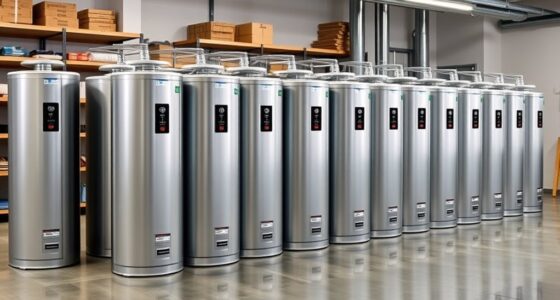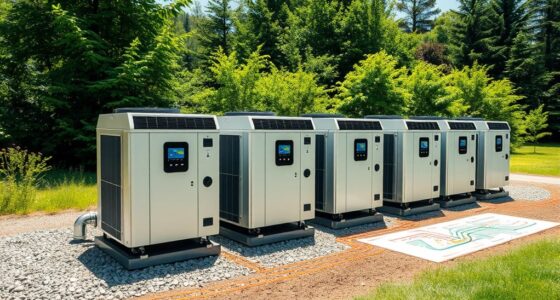
I believe the best server rack batteries for solar storage in 2026 are those with high durability, advanced safety features, and expandability. Models like the 48V 100Ah lithium batteries with Bluetooth, or scalable LiFePO4 systems, offer long lifespans, deep cycle support, and reliable monitoring options. These choices guarantee your energy stays safe and efficient now and into the future. Keep exploring, and you’ll discover even more ways to optimize your solar storage system.
Key Takeaways
- Prioritize batteries with a long lifespan (10-15 years) and high cycle counts (>6,000 deep cycles) for durability and reliability.
- Ensure compatibility with existing server rack systems, inverters, and communication protocols like RS485, CAN, or RS232.
- Choose models with advanced BMS protections, remote monitoring, and safety features to safeguard against overcharge, overheating, and short circuits.
- Opt for corrosion-resistant materials and open ventilation design to prevent overheating and extend environmental durability.
- Consider scalability options supporting expansion up to 15 units for future energy storage growth and system flexibility.
| SUNGOLDPOWER 3U Server Rack for Lithium Batteries | 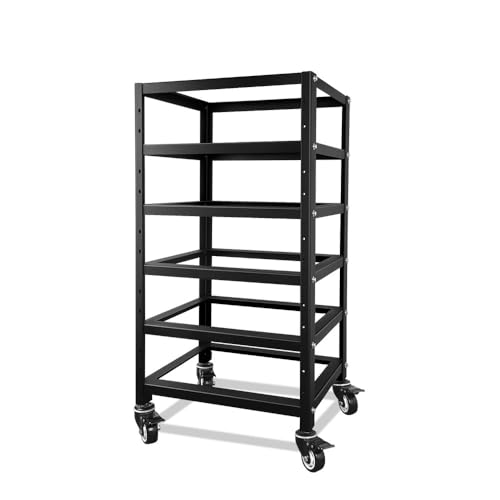 | Versatile and Durable | Capacity: Not specified (rack support) | Battery Type: Lithium batteries (assumed) | Management System: Not specified | VIEW LATEST PRICE | See Our Full Breakdown |
| 48V 100Ah Lithium Battery with Bluetooth & App | 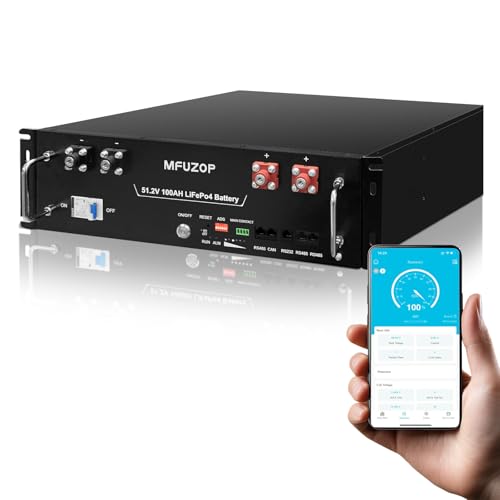 | Smart Monitoring | Capacity: 5.12kWh | Battery Type: LiFePO4 | Management System: 100A BMS + Bluetooth & App | VIEW LATEST PRICE | See Our Full Breakdown |
| LiFePO4 30.72kWh Server Rack Battery System |  | Heavy-Duty Power | Capacity: 30.72kWh | Battery Type: LiFePO4 | Management System: Independent Smart BMS with Bluetooth app | VIEW LATEST PRICE | See Our Full Breakdown |
| LiFePO4 Server Rack Battery Pack (3PCS) |  | Expandable System | Capacity: 15.36kWh | Battery Type: LiFePO4 | Management System: 100A Smart BMS + Bluetooth | VIEW LATEST PRICE | See Our Full Breakdown |
More Details on Our Top Picks
-
MFUZOP 48V 100Ah LiFePO4 Lithium Battery with Bluetooth & Mobile APP Built-in 100A BMS, 5.12kWh 3U Rack Mount Server Battery, 6000+ Cycles Perfect for Solar Energy Storage, Home Backup Power Storage
【High Capacity & Standard Rack 3U Size】48V 100Ah LiFePO4 battery provides 5.12kWh usable capacity in a compact 3U...
As an affiliate, we earn on qualifying purchases.
SUNGOLDPOWER 3U Server Rack for Lithium Batteries
If you’re looking for a durable, versatile rack that can securely hold lithium batteries for your solar system, the Sungoldpower 3U Server Rack is an excellent choice. Made from stainless steel, it resists corrosion and offers long-lasting durability, ensuring your batteries stay protected over time. It’s compatible with most standard 3U batteries, making it adaptable for various energy storage setups. The rack features pre-drilled holes and included hardware for quick installation, while its open ventilation design promotes airflow. Wheels add mobility, and its stability features prevent shifting or damage during operation, boosting safety and reliability for your solar storage needs.
- Capacity:Not specified (rack support)
- Battery Type:Lithium batteries (assumed)
- Management System:Not specified
- Expandability:Supports parallel up to 32 units
- Installation Type:Rack-mounted with wheels
- Monitoring:Not specified
- Additional Feature:Ventilation airflow design
- Additional Feature:Equipped with wheels
- Additional Feature:Corrosion-resistant stainless steel
-
B0GGTK9J15
Amazon Product B0GGTK9J15
As an affiliate, we earn on qualifying purchases.
48V 100Ah Lithium Battery with Bluetooth & App
The V 100Ah Lithium Battery with Bluetooth & App stands out for its advanced monitoring capabilities, making it ideal for users who want real-time insight into their energy storage. Its compact 48V, 100Ah design fits easily into standard server racks, perfect for residential or commercial setups. Built with durable LiFePO4 cells, it offers up to 15,000 cycles and a lifespan of 10–15 years. The integrated Bluetooth and dedicated app let me monitor voltage, current, SOC, and cycle count remotely. With support for parallel connection and a 10-year warranty, this battery provides reliable, scalable, and eco-friendly power for diverse energy storage needs.
- Capacity:5.12kWh
- Battery Type:LiFePO4
- Management System:100A BMS + Bluetooth & App
- Expandability:Supports parallel up to 32 units
- Installation Type:Rack-mounted, wall or cabinet compatible
- Monitoring:Mobile app via Bluetooth
- Additional Feature:Supports parallel connections
- Additional Feature:Compact server rack size
- Additional Feature:Eco-friendly power source
-
B0GHNT9WTH
Amazon Product B0GHNT9WTH
As an affiliate, we earn on qualifying purchases.
LiFePO4 30.72kWh Server Rack Battery System
Designed for large-scale applications, the LiFePO4 30.72kWh Server Rack Battery System offers a robust and scalable energy storage solution. Comprising six 48V 100Ah units, it’s ideal for big residential estates or light industrial use, providing over 6,000 deep cycles for long-term reliability. Remote Bluetooth monitoring offers real-time insights into cell health and SOC, ensuring transparency and ease of management. Each unit features a smart BMS for multi-layered safety, protecting against over-current and overheating. It supports expansion with up to 15 units and is compatible with top-tier inverters like Sol-Ark and Victron, making system scaling flexible and straightforward.
- Capacity:30.72kWh
- Battery Type:LiFePO4
- Management System:Independent Smart BMS with Bluetooth app
- Expandability:Supports up to 15 units
- Installation Type:Rack-compatible, external rack sold separately
- Monitoring:Bluetooth app for remote control
- Additional Feature:Large capacity for industrial use
- Additional Feature:Supports up to 15 units
- Additional Feature:Compatible with top-tier inverters
LiFePO4 Server Rack Battery Pack (3PCS)
Powered by high-quality Grade A LiFePO4 cells, the 3-piece server rack battery pack offers a robust 15.36kWh capacity, making it ideal for medium-sized off-grid cabins or home emergency backups. With three units at 51.2V 300Ah each, it provides over 6,000 deep cycles and a 10-year lifespan, ensuring long-term reliability. The system features Bluetooth connectivity for remote monitoring of SOC, voltage, and cell health via a smartphone app. Each unit includes a smart BMS for safety, preventing overcharge and thermal issues. Designed for expansion, it supports up to 15 units, seamlessly integrating with major inverter brands.
- Capacity:15.36kWh
- Battery Type:LiFePO4
- Management System:100A Smart BMS + Bluetooth
- Expandability:Supports up to 15 units
- Installation Type:Rack-compatible, external rack not included
- Monitoring:Bluetooth app for remote monitoring
- Additional Feature:External rack and hardware sold separately
- Additional Feature:Designed for medium-sized off-grid
- Additional Feature:Can connect up to 15 units
Factors to Consider When Choosing a Server Rack Battery for Solar Storage
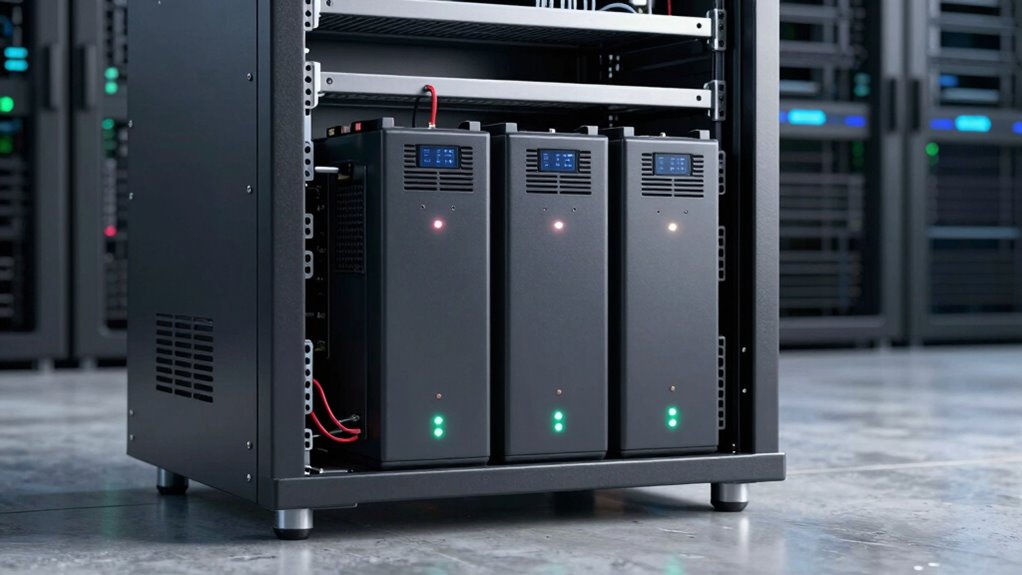
When selecting a server rack battery for solar storage, I consider compatibility with my existing systems to guarantee smooth operation. I also evaluate my power capacity needs and available installation space to choose the right size and type. Additionally, I look at battery management features and expandability options to make sure the system can grow with my future energy requirements.
Compatibility With Systems
Selecting a server rack battery for solar storage requires careful attention to system compatibility to guarantee smooth operation and scalability. First, confirm the battery’s dimensions and mounting setup match your existing or planned energy system. Compatibility extends to communication protocols like RS485, CAN, or RS232, which are essential for seamless integration with your inverter or control system. Check that the battery’s voltage and capacity align with your system’s power needs and constraints. It’s also crucial to verify that the battery’s management system (BMS) supports your monitoring and control protocols for effective operation. Finally, consider whether the rack and battery are designed for expansion or parallel connections if you plan to scale your system in the future. Compatibility is key to maximizing performance and future-proofing your solar storage setup.
Power Capacity Needs
Understanding your total energy storage needs is essential when choosing a server rack battery for solar, as it determines the capacity required to meet your daily power demands. To do this, I evaluate my daily power consumption in kilowatt-hours (kWh) and select a battery system that can supply energy for the needed duration without frequent recharging. I also consider whether the battery supports parallel or series configurations to expand capacity as my needs grow. Additionally, I account for the depth of discharge (DOD) to maximize usable capacity without shortening the battery’s lifespan. Finally, I match the battery’s voltage and current ratings with my inverter and system specifications to ensure smooth, reliable power delivery. This careful assessment helps me choose a system that’s both efficient and scalable.
Installation Space Availability
Have you confirmed that your available space can comfortably fit the physical dimensions of a server rack battery system? It’s crucial to measure height, width, and depth carefully to guarantee a proper fit without forcing or cramming the unit into tight spots. Equally important is considering ventilation; batteries generate heat, so adequate airflow and clearance are necessary to prevent overheating. Check if there’s enough room for maintenance, cable management, and future expansion—these factors save you time and hassle later. Additionally, verify that the installation area can support the weight of the rack and batteries safely. Finally, make sure the space complies with safety standards and accessibility requirements for secure handling and efficient operation. Proper planning here guarantees a safe, effective, and long-lasting installation.
Battery Management Features
A robust battery management system (BMS) is essential for ensuring the safety, reliability, and longevity of server rack batteries used in solar storage. A good BMS protects against overcharge, over-discharge, overcurrent, short circuits, and high temperatures, which can damage cells and compromise safety. Advanced features like real-time monitoring and data transmission via protocols such as RS485, CAN, or Bluetooth allow for remote oversight and quick troubleshooting. Multi-layered protections maintain balanced cell voltage and prevent thermal runaway, ensuring system stability. Moreover, a reliable BMS supports parallel connections of multiple batteries, enabling scalability without sacrificing safety. Seamless communication with inverters and energy management systems helps optimize energy efficiency and overall system performance, making the BMS a critical component for long-term solar storage success.
Expandability Options
When choosing a server rack battery system for solar storage, it’s vital to think about how easily it can expand to meet future energy demands. I look for systems that support parallel connections, making it straightforward to add more units as needed. It’s important to check the maximum number of units allowed in parallel without risking safety or stability. The battery management system (BMS) should support expansion, guaranteeing proper monitoring and protection across multiple batteries. Compatibility with existing or planned inverters and control systems is essential for seamless scalability. Additionally, I verify that the rack and mounting hardware are designed to accommodate future battery additions easily. These factors help guarantee my system can grow efficiently, avoiding costly upgrades down the line.
Durability and Lifespan
Durability and lifespan are key considerations when selecting a server rack battery for solar storage, as these factors determine how well the system will perform over time. A durable battery should be made from corrosion-resistant materials like stainless steel, helping it withstand environmental elements. The lifespan is often measured in deep cycles; high-quality LiFePO4 batteries can surpass 6,000 cycles, offering long-term reliability. Batteries equipped with advanced Battery Management Systems (BMS) provide enhanced safety, protecting against overcharge, over-discharge, and thermal runaway, which extends their durability. An open ventilation design prevents overheating during continuous operation, further promoting longevity. When properly chosen, a well-designed server rack battery system can maintain its structural integrity and performance for 10-15 years, even with frequent charge and discharge cycles.
Monitoring and Control
Effective monitoring and control are essential for maximizing the performance and safety of server rack batteries in solar storage systems. I look for systems that support Bluetooth or Wi-Fi connectivity, enabling real-time remote monitoring through mobile apps. A robust Battery Management System (BMS) is key, providing detailed updates on voltage, current, and state of charge (SOC). Compatibility with protocols like RS485, CAN, or RS232 ensures seamless integration with existing solar components and inverters. User-friendly features such as visual dashboards and alerts for overcharge, over-discharge, or temperature issues help me quickly identify and address potential problems. Transparent, accessible data allows proactive management, minimizes downtime, and extends the system’s lifespan. Overall, effective monitoring tools are essential for reliable, efficient solar energy storage.
Safety and Reliability
Ensuring safety and reliability is vital when selecting server rack batteries for solar storage. I always check for a high-quality Battery Management System (BMS) that safeguards against overcharge, over-discharge, overcurrent, and thermal issues. Batteries with independent, multi-layered protection features are essential to prevent overheating, short circuits, and thermal runaway. I prefer systems with proven long cycle life—over 6,000 deep cycles—to guarantee consistent performance over time. Durability matters, so I look for batteries made from corrosion-resistant materials like stainless steel or high-grade LiFePO4 cells. Additionally, remote monitoring capabilities are a big plus, allowing early detection of potential safety issues. Prioritizing these factors helps make certain my solar storage system remains safe, reliable, and efficient over the long term.
Frequently Asked Questions
How Long Do Server Rack Batteries Typically Last?
Server rack batteries typically last between 3 to 5 years, depending on usage, maintenance, and the type of battery. I’ve found that proper care, like regular checks and avoiding deep discharges, can extend their lifespan. Lithium-ion batteries tend to last longer than lead-acid ones, offering better efficiency and durability. Keep an eye on performance metrics, and replacing batteries before they fail guarantees your system stays reliable.
Are Lithium Batteries Environmentally Friendly for Solar Storage?
Yes, lithium batteries are generally more environmentally friendly than traditional options like lead-acid because they last longer, are more efficient, and produce fewer emissions. However, their production and disposal still pose environmental challenges, such as mining impacts and recycling issues. I believe it’s important to weigh these factors and support advancements in recycling technologies to make lithium batteries a more sustainable choice for solar storage.
What Are the Safety Concerns With Server Rack Batteries?
Safety concerns with server rack batteries mainly revolve around fire risks, chemical leaks, and electrical hazards. I always make certain to follow proper installation procedures, use quality batteries, and maintain good ventilation. Overcharging or physical damage can lead to thermal runaway, so regular inspections are essential. Proper handling and safety gear are a must to prevent injuries. Staying vigilant helps guarantee safe operation and protects both people and equipment.
Can Server Rack Batteries Be Expanded Later?
Think of server rack batteries like building blocks; yes, they can be expanded later. Most systems are designed with scalability in mind, allowing you to add more units as your energy needs grow. I’ve seen setups where additional batteries seamlessly integrate, much like adding new chapters to a book. Just make certain your initial setup supports expansion, and check compatibility to keep everything running smoothly.
How Do Temperature Fluctuations Affect Battery Performance?
Temperature fluctuations can substantially impact battery performance. When it gets too hot, batteries may degrade faster, reducing their lifespan and capacity. Cold temperatures can slow down chemical reactions, leading to decreased efficiency and power output. I always recommend maintaining a stable environment for your batteries, ideally between 20°C and 25°C, to maximize their longevity and performance. Proper thermal management is essential to guarantee your batteries work at their best over time.
Conclusion
If you’re worried about choosing the right server rack battery for your solar setup, trust me, it’s worth doing your research. These options offer reliable power and smart features, making solar storage easier and more efficient. Even if you’re new to this, remember that investing in quality batteries can save you headaches and money long-term. Don’t let uncertainty hold you back—embrace the upgrade and enjoy cleaner, dependable energy for years to come.