TL;DR

Get backup power and energy gear delivered free — and shop member deals
- Fast, free delivery on millions of items
- Access to Prime Big Deal Days deals on October 6–7
- Prime Video, Amazon Music and more included
Solar backup power generators store electricity in a battery and supply it through an inverter, then recharge from solar panels or other sources. To choose one, match its usable watt-hours to the energy your devices need and confirm its continuous and surge wattage can handle them. A portable station usually supports selected devices, not an entire home.
A power station can show a battery full and still fail to start your refrigerator. That’s because battery capacity tells you how much energy it stores, while the inverter’s wattage limit determines what it can power at once.
Solar backup power generators are usually portable battery stations that accept energy from panels. They can keep a router, lights, phones, and some appliances running without fuel or engine exhaust, but they are not magic boxes for an entire home. This guide explains how to size one, what solar charging looks like in real weather, and which safety and installation limits matter before an outage hits.
You’ll also get a practical way to compare products without getting distracted by a giant watt-hour figure. The useful question isn’t “Which unit is biggest?” It’s “Which loads do I need, for how long, and how will I recharge?”
Estimate runtime from usable watt-hours and device draw; a 1,000 Wh station may run a steady 100 W load for about 8–9 hours after losses.
Check both continuous output and surge output, since motor-driven appliances can need a brief burst to start.
Panel wattage does not guarantee charging speed; shade, weather, panel angle, and the station’s solar-input limit all matter.
Compare battery chemistry, cycle-life conditions, warranty, expansion options, and the cost of panels—not only headline capacity.
Use a licensed electrician for household circuit connections, and follow the station manual for indoor placement, charging, and storage.
What a solar backup power generator can—and can’t—do
A solar backup power generator is usually a portable power station with a battery, an inverter, and an input for solar panels. It stores electricity for later use, so you can run compatible devices without burning fuel while the station is operating. Think of it as a rechargeable water tank: the battery holds a limited supply, and your appliances draw from it at different rates.
That makes the experience different from a gas generator. A battery station produces no combustion exhaust during operation and is often quiet enough to sit beside a desk, but it eventually runs out of stored energy unless you recharge it. During a summer outage, it might keep a modem, two LED lamps, and phones going; it won’t necessarily run central air conditioning or every circuit in your house.
“Solar generator” can also be a fuzzy label. In practice, it usually means a portable power station paired with panels, not a single device that makes power from sunlight on its own. Read the manufacturer’s specifications for battery capacity, AC output, surge output, and solar-input limits. Those details reveal more than the product name does.
The category now includes features such as LFP batteries, modular expansion packs, app monitoring, and pass-through or UPS-style operation. Those features vary by model, and product claims don’t guarantee compatibility with every device. A small detail—like whether your router’s power supply stays connected during a switchover—can make a big difference when the lights go out.
As an affiliate, we earn on qualifying purchases.
Choose a battery and inverter that match your actual loads
Solar backup power generators need two separate checks: enough watt-hours (Wh) to cover how long you’ll use your devices, and enough continuous and surge watts to run them. Capacity is the size of the energy tank; inverter output is the width of the pipe. A large tank cannot compensate for a pipe that is too narrow.
Estimate runtime with this rough formula: hours ≈ battery Wh × usable fraction ÷ appliance watts. For example, a 1,000 Wh station running a steady 100 W load may provide around 8–9 hours after conversion losses. Real use varies, and a device that cycles on and off won’t draw the same power constantly.
For a kitchen scenario, check the refrigerator label or measure its energy use if you can, then include other loads such as a router or phone chargers. Refrigerators draw extra power when their compressors start, so check the station’s surge rating as well as its continuous output. A unit might have ample battery for the night yet fail to start the compressor because the brief startup demand exceeds its inverter limit.
Before you shop, make a short list of what you’ll power and rank it by importance. Add the devices’ expected energy needs for the number of hours you want backup, then check the station’s output against the highest simultaneous load. If you rely on a medical device, follow its manufacturer’s power requirements and discuss backup planning with your care team; don’t assume a product’s advertised capacity guarantees a particular runtime.
- List priority devices, such as a router, medical equipment, lights, or refrigerator.
- Check running and startup watts for each appliance.
- Estimate total energy for the backup period, allowing for conversion losses and changing loads.
- Compare both limits: usable battery capacity and inverter output.
portable solar generator for camping
As an affiliate, we earn on qualifying purchases.
As an affiliate, we earn on qualifying purchases.
Compare fuel generators and battery stations before you buy
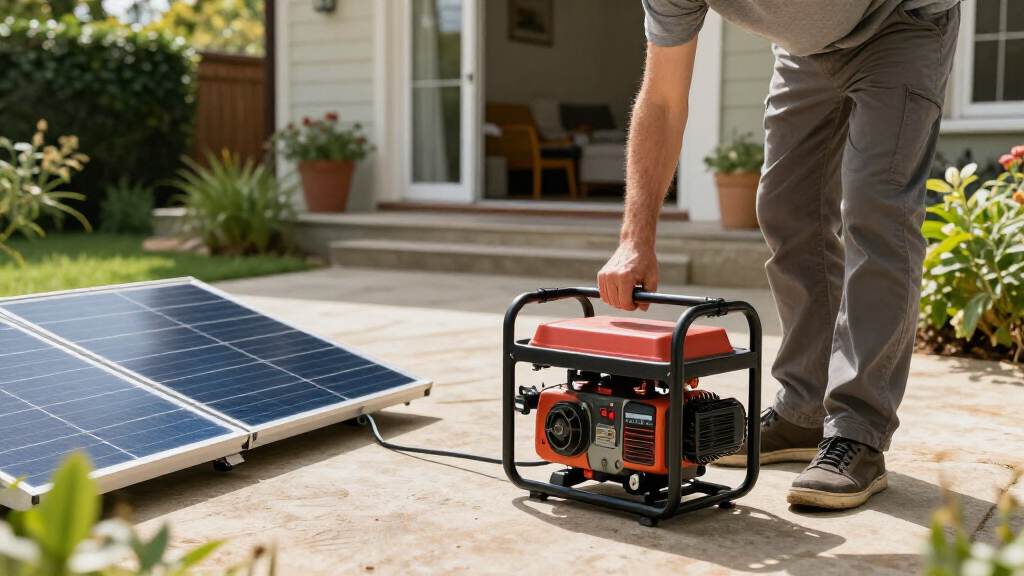
Solar backup power generators suit quiet, limited-load backup, while fuel generators can keep supplying power as long as you have fuel and run them safely outdoors. Neither option fits every situation. A battery station is like a charged phone: quiet and ready, but limited by what’s stored; a fuel generator is more like a small engine-powered pump, with ongoing fuel, noise, and exhaust to manage.
| Feature | Battery station with solar | Fuel generator |
|---|---|---|
| Operating sound | Usually quiet | Engine noise |
| Exhaust while running | None from the battery station | Produces combustion exhaust |
| Energy supply | Limited by stored energy and recharging | Continues while fuel is available |
| Best fit | Electronics, lights, selected appliances | Longer or higher-power backup, subject to safe use |
| Charging or refueling | Solar, wall outlet, or sometimes vehicle | Fuel and maintenance |
For example, a renter who wants to keep a modem, laptop, and a couple of lamps running may value a quiet station that can sit indoors if the manual permits. Someone preparing to power large loads for a long outage may need a different plan, including careful fuel-generator placement and suitable electrical equipment. The choice depends on load, outage duration, and recharging options.
Don’t treat the table as a promise about every model. Battery stations differ in output and solar input, while fuel generators differ in capacity and operating instructions. If you need a connection to household circuits, get qualified advice rather than improvising a connection. The right comparison includes safe setup and total system cost, not just purchase price.
As an affiliate, we earn on qualifying purchases.
Know what solar charging can deliver on an ordinary day
Solar charging speed depends on panel wattage, sunlight, angle, weather, and the station’s maximum solar input. A panel’s advertised wattage is a rating, not a promise that it will deliver that power hour after hour. Clouds and shade can cut production sharply, and a panel against the wrong angle may collect less energy than one aimed toward open sun.
A useful first estimate divides the battery energy you need to replace by the solar input, then allows for conversion losses and changing sunlight. If a station needs about 500 Wh and your panels average 200 W of input during good conditions, the arithmetic suggests a few hours—but real charging can take longer. The station may cap input below what the panels could produce, so check its solar-input limit before buying extra panels.
Picture a weekend outage: you run a router and lights overnight, then set panels in a sunny yard the next morning. Moving a panel out of a tree’s shadow can help more than adding a second panel that pushes the station past its input limit. That’s why the site matters. Solar backup power is a system made of battery, panels, cables, sunlight, and loads—not just a battery with a solar label.
Many stations can also recharge from a wall outlet or, on some models, a vehicle. Those options can help when clouds linger or daylight is short, but the available charging rate and vehicle compatibility vary. Treat panels as a useful recharging source, not a guarantee of uninterrupted power. In a region with frequent overcast weather, another charging method can make your backup plan more dependable.
solar panel compatible portable power station
As an affiliate, we earn on qualifying purchases.
As an affiliate, we earn on qualifying purchases.
Check battery chemistry, lifespan, and the full system price
Battery chemistry affects weight, expected cycle life, and how a station fits your routine. Many newer units use lithium iron phosphate (LFP or LiFePO₄), while lithium nickel manganese cobalt (NMC) batteries also appear in portable stations. LFP is valued for long cycle life and thermal stability; NMC models can offer a lighter or more compact design. Compare the specific product’s claims rather than assuming every battery in a chemistry group performs the same way.
Cycle-life numbers need context. A manufacturer may state how many charge cycles a battery can complete before it retains a specified share of its original capacity. Check what remaining-capacity figure the rating uses, what conditions apply, and what the warranty covers. Temperature, storage, and how often you use the station all affect real service life.
Price the whole setup: station, panels, any expansion battery, and the cables or accessories the product requires. A cheaper unit with a low solar-input limit may take longer to recharge; a pricier expandable model may suit a household that expects to add loads later. For example, a camper who mainly charges phones may prioritize a smaller, lighter station, while a household planning to keep a refrigerator running may value usable capacity and a higher inverter rating more.
Newer features include app-based monitoring, faster AC charging, expansion batteries, and pass-through power that may let selected devices keep running while the station charges. Features vary by model, and UPS-style switching has specific behavior and compatibility limits. Confirm the exact specifications, warranty, and support options before you pay. A clear warranty and repair path can be worth more than a flashy feature you won’t use.
Use your station indoors safely and plan home connections carefully
Battery power stations produce no combustion exhaust while operating, unlike fuel generators, but you still need to follow the manufacturer’s placement and charging instructions. Keep the unit dry, away from excessive heat, and ventilated as the manual directs. Check whether the specific model is approved for indoor use, and never treat its quiet operation as a reason to ignore electrical safety.
For a straightforward setup, put the station on a stable surface and plug compatible devices directly into its outlets. Keep cables out of walkways and inspect connectors for damage. If you’re charging panels outdoors, follow the panel and station instructions, protect connections from moisture as directed, and keep the equipment away from heat sources. A tidy setup in the hallway can prevent someone from tripping over a cable during a dark outage.
Powering selected household circuits is a different job from plugging in a lamp. Whole-home backup typically requires much more battery and inverter capacity, planned loads, and compatible transfer equipment. Have a licensed electrician assess the installation and local requirements; never backfeed a home circuit through an improvised connection. Electrical code and permit rules may apply, and a professional can help prevent dangerous power from reaching utility lines.
Before an outage, test the exact devices you plan to use and confirm any pass-through or UPS behavior in the manual. For instance, if your internet equipment must stay online during a switch, test that combination in normal conditions rather than discovering a compatibility issue at midnight. A few minutes of practice can turn a pile of cables into a calm, working plan.
Make your backup plan work before the next outage
A useful backup plan starts with priorities, not product browsing. Write down the devices you need, how long you want them to run, and which ones can take turns using power. A router, one lamp, and phones may be more valuable than trying to keep every appliance on at once. This simple list helps you buy capacity for the outage you expect rather than a vague idea of “backup.”
Try a dry run on a quiet afternoon. Charge the station, connect your chosen devices, note the time, and see how the battery percentage changes over an hour. If a refrigerator is on your list, check its startup behavior and actual energy use instead of relying on a generic estimate; compressor cycles vary with the model and conditions. Label the cables or keep them in one box so you can find them when the kitchen is dark.
Keep the station stored and maintained as its manual directs, and review your plan when you add a new device or change how you use the space. If solar charging is part of the plan, test where panels can sit without shade and how you’ll keep cables secure. The practical question is whether your setup can deliver the right power at the right time—not whether the product page lists an impressive peak number.
For a blog article or a buying checklist, the key facts for your decision are usable Wh, continuous and surge watts, solar-input limits, battery warranty, and total system cost. A modest station matched to essential loads can be more useful than a larger, heavier unit you cannot recharge or safely connect as intended. Once those basics are clear, the specifications stop looking like a wall of numbers and start telling a story about what your home can keep running.
Frequently Asked Questions
How long will a solar backup power generator run my devices?
Estimate runtime by dividing usable battery watt-hours by the devices’ power draw, then allow for inverter losses and changing loads. A 1,000 Wh unit powering a steady 100 W load may run around 8–9 hours, but appliances that cycle or draw extra power at startup change the result.
Can a portable solar power station run a refrigerator?
Some stations can run a refrigerator, but check both its energy use and the station’s continuous and surge output. A refrigerator’s compressor needs extra power to start, so a large battery alone does not guarantee compatibility. Test the specific refrigerator and station combination if possible.
How long does it take to recharge with solar panels?
Charging time depends on the energy to replace, panel output, sun, angle, weather, and the station’s solar-input limit. Dividing battery energy by rated panel watts gives a rough starting estimate, not a promised charge time. Shade or clouds can make the process take substantially longer.
Can I use a solar power station indoors?
A battery station produces no combustion exhaust while running, but you still need to follow its manual for indoor use, ventilation, heat, moisture, and charging. Keep it on a stable, dry surface and use compatible equipment. Fuel generators are different: their exhaust makes indoor operation dangerous.
Can a portable solar generator power my whole house?
Most portable stations are better suited to selected loads than an entire home. Whole-home backup requires careful load planning, sufficient battery and inverter capacity, and compatible electrical equipment. Ask a licensed electrician about transfer equipment, code requirements, and permits before connecting a system to household circuits.
Can I run devices while the station is charging?
Some models support pass-through operation or UPS-style switching, but the behavior and compatibility vary. Check the exact model’s manual and test the devices you plan to keep connected. Don’t assume a feature name guarantees uninterrupted power for every appliance.
Conclusion
Choose a solar backup power generator by starting with the devices you need to run, then match both usable battery capacity and inverter output to those loads. Check how you’ll recharge it, read the warranty and manual, and get professional help for any connection to household circuits.
A good backup plan is less like a giant battery waiting in the garage and more like a well-packed flashlight drawer: each piece has a job, and you know where it is when the lights go out.
Halloween Picks
halloween
As an affiliate, we earn on qualifying purchases.