
TL;DR

Get backup power and energy gear delivered free with Prime
- Fast, free delivery on millions of items
- Prime Video, Amazon Music and more included
- Member-only deals all year
An ESS News reviewer tested a pre-release Anker Solix S5000 in Northern California, including two AC charging runs, solar charging and backup during a three-day outage. The unit has 5,024 Wh of LFP storage and a 4,500 W inverter; the review also found differences between the app’s charging readings and a wall meter. Some specifications and features, including 240 V charging and generator charging, were not tested.
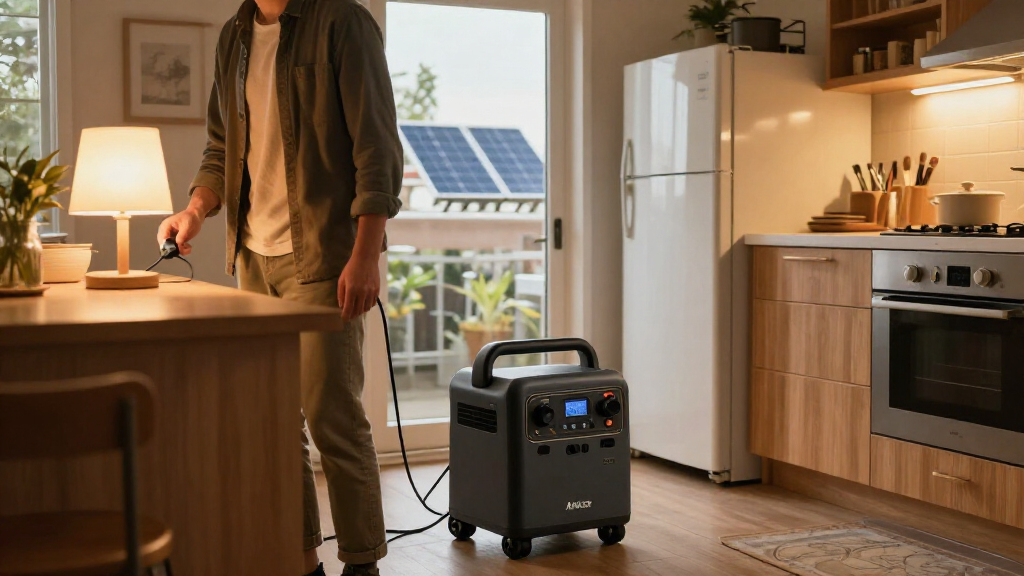
ESS News published a hands-on review of Anker’s Solix S5000, a wheeled power station with 5,024 Wh of LFP storage, after testing a pre-release unit in Northern California. The reviewer measured AC and solar charging and used the unit during a three-day power outage, offering real-world results alongside Anker’s specifications.
The S5000 is rated for 4,500 W of continuous AC output, with a peak output of 8,000 W, and supplies both 120 V and 240 V. Its ports include four NEMA 5-20R outlets, a TT-30R outlet and a 240 V L14-30R outlet. Anker lists a 5-year warranty and a cycle life of 6,000 cycles to 80% capacity, or 10,000 cycles to 60%.
For the review’s AC tests, the reviewer charged the unit from a standard 120 V outlet at two app settings. At 1,800 W, a full charge took 3 hours 40 minutes and drew 6.24 kWh from the wall. At 1,000 W, it took 6 hours 3 minutes and drew 6.13 kWh. The higher setting ran near 1.79 kW for almost three hours before dropping to about 1.43 kW for the final 50 minutes; the reviewer connected that step-down with Anker’s stated limit on high-current charging from 120 V.
The app and display reported less charging energy than the wall meter recorded: 5.91 kWh versus 6.24 kWh at the higher setting, and 5.95 kWh versus 6.13 kWh at the lower setting. The reviewer said the reason for the gap was unclear. In a separate solar test, two Anker Solix PS400 panels produced a peak of 680 W on a sunny October day, against their combined rated output of 800 W. The reviewer said the panels, rather than the S5000’s input, limited the result.
What the outage test can show
The test gives buyers measured performance figures beyond the headline capacity and output ratings. Charging time, wall energy use and the difference between the app reading and an external meter may matter to households deciding how quickly they can refill the unit or estimate the energy used.
The S5000’s 240 V output and 4,500 W continuous rating distinguish it from smaller portable power stations, while its 44 kg (97 lb) weight makes the wheels relevant to moving it around a home. The reviewer’s account of using it through a real outage provides practical evidence, but one household’s experience cannot establish how it will perform with different loads, weather, wiring or outage duration.
Products Worth Considering

Bose SoundLink Flex Bluetooth Speaker (2nd Gen), Portable Waterproof Speaker, Black

Dyson Ball Animal 2 Plus Corded Vacuum

Shark Rocket Pet Plus Corded Stick Vacuum, Bordeaux, HV322
As an affiliate, we earn on qualifying purchases.
From launch to field testing
Anker announced the Solix S5000 on October 9, 2026. The ESS News reviewer tested a pre-release unit in Northern California and focused on charging, usable capacity, idle consumption, portability and outage backup. The review followed the author’s earlier tests of Anker’s Solix E10 and S2000, according to the report.
Anker rates the S5000’s two solar inputs for up to 3,000 W combined, and says the unit can expand to 30 kWh with additional batteries. It also lists AC charging up to 4,500 W from a 240 V source and up to 1,800 W from 120 V. The reviewer tested only 120 V AC charging, not 240 V charging, and used solar panels for the solar test.
“The S5000 is a wheeled power station with 5,024 Wh of LFP storage and a 4,500 W inverter that supplies both 120 V and 240 V.”
— ESS News reviewer
Tests the review did not cover
The supplied review material does not provide the outage’s detailed load profile, the total energy consumed, or a full account of which appliances remained powered throughout the three days. It also does not state the S5000’s measured usable capacity under a controlled discharge test, despite listing usable capacity among the review’s focus areas.
The reviewer did not test 240 V AC charging, the Smart Generator, or vehicle-alternator charging. Anker’s claim that the 240 V outlet can continue supplying power while the unit charges from a 120 V source or generator was also not tested. The review reports that the app and display readings were below the wall-meter readings, but does not identify where that difference arises.
Further testing and availability
The report does not specify when the S5000 will go on sale, its price, or whether the reviewer expects to publish additional test results. Further evaluation would be needed to verify 240 V charging performance, generator and alternator charging, measured usable capacity and the claimed output behavior while charging. Anker’s listed specifications remain manufacturer ratings unless independently tested.
Key Questions
What is the Anker Solix S5000?
It is a wheeled power station with 5,024 Wh of LFP battery storage. Anker rates it for 4,500 W continuous AC output, with both 120 V and 240 V outlets.
How long did 120 V AC charging take in the review?
A full charge took 3 hours 40 minutes at the 1,800 W app setting and 6 hours 3 minutes at the 1,000 W setting. The reviewer measured 6.24 kWh and 6.13 kWh, respectively, at the wall.
How did the solar test perform?
Two Anker Solix PS400 panels, rated for 800 W combined, reached a 680 W peak on a sunny October day. The reviewer said the panels set the limit in that test.
Did the reviewer test 240 V charging?
No. The review tested charging from a standard 120 V outlet and solar, but did not test 240 V AC charging, the Smart Generator or vehicle-alternator charging.
What remains unknown about the outage test?
The available report does not give a detailed load profile or total energy use for the three-day outage, so readers cannot tell from the supplied details exactly which appliances were powered or how much capacity remained.
Source: rss