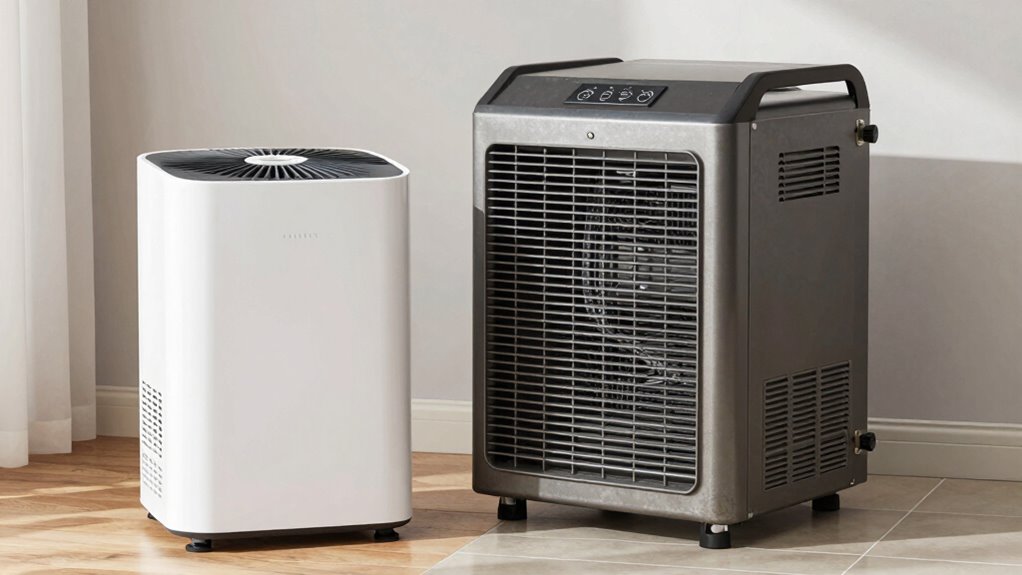

The main difference between residential and commercial dehumidifiers is their size and capacity. Residential models are designed for small spaces like homes or apartments and are easy to operate, offering energy efficiency and lower costs. Commercial units handle larger areas like warehouses or factories, working faster and more effectively, but they consume more power and are pricier. Understanding these differences helps you choose the right dehumidifier for your needs; keep going to get a deeper insight.
Key Takeaways
- Commercial dehumidifiers have higher capacity and faster operation for large spaces, while residential units are suitable for smaller areas.
- Commercial models consume more energy but offer advanced features and greater durability for intensive use.
- Residential units are more affordable, energy-efficient, and easier to operate for everyday moisture control.
- Commercial units include features like variable speed fans and smart controls for optimized performance in large environments.
- The choice depends on space size, moisture levels, budget, and long-term environmental management needs.

Dehumidifiers are vital appliances that help control moisture levels in both residential and commercial spaces, preventing mold growth, reducing allergens, and improving air quality. When choosing between a residential and a commercial dehumidifier, you’ll notice significant differences in size, capacity, and performance. Residential units are designed for smaller spaces like homes, basements, or apartments, while commercial models are built to handle larger areas such as warehouses, factories, or large office buildings. This distinction directly impacts their energy efficiency and cost comparison. Commercial dehumidifiers, with their higher capacity, tend to consume more power, but they also work faster and more effectively in large areas, which can justify the higher energy use depending on your needs. Conversely, residential units are more energy-efficient for small-scale applications, helping you save money on electricity bills over time.
When considering cost comparison, it’s important to look beyond just the initial purchase price. Commercial dehumidifiers often come with a heftier price tag due to their larger capacity, durability, and advanced features. However, if you have a large space that frequently suffers from excess moisture, investing in a commercial model might be more cost-effective in the long run because it can dehumidify more quickly and efficiently, reducing the overall running time and energy consumption. On the other hand, residential dehumidifiers are generally affordable, compact, and easy to operate, making them suitable for everyday use in smaller environments. They typically require less maintenance and have lower operating costs, which helps you keep expenses down. Additionally, understanding the contrast ratio of a dehumidifier can help determine its effectiveness in different humidity levels and lighting conditions, ensuring you select the right model for your space. Recognizing the energy efficiency features of different units can also lead to smarter, more sustainable choices. Moreover, selecting a model with smart controls can further optimize energy use and enhance user convenience.
Incorporating optical drives or other backup solutions can sometimes be relevant for safeguarding data, especially in larger or more sensitive environments, highlighting the importance of reliable equipment. Energy efficiency plays a vital role in your decision-making process. Commercial dehumidifiers often include features like variable speed fans, automatic shut-off, and intelligent humidity controls, which can optimize power usage. While they may use more energy overall, these features help guarantee they operate only when necessary, preventing unnecessary power drain. Residential models, although smaller, are still designed to be energy-efficient, often with built-in humidistats to maintain consistent moisture levels without wasting electricity. When comparing the two, consider your space, moisture problems, and budget. If you need a solution for a large commercial space, the higher initial investment may be offset by better performance and lower energy costs over time. For smaller, personal spaces, a residential dehumidifier offers a more budget-friendly, energy-efficient choice that keeps your environment comfortable without breaking the bank. Additionally, understanding humidity control principles can help you select the most suitable model for maintaining optimal indoor conditions.

Airecoler 70 Pints Energy Star Commercial Dehumidifier with Pump, Portable Crawl Space Dehumidifiers for Basement and Home, Built-in Remote Control, Auto Defrost | Airecoler Stellar SP10
- High Moisture Removal: Removes up to 70 pints daily
- Energy Efficient: Energy Star certified for savings
- Suitable for Large Spaces: Covers up to 1,000 sq ft
As an affiliate, we earn on qualifying purchases.
As an affiliate, we earn on qualifying purchases.
Frequently Asked Questions
How Long Do Residential Dehumidifiers Typically Last?
You can expect your residential dehumidifier to last around 5 to 10 years with proper maintenance. Regular dehumidifier maintenance, like cleaning filters and checking for leaks, helps extend its lifespan. Compared to commercial units, residential dehumidifiers generally have a shorter lifespan, but diligent upkeep can make a significant difference. Keep an eye on performance and perform routine maintenance to maximize your appliance’s longevity and efficiency.
Are Commercial Dehumidifiers Quieter Than Residential Models?
Commercial dehumidifiers are generally louder than residential models due to their larger size and higher capacity, which can produce more noise during operation. If noise levels are a concern, residential units tend to be quieter. Additionally, commercial dehumidifiers often have higher operating costs because they’re built for continuous, heavy-duty use. You should consider both noise and operating costs when choosing the right dehumidifier for your space.
Can Both Types Be Used in Basements?
Yes, both residential and commercial dehumidifiers can be used in basements for effective humidity control. They help reduce basement moisture, preventing mold and musty odors. Choose a unit with the right capacity for your space to guarantee ideal humidity levels. Commercial models often handle larger areas and higher moisture levels better, but residential units can work well in smaller or less damp basements.
What Are the Energy Consumption Differences?
Power consumption primarily drives energy efficiency differences between residential and commercial dehumidifiers. Commercial models tend to consume more energy because they are designed to handle larger spaces and higher humidity loads, but they often operate more efficiently at scale. Residential dehumidifiers use less power, making them more energy-efficient for small spaces. If you prioritize energy savings, choose a model suited to your space, balancing power consumption with effective dehumidification.
Do They Require Professional Installation?
You generally don’t need a professional for installation, but the complexity varies. Residential dehumidifiers are usually simple to set up, often requiring just a power connection and basic placement. Commercial units, on the other hand, may involve more complex installation due to larger size, ventilation needs, and integration into existing systems. Maintenance requirements also differ; commercial models often demand regular professional servicing, while residential units are typically easier to maintain yourself.

Airzentti 155 Pint Commercial Dehumidifier with Pump and Drain, Energy Star
- High Capacity Moisture Removal: Removes up to 155 pints daily
- Large Coverage Area: Suitable for spaces up to 7,500 sq ft
- Versatile Application: Ideal for basements, attics, and large rooms
As an affiliate, we earn on qualifying purchases.
As an affiliate, we earn on qualifying purchases.
Conclusion
Whether you choose a residential or commercial dehumidifier, understanding their differences helps you make the right call. But here’s the question—are you truly prepared for what’s lurking behind the moisture? The right dehumidifier can protect your space, but only if you recognize what’s at stake. Don’t settle for less; the decision could impact more than just comfort. Are you ready to uncover what’s really hiding in the humidity? The choice is yours.

BANABIE 2500 Sq.Ft Dehumidifier for Basement, 32 Pint Dehumidifiers for Home with Drain Hose, Ultra Quiet 32dB, Smart Humidity Control, 24H Timer, Energy Efficient, Portable for Bedroom, Bathroom, RV
- Coverage Area: Covers up to 2,500 sq ft
- Moisture Removal: Removes 32 pints daily
- Drainage Options: Includes hose and tank options
As an affiliate, we earn on qualifying purchases.
As an affiliate, we earn on qualifying purchases.

ALORAIR Commercial Dehumidifier with Pump, Up to 180 PPD (Saturation), 85 PPD at AHAM, 6 Years Limited Warranty, LGR Industrial Dehumidifier for Flood Repair, Crawlspace and Basement Drying
- High Airflow for Fast Drying: 210 CFM for efficient moisture removal
- High Capacity Water Removal: Up to 180 pints/day at saturation
- Compact Size for Tight Spaces: 22.8×13.7×17.3 inches design
As an affiliate, we earn on qualifying purchases.
As an affiliate, we earn on qualifying purchases.