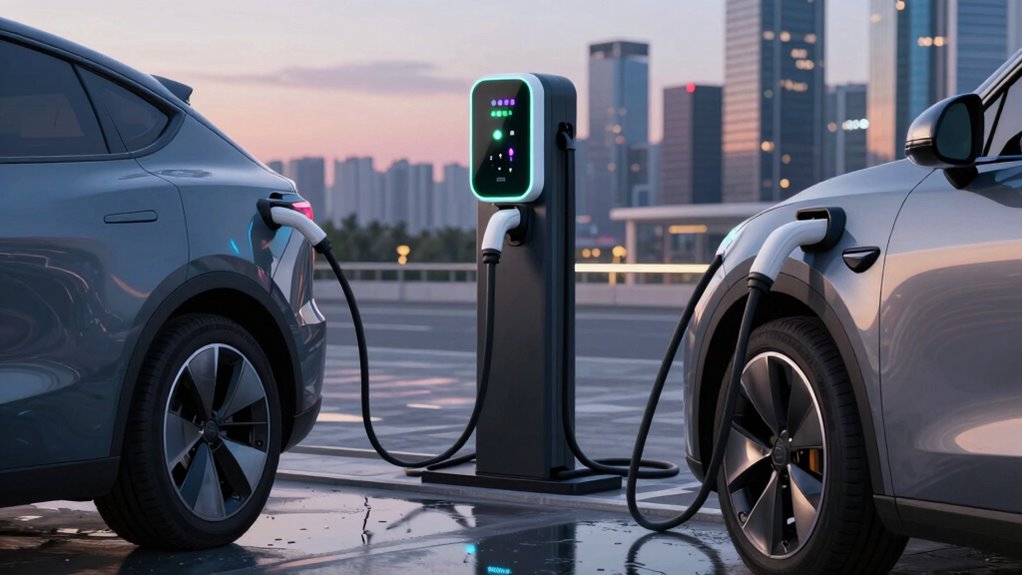

Power sharing in EV charging helps you charge two vehicles efficiently from a single power source, preventing overloads and ensuring both get adequate charge. It monitors battery statuses, adjusts current flow, and manages energy to maximize charging speed and lifespan. Smart systems automatically allocate power based on needs, reducing waste and preventing damage. If you’re interested, there’s more to discover about how these systems enhance safety, efficiency, and performance in multi-vehicle charging setups.

Get backup power and energy gear delivered free — and shop member deals
- Fast, free delivery on millions of items
- Access to Prime Big Deal Days deals on October 6–7
- Prime Video, Amazon Music and more included
Key Takeaways
- Balances power distribution to prevent overloading and ensure both vehicles are charged efficiently.
- Optimizes charging times by dynamically reallocating energy based on each vehicle’s needs.
- Protects batteries from damage caused by uneven or excessive charging currents.
- Enhances system reliability by managing peak loads and avoiding power surges.
- Enables safe, quick, and long-lasting charging sessions for multiple EVs from a single source.

Have you ever wondered how to efficiently share power between two electric vehicles charging from a single source? It’s a common challenge, especially as EV adoption rises and charging stations become more in demand. The two-car charging problem power sharing provides a solution that guarantees both vehicles get charged effectively without wasting energy or risking damage to the batteries. By managing how power is distributed, you can maximize battery health and enhance charging efficiency, making the process smoother and more reliable.
Efficiently sharing power between two EVs enhances battery health, speeds up charging, and prevents energy waste.
When you’re dealing with two EVs connected to one power supply, it’s essential to prioritize battery optimization. This means adjusting the charging process to prevent overcharging or rapid fluctuations that could deteriorate the batteries over time. Power sharing algorithms are designed to monitor each vehicle’s battery status constantly, adjusting the flow of electricity based on real-time data. This ensures that both vehicles receive the right amount of current to maintain ideal battery health, extending their lifespan and improving overall performance.
Charging efficiency is also a critical aspect of this process. Instead of having one car fully charged while the other waits, smart power sharing distributes energy based on each vehicle’s needs and the available power. This prevents unnecessary energy loss and reduces charging times. When you’re using a well-designed power sharing system, you’ll notice that both vehicles charge more quickly and with less wasted energy. That’s because the system dynamically reallocates power, reducing idle periods and ensuring the energy from the single source is used in the most effective way possible. Additionally, integrating smart controllers can further optimize the process by adapting to changing conditions in real time. Incorporating energy management systems can also help in balancing load and maintaining system stability. Furthermore, understanding the importance of power distribution helps in designing more efficient charging setups that can handle multiple vehicles simultaneously. Proper power management not only improves efficiency but also protects the electrical infrastructure from potential overloads.
Implementing the two-car charging power sharing system isn’t just about convenience; it’s about making your charging setup smarter. It enables you to get the most out of your energy source, whether it’s a home charger or a public station. You won’t have to worry about uneven charging or overloading the system, as smart controllers handle the complexities behind the scenes. These systems also help in managing peak loads, preventing costly power surges, and maintaining a steady flow that’s safe for your batteries and electrical infrastructure.
In essence, the two-car charging problem power sharing is a practical solution that enhances both battery optimization and charging efficiency. It allows you to charge two vehicles from a single source quickly, safely, and in a way that preserves your batteries’ longevity. By understanding and applying these principles, you guarantee smoother, more efficient charging sessions that benefit your vehicles and your energy system alike.
EV dual charger power sharing system
As an affiliate, we earn on qualifying purchases.
As an affiliate, we earn on qualifying purchases.
Frequently Asked Questions
How Does Power Sharing Impact Battery Lifespan?
Power sharing helps extend your battery lifespan by reducing battery degradation caused by uneven charging. When you distribute power efficiently between cars, charging efficiency improves, meaning less strain on each battery. This balanced approach prevents overheating and minimizes wear over time. As a result, your batteries stay healthier longer, saving you money on replacements and ensuring consistent performance. Proper power sharing is essential for maintaining ideal battery longevity and overall vehicle reliability.
Can Power Sharing Be Automated or Does It Require Manual Intervention?
You can automate power sharing with advanced control systems that monitor battery levels and adjust charging rates in real time. For example, a smart charging station for two cars might automatically balance power based on each vehicle’s needs, eliminating manual adjustments. This automated control guarantees efficiency and convenience, freeing you from constantly monitoring and manually adjusting settings. However, manual adjustment remains an option if you prefer direct control over the process.
What Are the Safety Considerations for Power Sharing Between Cars?
You need to prioritize fire safety and adhere to electrical standards when sharing power between cars. Guarantee the charging system includes proper circuit protection, such as fuses and circuit breakers, to prevent overheating or electrical faults. Regularly inspect cables and connectors for damage, and use certified equipment. Following safety protocols reduces risks, prevents electrical fires, and guarantees safe, efficient power sharing between vehicles.
How Does Charging Speed Vary With Different Power Sharing Strategies?
Think of power sharing as a dance, where each car’s charging speed depends on the rhythm of power distribution. When you allocate more power to one vehicle, its charging efficiency accelerates, but the other slows down. Balanced strategies create a harmonious flow, optimizing overall charging speed. Adjusting how power is divided directly influences charging rates, making the dance smoother or more staggered depending on your sharing approach.
Is Special Hardware Needed for Implementing Power Sharing in Vehicles?
You don’t need special hardware for power sharing in vehicles if you use wireless transfer and voltage regulation. Wireless transfer allows energy to flow without physical connectors, simplifying the setup, while voltage regulation manages the power levels to guarantee safe and efficient charging. This approach minimizes the need for complex, dedicated hardware, making it easier to implement and adapt in various vehicle models, enhancing flexibility and convenience.
smart EV charging station for two cars
As an affiliate, we earn on qualifying purchases.
As an affiliate, we earn on qualifying purchases.
Conclusion
By implementing power sharing strategies for the two-car charging problem, you can optimize energy distribution and reduce charging time. Notably, studies show that shared charging systems can boost efficiency by up to 30%, meaning your vehicles get charged faster and more reliably. This innovation not only saves you time but also enhances energy use, making your charging experience smarter and more sustainable. Embrace power sharing, and take a step toward a more efficient electric future.
home EV charger with load balancing
As an affiliate, we earn on qualifying purchases.
As an affiliate, we earn on qualifying purchases.
multi-vehicle EV charging controller
As an affiliate, we earn on qualifying purchases.
As an affiliate, we earn on qualifying purchases.
Halloween Picks
halloween
As an affiliate, we earn on qualifying purchases.