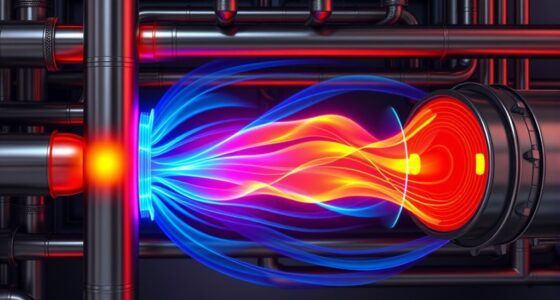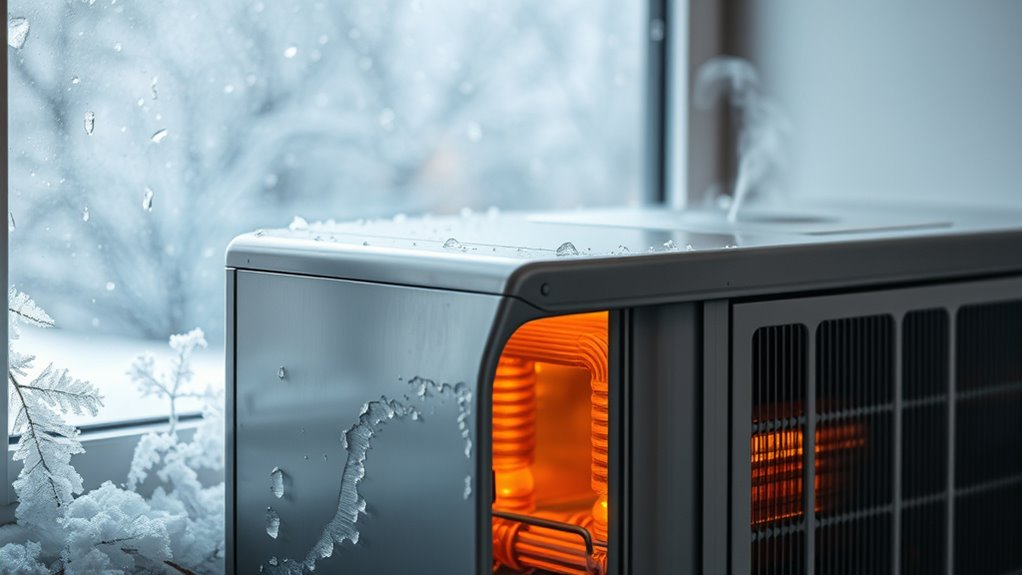

In heat pump operation, entropy and the Second Law of Thermodynamics explain why energy conversions can never be perfectly efficient. As the refrigerant cycles through compression, condensation, expansion, and evaporation, entropy increases, which leads to energy losses as waste heat. This natural increase limits how effectively a heat pump transfers heat. Understanding these principles helps you see why some energy always dissipates, and there’s a limit to system efficiency—if you explore further, you’ll see how specialists work to minimize these effects.
Key Takeaways
- Entropy increases during refrigerant phase changes and heat transfer, reflecting irreversibilities in the heat pump cycle.
- The Second Law limits heat pump efficiency by dictating unavoidable entropy production and energy dissipation as waste heat.
- Compression and expansion processes cause entropy changes that influence the system’s temperature and performance.
- Managing entropy production through improved components reduces irreversibilities, enhancing overall efficiency.
- Thermodynamic principles guide system design, emphasizing the fundamental limits imposed by entropy and the Second Law.

Understanding how entropy and the Second Law of Thermodynamics govern heat pump operation is essential for grasping their efficiency and limitations. At the core of a heat pump’s functioning lies the refrigerant cycle, which transfers heat from one place to another. This cycle involves compressing, condensing, expanding, and evaporating a refrigerant fluid, enabling the system to move heat against its natural flow. The Second Law of Thermodynamics states that entropy, or disorder, tends to increase in any real process. In a heat pump, this principle means that some energy is always lost as waste heat, limiting the maximum achievable efficiency. You can’t convert all the input energy into useful heat transfer; instead, a portion inevitably dissipates, emphasizing the importance of optimizing the refrigerant cycle for better energy efficiency.
The refrigerant cycle leverages the principles of thermodynamics to transfer heat efficiently. When the refrigerant evaporates in the indoor coil, it absorbs heat from the indoor environment, even if it’s cold outside. Then, as it compresses, the refrigerant’s temperature rises, allowing it to release heat to the outdoor environment when condensed. This cycle repeats continuously, and the system’s effectiveness depends heavily on how well it manages these phase changes and temperature differences. Because entropy increases during this process, some energy inevitably escapes as waste heat, which is why heat pumps cannot achieve 100% efficiency. Instead, their energy efficiency hinges on how well they minimize these losses and maximize heat transfer within the bounds set by thermodynamics.
You should recognize that the laws governing entropy influence not only the theoretical limits but also the practical performance of heat pumps. For example, as the refrigerant absorbs and releases heat, entropy increases, and some energy becomes unavailable for useful work. This is why even high-efficiency heat pumps require electrical input and why improvements focus on reducing irreversibilities within the refrigerant cycle. Enhanced compressor designs, better heat exchangers, and optimized expansion valves help manage entropy production, improving energy efficiency. However, no matter how advanced the technology, the Second Law reminds you that a certain amount of energy will always be lost as heat, defining the ultimate limits of heat pump performance. Recognizing the impact of natural energy flow can guide better system design and efficiency improvements.

Rinnai REHP65 Electric Heat Pump Water Heater‚ 65 Gallon, 240V, 30A, Energy Star Certified, 3.90 UEF, 80 Gallon First Hour Delivery for Residential Use
Energy-efficient performance: Energy Star Certified. Extracts heat from ambient air to deliver consistent hot water with zero emissions…
As an affiliate, we earn on qualifying purchases.
As an affiliate, we earn on qualifying purchases.
Frequently Asked Questions
How Does Entropy Affect Heat Pump Efficiency Over Time?
Entropy management directly impacts your heat pump’s efficiency over time. As system irreversibility increases, entropy rises, causing energy losses and reducing performance. You can mitigate this by maintaining and optimizing components, reducing friction, and preventing leaks. Properly managing entropy helps sustain efficiency, ensuring your heat pump operates smoothly longer. Ignoring these factors leads to greater irreversibility, more entropy, and a noticeable decline in system effectiveness over time.
Can Entropy Decrease Locally Within a Heat Pump System?
Yes, you can achieve a local decrease in entropy within a heat pump system. While the Second Law states entropy tends to increase overall, systems like heat pumps can experience entropy reduction locally through processes such as compression and refrigeration. This local decrease in entropy enables the system to transfer heat efficiently, highlighting the contrast between inevitable universal trends and targeted, manageable reductions within specific parts of the system.
What Role Does Entropy Play in Heat Pump Refrigerant Cycles?
Entropy plays a vital role in your heat pump refrigerant cycle by driving refrigerant phase changes and facilitating entropy transfer. As the refrigerant absorbs heat, it increases in entropy during evaporation, and as it releases heat during condensation, entropy decreases. This transfer ensures the refrigerant moves efficiently through the cycle, enabling heat exchange. You can optimize performance by understanding how entropy shifts during these phase changes, improving overall heat pump efficiency.
How Is Entropy Generation Minimized in Heat Pump Design?
While subtle, effective entropy management is key to system enhancement. You minimize entropy generation by designing components with smooth, efficient heat exchanges, reducing irreversibilities. Using high-quality refrigerants and maintaining ideal operating conditions also help. Careful control of pressure and temperature gradients ensures the system runs seamlessly, lowering entropy production. These strategies subtly enhance performance, ensuring your heat pump operates efficiently, conserving energy, and extending its lifespan.
Does Entropy Influence the Environmental Impact of Heat Pumps?
Yes, entropy influences the environmental impact of heat pumps by contributing to entropy pollution, which increases their environmental footprint. When heat pumps operate efficiently, they generate less entropy pollution, reducing negative effects on the environment. You can lower the environmental footprint by choosing models with high efficiency, as these minimize unnecessary entropy generation, leading to less pollution and a more sustainable operation overall.

Quick Guide to the Refrigeration Cycle, Refrigerants, and Components
As an affiliate, we earn on qualifying purchases.
As an affiliate, we earn on qualifying purchases.
Conclusion
By understanding entropy and the second law, you unveil the secret to heat pumps working like unstoppable energy wizards. Imagine controlling the universe’s most chaotic dance, turning disorder into cozy warmth with a flick of a switch. Every cycle you operate isn’t just a process—it’s a symphony of nature’s deepest laws, transforming chaos into comfort. Embrace this knowledge, and you’ll wield the power to tame the wildest thermodynamic beasts.

Air Compressor Pump Head, 3HP 2.2KW Oil Lubricated Air Compressor Piston Pump Head 250L/min 2065-3HP Piston Air Compressor Pump Head Motor Twin Cylinder Cast Iron
Powerful Function – It can be matched with 3HP engines, with an exhaust capacity of up to 66Gal/min,…
As an affiliate, we earn on qualifying purchases.
As an affiliate, we earn on qualifying purchases.

XAXAX Heat Exchanger, 1.5 Condenser of Heat Pump Water Heater is Also Matching 1/3 R404a Or R290 Low Temperature Freezers Or Air Conditioners for Floor Heating, Water Heating, Snow Melting
Coaxial Tube Coils are designed for use as Water Cooled Condensers, Water Chillers and in Water Source Heat…
As an affiliate, we earn on qualifying purchases.
As an affiliate, we earn on qualifying purchases.