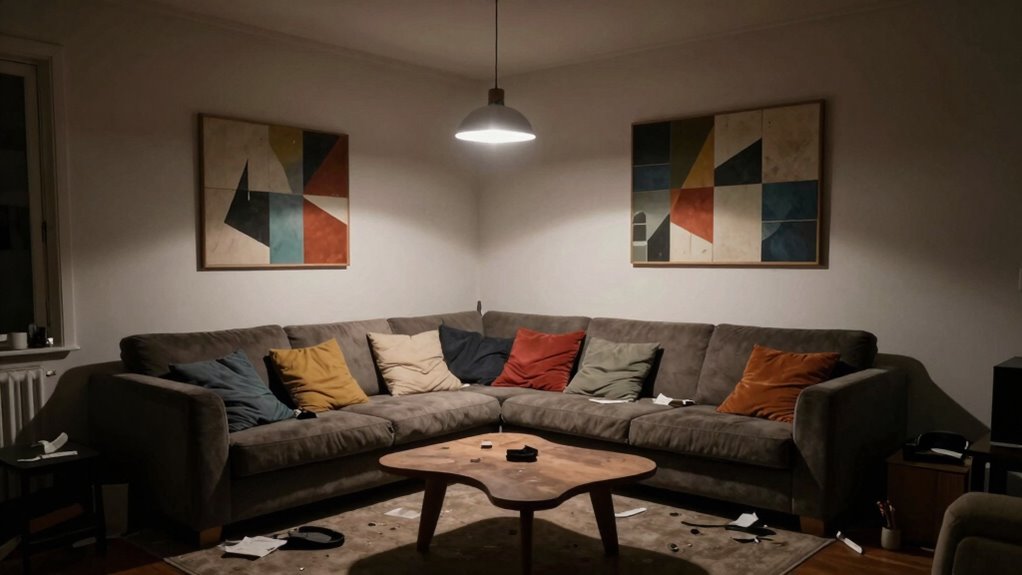

Radiant asymmetry in a room disrupts your usual sense of balance and harmony, making the space feel unsettling. When everything is irregularly arranged or unevenly colored, your subconscious senses chaos and discomfort. Without symmetry, the space challenges your brain’s natural pattern recognition, leading to feelings of disorientation and unease. If you want to understand exactly how these design choices influence your emotional response, keep exploring how balance and harmony affect your environment.

Get backup power and energy gear delivered free with Prime
- Fast, free delivery on millions of items
- Prime Video, Amazon Music and more included
- Member-only deals all year
Key Takeaways
- Radiant asymmetry disrupts visual harmony, causing subconscious discomfort and a sense of chaos in the room.
- Uneven color distribution in asymmetric designs heightens feelings of imbalance and disorientation.
- Irregular furniture placement hampers natural movement and reduces overall spatial stability.
- Lack of clear focal points in asymmetric layouts increases confusion and distracts the eye.
- Disrupted balance in design elements prevents the brain from recognizing patterns, leading to unease.

When a room features radiant asymmetry—where elements are unevenly balanced or deliberately irregular—it can create a sense of discomfort that’s hard to ignore. Your eyes are naturally drawn to symmetry and order, so when things are intentionally off-kilter, it can unsettle your perception. This imbalance often affects how you experience the space, making it feel less welcoming and more chaotic. One key factor that influences this feeling is color balance. If the colors in your room don’t harmonize or are unevenly distributed, your mind perceives a lack of cohesion. Bright, bold hues scattered unpredictably can draw attention away from the room’s overall ambiance, heightening that sense of discomfort. Conversely, if the color palette is unevenly applied—like a vibrant wall on one side with muted tones on the other—it emphasizes the irregularity, making the asymmetry feel more pronounced and unsettling. Additionally, our subconscious response to visual harmony** plays a significant role in how we perceive spatial comfort, further intensifying these feelings when harmony is disrupted. Moreover, our innate preference for spatial balance influences how we interpret and respond to irregular arrangements, often leading to feelings of disorientation. Furniture placement plays an equally critical role. When furniture is arranged asymmetrically, especially without a clear focal point or logical flow, it can disrupt your natural movements and sense of orientation. Imagine walking into a room where a sofa is pushed against one wall but no other furniture mirrors that balance; instead, chairs are scattered haphazardly across the space. Your brain struggles to find a pattern or rhythm, which heightens your discomfort. The placement of larger pieces, in particular, should ideally guide your eye and create visual stability, but when they’re positioned unevenly or without regard to the room’s overall layout, it makes the space feel disjointed. This irregularity in furniture placement can also hinder functionality, forcing you to navigate awkwardly around the room, further amplifying that uneasy feeling. In essence, the combination of color imbalance and erratic furniture placement contributes markedly to the discomfort associated with radiant asymmetry. You might find yourself constantly adjusting your gaze or feeling unsettled, even if you can’t immediately pinpoint why. These design choices interrupt the natural flow and harmony that your brain craves in a space. When you lean into symmetry and balance—whether through carefully coordinated color schemes or thoughtfully arranged furniture—you restore a sense of stability. But when asymmetry is radiantly intentional and left unbalanced**, it can evoke a subconscious feeling of unease, making the room feel less like a sanctuary and more like a space that challenges your comfort.
As an affiliate, we earn on qualifying purchases.
Frequently Asked Questions
How Does Symmetry Influence Our Perception of Comfort in a Room?
Symmetry enhances your perception of comfort in a room by creating visual harmony and a sense of order. When elements are balanced and mirror each other, your mind finds it easier to process the space, making it feel more inviting. You’re naturally drawn to spatial balance, which reduces visual tension and promotes relaxation. Conversely, asymmetry can disturb this harmony, making the room feel unsettling or less welcoming.
Can Intentional Asymmetry Create a Cozy or Inviting Atmosphere?
You can turn asymmetry into a cozy embrace by playing with balance illusions, creating a visual dance that feels inviting rather than chaotic. Intentional asymmetry introduces subtle visual dissonance, making your space feel alive and dynamic. It’s like a perfectly imperfect melody, where uneven elements spark curiosity and warmth. By thoughtfully balancing these elements, you craft an environment that feels relaxed, welcoming, and uniquely yours—an oasis of comfort amid visual intrigue.
Are There Psychological Reasons Why Asymmetry Feels Unsettling?
Yes, there are psychological reasons why asymmetry can feel unsettling. You might experience visual imbalance, where your brain struggles to process the uneven arrangement, creating a sense of discomfort. This triggers cognitive dissonance, as your mind expects harmony but encounters chaos. As a result, asymmetry can evoke unease because your subconscious perceives it as a sign of disorder or instability, making spaces feel less inviting or even unsettling.
How Does Lighting Interact With Asymmetrical Room Designs?
Lighting interacts with asymmetrical room designs by highlighting contrast and emphasizing focal imbalance. When you use lighting contrast strategically, it accentuates the uneven elements, making the imbalance more noticeable. This can make the space feel unsettling because your eye is drawn to areas of stark difference instead of balance. To create harmony, consider balancing lighting across the room, softening focal imbalance and making the overall space feel more comfortable and inviting.
What Are Common Mistakes When Designing With Asymmetry?
You might think asymmetry naturally creates visual tension, but a common mistake is ignoring balance and harmony. When you neglect these, the room feels chaotic instead of dynamic. Avoid uneven furniture placement or mismatched decor that disrupts flow. Instead, intentionally use asymmetry to generate interest, ensuring elements complement each other. Focus on maintaining a sense of equilibrium so that the visual tension enhances, rather than detracts from, the overall design.
irregular furniture arrangement decor
As an affiliate, we earn on qualifying purchases.
As an affiliate, we earn on qualifying purchases.
Conclusion
Just like a symphony thrives on harmonious balance, your room’s comfort hinges on symmetry. Radiant asymmetry, though intriguing, risks turning your space into a discordant melody that unsettles your senses. Imagine walking into a garden where every flower is perfectly aligned—your eyes find peace. Keep this in mind: symmetry is the steady beat that keeps your room serene, while imbalance creates a dissonant tune. Embrace harmony to foster comfort and calm in your space.
As an affiliate, we earn on qualifying purchases.
disruptive visual balance room accessories
As an affiliate, we earn on qualifying purchases.
As an affiliate, we earn on qualifying purchases.
Halloween Picks
halloween
As an affiliate, we earn on qualifying purchases.