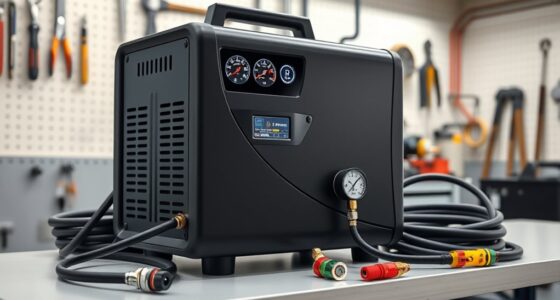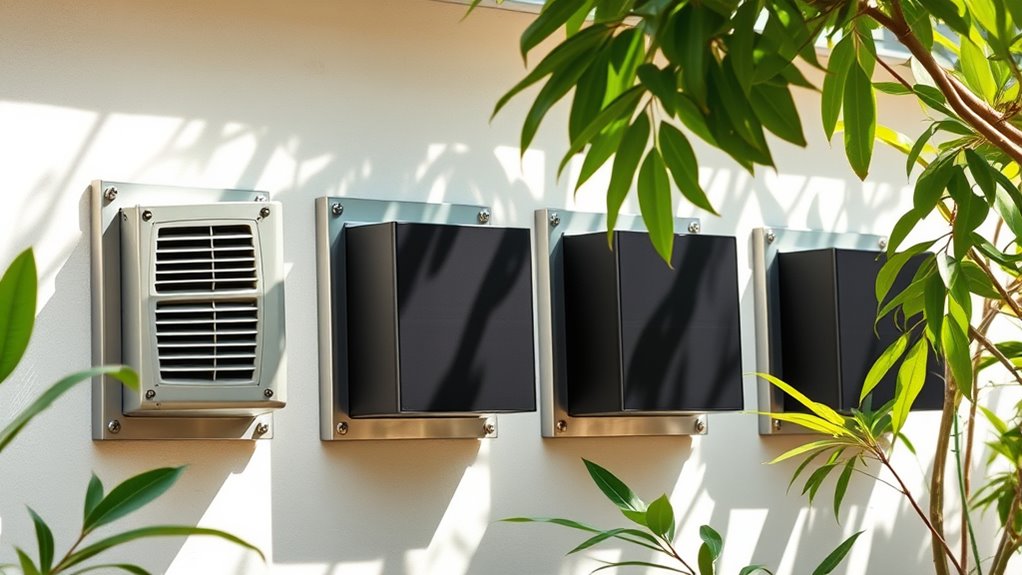

If you’re looking for the best ERVs for humid climates in 2025, I recommend the Tjernlund V4D UnderAire, which is compact and effective at moisture control. The 90 CFM energy recovery ventilator offers reliable airflow and energy savings, while the Total Recovery Premium ERV handles larger spaces with advanced moisture transfer. The Aprilaire V22BEC is great for big homes and high humidity. Keep exploring to find out which system fits your needs perfectly.
Key Takeaways
- Look for ERVs with high moisture transfer ratios and moisture-resistant core materials to prevent condensation and mold in humid climates.
- Choose units with adjustable dehumidistats and airflow controls to maintain indoor humidity between 30-50%.
- Select models with total or high-efficiency recovery cores that excel in handling humidity extremes and reduce energy costs.
- Ensure the ERV has versatile installation options and easy maintenance for reliable performance in humid environments.
- Prioritize units with certifications like HVI or SEER to guarantee energy efficiency and effective moisture management.
Tjernlund – V4D UnderAire Moisture Reducing Crawlspace Ventilator Fan
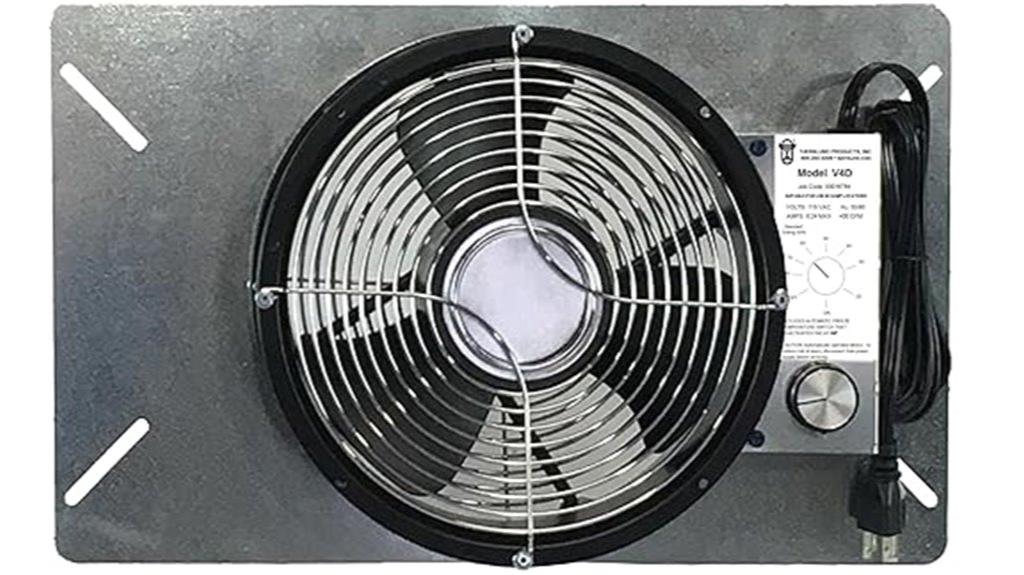
If you’re looking to reduce moisture in your crawlspace effectively, the Tjernlund V4D UnderAire Moisture Reducing Crawlspace Ventilator Fan is an excellent choice. Its compact size (18 x 11 x 4 inches) fits well under most homes, and you can trim it to 12 1/2” x 10 1/2” for a custom fit. The fan connects easily through existing passive vents, circulating fresh outdoor air underneath. It features an adjustable dehumidistat and freeze protection, ensuring ideal operation in various conditions. With a powerful airflow of 540 CFM powered by a 120-volt motor, it helps considerably reduce moisture buildup and improve your crawlspace’s overall air quality.
Best For: homeowners seeking an effective moisture control solution for their crawlspaces to prevent mold, mildew, and structural damage.
Pros:
- Compact and trimmable design allows for a customized fit under most homes.
- Includes adjustable dehumidistat and freeze protection for versatile operation.
- High airflow capacity of 540 CFM effectively reduces moisture buildup.
Cons:
- Requires existing passive vents for installation, limiting use in sealed or ventless crawlspaces.
- May need professional installation for optimal placement and wiring.
- Power consumption at 0.24 amps may contribute to higher energy use over time.
Energy Recovery Ventilator (90 CFM)

The Energy Recovery Ventilator (90 CFM) stands out as an ideal choice for homeowners seeking reliable indoor air quality improvement in humid climates. It efficiently exchanges stale indoor air with fresh outdoor air through a high-quality energy exchange core, offering total recovery (TR) for all climates. This feature moderates temperature and humidity extremes, creating a comfortable indoor environment. Its large core size ensures high efficiency, with no condensate pan or drain needed. Equipped with MERV-8 filters and low standby power consumption, it’s easy to install using integral mounting flanges or hanging brackets. Overall, it provides dependable, energy-efficient ventilation tailored for humid conditions.
Best For: homeowners in humid climates seeking reliable, energy-efficient ventilation to improve indoor air quality and maintain comfortable living environments.
Pros:
- Efficient air exchange with total recovery (TR) suitable for all climates
- No condensate pan or drain needed, reducing maintenance and installation complexity
- Low power consumption (<1 watt standby) and easy installation options with integral flanges and brackets
Cons:
- Limited to 90 CFM airflow, which may not suit larger or multi-zone homes
- Requires proper ducting and installation space, possibly challenging in retrofit situations
- Only available from July 2, 2025, which may delay procurement or installation plans
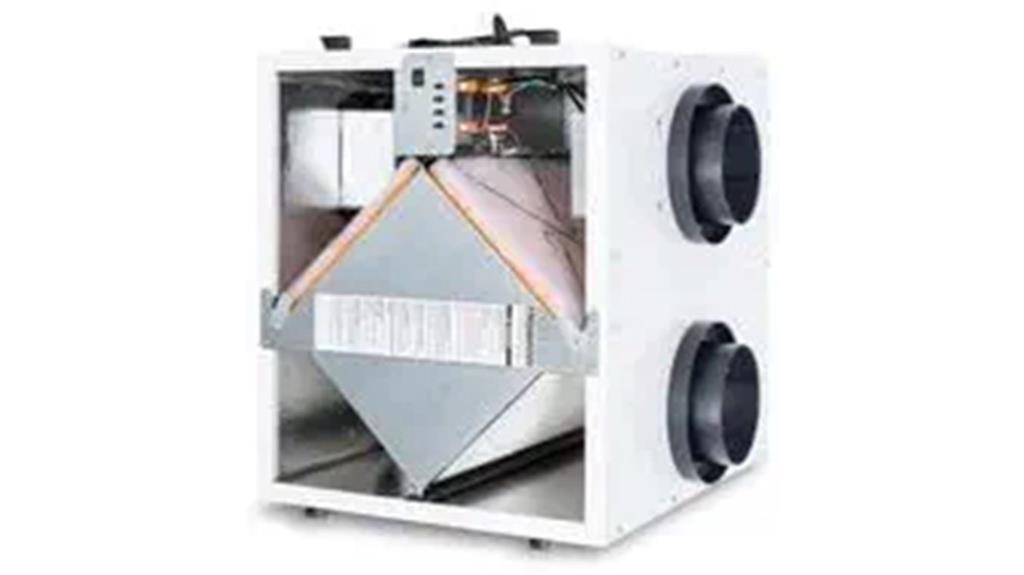
Designed for flexibility and efficiency, the Total Recovery Premium Energy Recovery Ventilator with Line Cord (30-225 CFM) stands out as an ideal choice for humid climates, thanks to its advanced heat and humidity transfer core. This ERV uses a multi-layered resin plate core that efficiently transfers heat and moisture without mixing or contamination, improving indoor air quality. Its versatile design allows for various mounting orientations, and features like Dial-A-Flow enable precise airflow adjustments. With variable speed operation, it balances continuous low-speed ventilation and boost modes, offering customizable airflow. Overall, this unit combines performance, adaptability, and energy savings, making it a top pick for humid environments.
Best For: homeowners and building managers in humid climates seeking energy-efficient ventilation and superior indoor air quality.
Pros:
- Highly effective heat and humidity transfer core for optimized indoor comfort
- Flexible mounting options and adjustable airflow with Dial-A-Flow system
- Variable speed operation allows customization for continuous or boost ventilation
Cons:
- First availability scheduled for July 2, 2025, which may delay immediate purchase
- Warranty details require inquiry, potentially complicating post-sale support
- Price and availability monitoring may lead to fluctuations in market pricing
Aprilaire V22BEC Energy Recovery Ventilator (ERV)
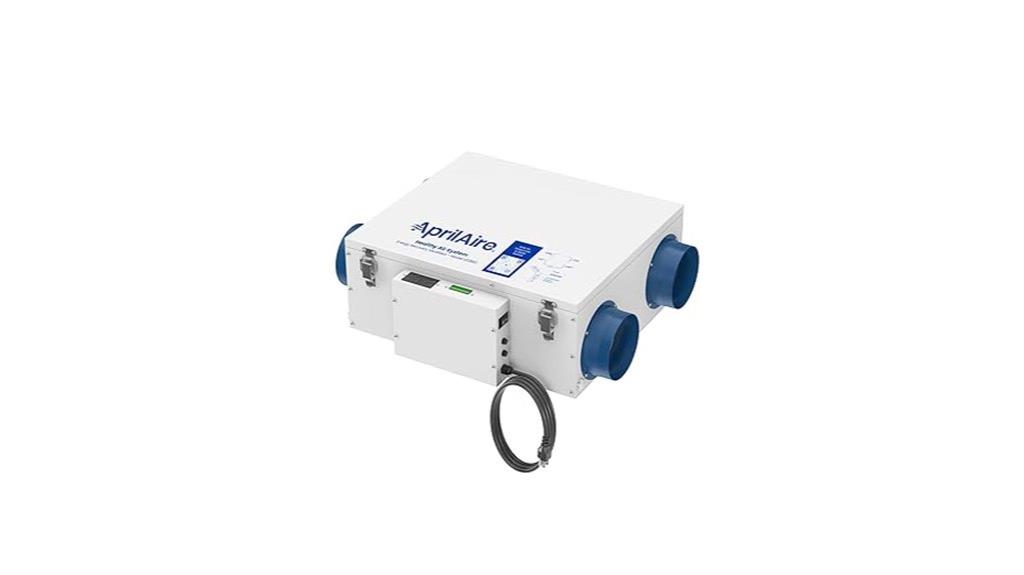
The Aprilaire V22BEC Energy Recovery Ventilator (ERV) stands out for its capacity to service large homes up to 6,000 square feet with 120 CFM airflow, making it ideal for those needing effective whole-house ventilation. It’s versatile, mounting easily on walls, ceilings, or floors with included brackets. It improves indoor air quality by replacing stale air with fresh outdoor air, reducing odors, humidity, and pollutants. Its energy recovery core tempers incoming air by exchanging heat and moisture, helping lower heating and cooling costs. Simple push-button controls make operation straightforward, ensuring balanced ventilation and climate control for a healthier, more comfortable home year-round.
Best For: homeowners with large properties up to 6,000 sq. ft. seeking an energy-efficient, whole-house ventilation solution that improves indoor air quality and maintains comfort year-round.
Pros:
- Provides high airflow capacity of 120 CFM suitable for large homes
- Easy to install on walls, ceilings, or floors with included brackets
- Enhances indoor air quality by reducing odors, humidity, and pollutants
Cons:
- May require professional installation for optimal setup
- Limited to 120 CFM airflow, which might not suit smaller or highly airtight homes
- Controls are basic push-button, which might lack advanced customization options
Factors to Consider When Choosing Energy Recovery Ventilators for Humid Climates
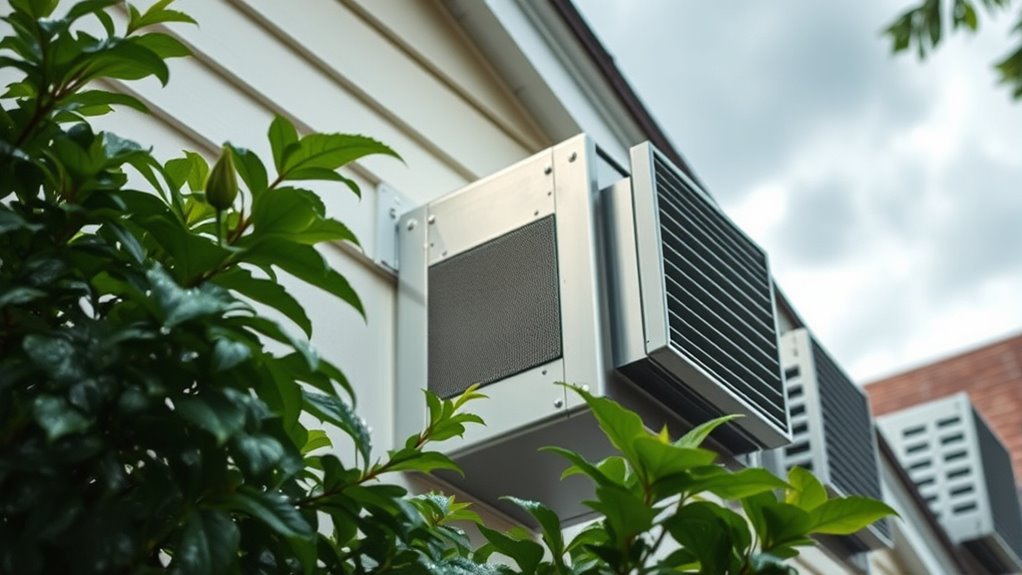
When choosing an energy recovery ventilator for humid climates, I focus on humidity control capabilities and core moisture transfer to prevent mold growth. I also consider ventilation capacity to meet my home’s needs and look for climate-specific features that enhance performance. Finally, I pay attention to energy efficiency ratings to make sure I get effective ventilation without high running costs.
Humidity Control Capabilities
In humid climates, controlling indoor humidity is essential for comfort and health, and choosing an energy recovery ventilator (ERV) with strong moisture transfer capabilities can make a considerable difference. ERVs with high moisture transfer ratios effectively exchange moisture between incoming and outgoing air streams, preventing excess humidity buildup. Selecting an ERV that matches your home’s humidity levels ensures ideal dehumidification without over-drying indoor air. Proper moisture transfer performance also reduces the risk of condensation and mold growth within the system and surrounding structures. Features like moisture transfer cores made from engineered resins or high-efficiency materials greatly enhance an ERV’s ability to regulate humidity. Maintaining indoor relative humidity between 30-50% becomes easier, promoting a healthier, more comfortable living environment in humid climates.
Core Moisture Transfer
Choosing an energy recovery ventilator (ERV) with an effective core is essential for humid climates, where excess moisture can cause problems like mold and condensation. The core’s moisture transfer capability is key to managing indoor humidity levels, preventing these issues. Advanced cores with engineered resin plates facilitate efficient heat and humidity exchange while keeping air streams separate, maintaining indoor comfort. In humid environments, cores with moisture transfer features help remove excess moisture from incoming air, reducing the risk of condensation and frost buildup within the system. The material and design of the core directly influence its ability to transfer moisture effectively. Properly rated cores with strong moisture transfer performance ensure your ERV can dehumidify continuously, protecting your home from mold growth and structural damage in humid climates.
Ventilation Capacity Needs
Selecting the right ventilation capacity for your ERV is essential to controlling humidity and assuring effective airflow in humid climates. To do this, I consider the size of the space, since larger areas require higher airflow capacities—measured in CFM—to effectively reduce moisture levels. I also evaluate the system’s ability to maintain consistent airflow despite high humidity, which is critical for proper moisture removal. It’s important to match the ventilator’s capacity with my home’s specific moisture and airflow needs to avoid under- or over-ventilation. Additionally, I guarantee the system can operate efficiently at the necessary capacity without excessive energy use or noise. Properly sizing the ERV guarantees ideal humidity control, energy efficiency, and comfort in my humid climate home.
Climate Compatibility Features
When evaluating energy recovery ventilators for humid climates, it’s vital to look for features that effectively manage moisture and temperature. Units with moisture transfer capabilities prevent condensation and frost buildup, guaranteeing reliable operation. Those with advanced heat and humidity exchange cores can better regulate indoor conditions, maintaining comfort and reducing strain on heating or cooling systems. Integrated dehumidistat controls are also necessary, as they help maintain ideal humidity levels and prevent excess moisture. Additionally, using moisture-resistant materials and proper insulation in the core and casing enhances durability in humid environments. Features like moisture transfer without mixing air streams boost energy efficiency while controlling humidity. Prioritizing these climate compatibility features helps guarantee your ventilator performs effectively and reliably in challenging humid conditions.
Energy Efficiency Ratings
Energy efficiency ratings provide a clear measure of how well an energy recovery ventilator (ERV) performs in managing heat and humidity, especially in humid climates. Higher ratings indicate more effective transfer of heat and moisture, which reduces energy consumption and enhances indoor comfort. Units with a total recovery (TR) core excel at handling humidity extremes without condensation, boosting efficiency further. Ratings like SEER or HVI certification quantify the ERV’s ability to recover energy under challenging conditions. An ERV with strong moisture transfer capabilities minimizes the load on HVAC systems, maintaining consistent indoor humidity levels. Choosing an ERV with proven efficiency performance ensures maximum operation during humid seasons, helping you save on energy costs while effectively controlling indoor moisture.
Installation Flexibility Options
Choosing an ERV with versatile mounting options is essential for guaranteeing a smooth installation in various spaces, especially in humid climates where proper placement can impact performance. Look for units that support wall, ceiling, or floor mounting to adapt to different room layouts. Adjustable mounting brackets or flanges make installation easier, allowing for multiple orientations. Flexible duct connection sizes, like 6 or 8-inch collars, help match existing ductwork and streamline setup. Some models come with integral mounting flanges and hanging brackets, perfect for tight or unconventional spaces. Additionally, ensure the ventilation system can easily integrate with your current home ventilation and humidity control systems. These flexibility options not only simplify installation but also optimize the ERV’s effectiveness in maintaining indoor air quality in humid environments.
Maintenance Requirements
Proper maintenance is vital for guaranteeing your energy recovery ventilator (ERV) performs effectively in humid climates. I recommend regularly inspecting and cleaning filters to prevent mold growth and keep airflow ideal. Scheduling periodic cleaning of the energy recovery core helps remove dust, mold, and bacteria buildup that can compromise performance. It’s also essential to check that drain pans and condensate removal systems are working properly to avoid water accumulation and mold issues. Additionally, replacing or servicing dehumidistat controls ensures accurate humidity management. Finally, verify that seals and gaskets are intact to prevent moisture infiltration and maintain the unit’s efficiency. Staying on top of these maintenance tasks not only extends your ERV’s lifespan but also guarantees it continues to operate effectively in challenging humid conditions.
Durability in Moisture
When selecting an energy recovery ventilator for humid environments, durability becomes a top priority. I look for units made with moisture-resistant materials like engineered resins and coated metals to prevent corrosion and mold growth. Sealed and insulated casings are essential—they block moisture infiltration and reduce condensation inside the system. I also check that the core can transfer moisture without water ingress, ensuring it stays effective over time. Properly rated and sealed electrical components are crucial to avoid moisture-related malfunctions. Additionally, a design that allows easy inspection and cleaning helps maintain long-term durability, especially in moisture-prone areas. These features ensure the ventilator remains reliable, efficient, and resistant to the challenges posed by high humidity.
Frequently Asked Questions
How Do ERVS Handle High Humidity Levels Effectively?
ERVs handle high humidity effectively by using dedicated moisture control features like enthalpy wheels or heat exchangers that transfer both heat and humidity. These systems selectively exhaust humid indoor air and bring in drier, fresh outdoor air, balancing indoor moisture levels. I’ve found that choosing models with adjustable humidity controls guarantees ideal comfort and energy efficiency, especially in humid climates where managing moisture is critical for healthier indoor air quality.
Are There Specific Maintenance Routines for Humid Climate ERVS?
Humid climate ERVs do need special care to keep them running smoothly. I recommend inspecting and cleaning filters monthly, especially during peak humidity. Also, check for mold or mildew buildup and clean heat exchangers annually. Keeping drainage pans clear is vital to prevent water damage. These simple routines make sure your ERV performs like a champ, saving energy while maintaining fresh, healthy air inside your home.
Can ERVS Improve Indoor Air Quality in Humid Environments?
Yes, ERVs can substantially improve indoor air quality in humid environments. They exchange stale indoor air with fresh outdoor air while retaining energy, reducing humidity levels and preventing mold growth. I’ve seen firsthand how proper ventilation minimizes indoor pollutants, allergens, and excess moisture. Installing an ERV tailored for humid climates ensures healthier air, reduces indoor humidity, and keeps your home comfortable and energy-efficient.
What Energy Savings Can I Expect With ERVS in Humid Climates?
Studies show ERVs can cut heating and cooling costs by up to 30%. In humid climates, I’ve found that using an ERV markedly reduces energy consumption by efficiently managing indoor humidity and air exchange. This means lower utility bills and a more comfortable environment. I’ve personally noticed the savings, especially during peak summer and winter months, making ERVs a smart investment for energy efficiency and comfort.
How Do ERVS Influence Mold Growth Prevention?
ERVs help prevent mold growth by continuously exchanging stale, humid air with fresh, drier air, reducing excess moisture inside your home. I’ve seen how they keep humidity levels in check, making it harder for mold spores to thrive. Plus, they improve air quality overall. By maintaining balanced humidity, ERVs create an environment that discourages mold, protecting your health and preserving your home’s integrity.
Conclusion
Just like a wise sailor navigates through stormy seas, choosing the right energy recovery ventilator helps me breathe easy and save energy in humid climates. With the right vent, I can turn the tide on excess moisture and inefficiency, ensuring my home stays comfortable and healthy. Remember, the right choice isn’t just about technology—it’s about steering your space toward calmer, drier waters. Let’s set sail toward smarter, healthier living today.