The DREO 1500W Portable Space Heater with Adjustable Tilt is my best overall pick for small spaces because its tilting design can direct warmth where it is needed. The Gaiatop Mini 500W and Amazon Basics 500W Mini Heater are better fits for close-range desk warmth, while the Lasko Bathroom Space Heater targets a more specific room. Choosing among the best small space heaters means balancing heating reach, footprint, controls, and safety features rather than assuming every compact unit can warm a whole room. Higher-wattage models suit broader spot heating, while lower-wattage minis are more limited but easy to place nearby. Read on for how the 15 options differ and which one fits your space.

Get backup power and energy gear delivered free with Prime
- Fast, free delivery on millions of items
- Prime Video, Amazon Music and more included
- Member-only deals all year
Key Takeaways
- Adjustable direction matters in tight rooms: The DREO 1500W Adjustable Tilt stands out for aiming heat without needing to reposition the entire heater.
- Small footprint does not mean whole-room heating: The Gaiatop and Amazon Basics 500W models are best understood as close-range desk heaters, not substitutes for 1500W options.
- Oscillation and tower shapes solve different placement problems: WINHL’s 70-degree oscillation spreads warmth across a small area, while DREO’s tower design uses vertical space.
- Controls are a meaningful separator: Remote and timer features on options such as VOCRS and AUBKN can help when the heater sits across a room, but add less value for a heater kept within arm’s reach.
- Special-use designs narrow the choice: Lasko’s bathroom-oriented model serves a more specific setting than general portable heaters, while the lineup also includes compact models with tip-over or overheat protection.
| DREO 1500W Portable Space Heater with Adjustable Tilt |  | Best for Directing Heat | Power: 1500 W | Heating method: Forced air, PTC ceramic | Tilt angles: 0°, 20°, 40°, 60° | VIEW LATEST PRICE | See Our Full Breakdown |
| WINHL 1500W Portable Ceramic Space Heater with 70° Oscillation |  | Best for Oscillating Room Coverage | Power: 1500 W | Heating element: PTC ceramic | Oscillation: 70° | VIEW LATEST PRICE | See Our Full Breakdown |
| DREO Atom One Portable Ceramic Space Heater |  | Best for Small Rooms with Programmable Control | Heat output: 1500 W | Heating element: PTC ceramic | Heating coverage: Up to 200 sq. ft. | VIEW LATEST PRICE | See Our Full Breakdown |
| VOCRS 1500W Portable Ceramic Space Heater with Remote and Timer |  | Best for Choosing a Lower Heat Setting | Heating power: 700W, 1000W, 1500W | Heating coverage: 200 sq. ft. | Temperature range: 40°F–40°C | VIEW LATEST PRICE | See Our Full Breakdown |
| Aikoper 1500W Portable Ceramic Space Heater with Thermostat |  | Best for Simple, Portable Supplemental Heat | Power: 1500 W | Voltage and amperage: 120 V; 12.5 A | Heating method: Convection | VIEW LATEST PRICE | See Our Full Breakdown |
| Gaiatop Mini 500W Portable Desk Space Heater |  | Best for Focused Desk Warmth | Power: 500 watts | Voltage: 230 volts | Heating element: PTC ceramic | VIEW LATEST PRICE | See Our Full Breakdown |
| AUBKN Portable Ceramic Space Heater with Remote and Thermostat |  | Best Compact Heater with Remote Control | Heating settings: 700W, 1000W, and 1500W | Heating method: Radiant | Coverage: Up to 200 sq. ft. | VIEW LATEST PRICE | See Our Full Breakdown |
| Amazon Basics 500W Ceramic Mini Space Heater with Tip-Over Protection, Black |  | Best Lightweight Budget-Style Desk Heater | Power: 500 watts | Voltage: 120 volts | Heating element: Ceramic | VIEW LATEST PRICE | See Our Full Breakdown |
| DREO 1500W Ceramic Space Heater with Thermostat |  | Best for Heating a Larger Small Room | Power: 1500W | Heating element: PTC ceramic | Coverage: Up to 270 sq. ft. | VIEW LATEST PRICE | See Our Full Breakdown |
| GiveBest Portable Ceramic Space Heater with Fan |  | Best for Heat-and-Fan Flexibility | Heating modes: 1500W and 750W | Fan mode: Cool air | Coverage: Up to 200 sq. ft. | VIEW LATEST PRICE | See Our Full Breakdown |
| Lasko Portable Ceramic Bathroom Space Heater |  | Best for Bathroom-Side Personal Heat | Heating element: Ceramic | Heat settings: 900W and 1500W | Heat output: 5,118 BTU | VIEW LATEST PRICE | See Our Full Breakdown |
| KIDEE Portable Ceramic Space Heater with Tip-Over and Overheat Protection |  | Best for Simple, Portable Personal Heat | Model: Q22 | Heating method: Forced air, PTC ceramic | Heat settings: 2 | VIEW LATEST PRICE | See Our Full Breakdown |
| DREO 1500W PTC Ceramic Tower Space Heater | 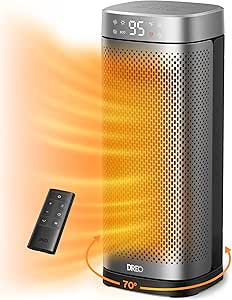 | Best for Heating a Small Room More Evenly | Model: DR-HSH014 | Heating element: PTC ceramic | Power: 1500W in title and description; 2000W in specifications | VIEW LATEST PRICE | See Our Full Breakdown |
| DREO Portable PTC Ceramic Space Heater with Remote |  | Best for Quiet, Precise Personal Control | Model: DR-HSH006 | Heating element: PTC ceramic | Power: 1500 watts | VIEW LATEST PRICE | See Our Full Breakdown |
| BZGG Q22 Portable Ceramic Space Heater |  | Best Lower-Wattage Pick | Model: Q22 | Heating technology: PTC ceramic | Power modes: 1000W high; 700W ECO | VIEW LATEST PRICE | See Our Full Breakdown |
| small space heater | Safety features | Heating element | Power | Dimensions |
|---|---|---|---|---|
| DREO 1500W Portable Space Heat | — | — | 1500 W | — |
| WINHL 1500W Portable Ceramic S | Overheat protection and tip-over shutoff | PTC ceramic | 1500 W | Approximately 5.9 in deep × 9.9 in tall |
| DREO Atom One Portable Ceramic | — | PTC ceramic | — | — |
| VOCRS 1500W Portable Ceramic S | Overheat protection and tip-over automatic shutoff | — | — | 5.8 × 5.5 × 8.5 in |
| Aikoper 1500W Portable Ceramic | Overheat protection and tip-over switch | Radiant | 1500 W | — |
| Gaiatop Mini 500W Portable Des | 45° tip-over protection and overheating protection | PTC ceramic | 500 watts | 2.6 × 5 × 5 inches |
| AUBKN Portable Ceramic Space H | Overheat protection and tip-over shutoff | — | — | 5.91 × 5.91 × 8.46 inches |
| Amazon Basics 500W Ceramic Min | — | Ceramic | 500 watts | 5.87 × 3.15 × 5.95 inches (D × W × H) |
| DREO 1500W Ceramic Space Heate | Tip-over protection, overheat protection, and 24-hour automatic shutoff | PTC ceramic | 1500W | — |
| GiveBest Portable Ceramic Spac | Overheat shutoff and tip-over protection | Ceramic | — | — |
| Lasko Portable Ceramic Bathroo | ALCI safety plug, overheat protection, cool-touch exterior | Ceramic | — | 8 inches tall; approximately 6.25 × 6.25-inch footprint |
| KIDEE Portable Ceramic Space H | Tip-over switch and overheat automatic shutoff | — | — | 5.28 × 4.45 × 8.5 inches; another listing gives 4.4 × 5.5 × 8.5 inches |
| DREO 1500W PTC Ceramic Tower S | — | PTC ceramic | 1500W in title and description; 2000W in specifications | — |
| DREO Portable PTC Ceramic Spac | Tip-over detection, overheat protection, child lock, ETL-certified safety plug | PTC ceramic | 1500 watts | — |
| BZGG Q22 Portable Ceramic Spac | Tip-over and overheat shutoff; fire-resistant casing | — | — | 5.28 × 4.45 × 8.5 inches in description; 19.5 × 11.5 × 12.5 inches in product measurements |
More Details on Our Top Picks
DREO 1500W Portable Space Heater with Adjustable Tilt
Four tilt angles make this DREO a better fit for warming a person at a desk or chair than a heater that spreads warmth mainly by oscillating. I like the flexibility to aim airflow from floor level or toward a seated position, while the 1°F thermostat adjustments give more precise control than the VOCRS’s three fixed power settings. Its 34 dB noise specification also makes it a quieter-sounding choice on paper than the DREO Atom One, listed at 37.5 dB.
The tradeoff is that tilting directs warmth rather than distributing it across a room; the WINHL and Atom One offer 70° oscillation for broader coverage. At 1500W, it still needs a suitable wall outlet, and its cord limits placement. I’d choose it for targeted comfort, not as a substitute for whole-home heating.
Pros:- Four tilt angles help direct airflow toward a specific seating position
- Thermostat adjusts in precise 1°F increments
- Listed noise level of 34 dB is quieter than the Atom One’s 37.5 dB specification
- Includes tip-over and overheat protection, flame-retardant materials, and a safety plug
Cons:- Lacks the wide-area oscillation offered by the WINHL and DREO Atom One
- Requires a corded indoor power source, which limits placement
- Its 1500W output is intended for supplemental warmth rather than whole-house heating
Best for: People working at a desk or sitting in one spot who want to aim warmth without moving the heater
Not ideal for: Buyers who want warmth spread across several seats or a larger room; this model tilts but does not list oscillation
- Power:1500 W
- Heating method:Forced air, PTC ceramic
- Tilt angles:0°, 20°, 40°, 60°
- Temperature range:41°F–95°F
- Temperature adjustment:1°F increments
- Speeds and modes:6 speeds; 3 modes
- Noise level:34 dB
- Dimensions and weight:9.65 × 5.71 × 10.12 in; 3.5 lb
- Included:Remote control, space heater, user manual
Our verdict“Choose this DREO if you want quiet, adjustable warmth aimed at one person rather than oscillation across a room.”
WINHL 1500W Portable Ceramic Space Heater with 70° Oscillation
The WINHL’s 70° oscillation gives it a clear advantage over the tilt-focused DREO 1500W when warmth needs to reach more than one spot. Its compact tower shape is designed for a tabletop, and the remote, thermostat, ECO mode, and 12-hour timer put routine adjustments within easy reach. Five heating modes also offer more operating choices than the VOCRS, which lists three power levels.
This remains a supplemental heater for personal spaces and small rooms, not a whole-house solution. Its small-room focus is also less clearly quantified than the DREO Atom One’s stated 200 sq. ft. coverage. The remote needs two AAA batteries that are not included, and the manufacturer advises plugging it directly into a 15A wall outlet rather than an extension cord or power strip. That placement requirement can matter in a crowded room.
Pros:- 70° oscillation spreads warmth more broadly than the tilt-only DREO 1500W
- Remote, thermostat, and ECO mode allow convenient temperature adjustments
- 12-hour timer supports scheduled shutoff
- Tip-over shutoff and overheat protection are included
Cons:- Designed for personal spaces and small rooms rather than whole-house heating
- Remote requires two AAA batteries, which are not included
- Manufacturer advises against using an extension cord or power strip
Best for: People in small rooms who want oscillating warmth and remote temperature and timer controls
Not ideal for: Buyers who need a heater for a large area or must place it far from a suitable wall outlet
- Power:1500 W
- Heating element:PTC ceramic
- Oscillation:70°
- Speeds:5
- Maximum temperature:95°F
- Timer:Up to 12 hours
- Controls:Remote control and thermostat
- Safety features:Overheat protection and tip-over shutoff
- Dimensions:Approximately 5.9 in deep × 9.9 in tall
Our verdict“Pick the WINHL if oscillation and scheduled remote control matter more than a stated room-coverage figure.”
DREO Atom One Portable Ceramic Space Heater
The Atom One is the most clearly specified choice here for a small room: its listed coverage is up to 200 sq. ft., and 70° oscillation helps move warmth beyond one fixed point. A programmable thermostat with 1°F adjustments, ECO mode, remote, and 1–12-hour timer make it more adaptable than the simpler Aikoper, whose temperature specification is unclear. The detachable filter is another practical distinction for buyers who want a removable part for upkeep.
Its 1500W output and indoor-only design still make it supplemental heat, not a replacement for central heating. The VOCRS offers three selectable wattages, while the Atom One emphasizes temperature control and oscillation instead. At up to 37.5 dB, it is not the quietest listed option in this group; the tilting DREO is specified at 34 dB. Choose this model for its control package and stated coverage, not minimum noise.
Pros:- Listed coverage of up to 200 sq. ft. helps set expectations for small-room use
- 70° oscillation distributes warmth beyond a single fixed direction
- 1°F thermostat adjustments, ECO mode, remote, and timer offer flexible control
- Detachable filter and tip-over and overheat protection are included
Cons:- Listed noise level of 37.5 dB is higher than the tilting DREO’s 34 dB specification
- Designed for indoor use and supplemental heating, not larger spaces
- Requires a corded 120V power source
Best for: People heating a bedroom, office, or other small room up to the listed 200 sq. ft. who want a programmable thermostat and oscillation
Not ideal for: Noise-sensitive buyers who want the lowest listed sound level, or anyone seeking heat for a space larger than its specified coverage
- Heat output:1500 W
- Heating element:PTC ceramic
- Heating coverage:Up to 200 sq. ft.
- Thermostat range:41–95°F, adjustable in 1°F increments
- Oscillation:70°
- Timer:1–12 hours
- Noise level:As low as 37.5 dB
- Dimensions and weight:6.69 × 5.51 × 10.31 in; 1.75 kg
- Included:Heater with detachable filter, remote control, user guide
Our verdict“Choose the Atom One for a small room where defined coverage, oscillation, and detailed thermostat control matter most.”
VOCRS 1500W Portable Ceramic Space Heater with Remote and Timer
The VOCRS stands out for letting you choose among 700W, 1000W, and 1500W, rather than relying mainly on thermostat behavior. Lower settings give small-space users a way to dial back output when full power feels excessive. The digital display, remote, and 1–12-hour timer also make adjustment straightforward, while a carry handle helps when moving it between rooms. Its listed 200 sq. ft. coverage matches the DREO Atom One’s stated coverage, though the Atom One adds 70° oscillation and finer 1°F thermostat steps.
That contrast matters: the VOCRS prioritizes selectable power, while the Atom One offers more detailed temperature control and room-wide movement. The VOCRS’s 40°F–40°C temperature range is an unusual mixed-unit specification, so I would not choose it for precise thermostat expectations without confirming the controls. Remote batteries are not included, and it is for indoor use.
Pros:- Three selectable power levels: 700W, 1000W, and 1500W
- Digital display and remote make adjustments easier from a seat
- 1–12-hour timer provides scheduled shutoff
- Carry handle and tip-over and overheat shutoff support room-to-room use
Cons:- Temperature range is listed as 40°F–40°C, leaving control details unclear
- Remote requires two AAA batteries that are not included
- Unlike the DREO Atom One and WINHL, oscillation is not listed
Best for: People who want to select lower wattage settings for a desk area or compact room and value a display and remote
Not ideal for: Buyers who want oscillation or especially clear, fine-grained thermostat specifications
- Heating power:700W, 1000W, 1500W
- Heating coverage:200 sq. ft.
- Temperature range:40°F–40°C
- Timer:1–12 hours
- Controls:Remote control and digital display
- Safety features:Overheat protection and tip-over automatic shutoff
- Dimensions:5.8 × 5.5 × 8.5 in
- Amperage:12.5 A
- Remote batteries:2 AAA batteries required; not included
Our verdict“Choose the VOCRS if selectable wattage is more useful to you than oscillation or precisely specified thermostat control.”
Aikoper 1500W Portable Ceramic Space Heater with Thermostat
The Aikoper keeps its controls straightforward: low, medium, high, and fan-only modes, plus a manual thermostat and built-in handle. That makes it a practical basic pick for someone who wants to move a compact heater between a floor and a tabletop without needing a remote or timer. Compared with the VOCRS, it gives up the digital display and scheduled shutoff, but it includes a fan-only mode for air circulation without selecting a heat setting. Its stated 150 sq. ft. coverage also places it below the 200 sq. ft. claims for the Atom One and VOCRS.
The main concern is a specification inconsistency: the temperature settings are listed as both a 41°F minimum and a 41°F maximum. That makes the thermostat range impossible to judge from the provided data. The Aikoper is also an indoor, corded heater, and its simple controls may feel limiting beside the WINHL’s remote and timer.
Pros:- Low, medium, high, and fan-only modes cover basic heating and airflow needs
- Manual adjustable thermostat avoids a more involved control setup
- Built-in handle supports moving it between floor and tabletop locations
- Tip-over switch and overheat protection are included
Cons:- Temperature is listed as 41°F for both minimum and maximum, so the range is unclear
- Listed coverage is 150 sq. ft., below the Atom One and VOCRS figures
- No remote or timer is listed
Best for: People who want a basic, portable heater for a small room and prefer simple manual controls over a remote
Not ideal for: Buyers who need a clear thermostat range, a timer, remote operation, or listed coverage above 150 sq. ft.
- Power:1500 W
- Voltage and amperage:120 V; 12.5 A
- Heating method:Convection
- Heating element:Radiant
- Modes:Low, medium, high, fan-only
- Thermostat:Adjustable manual thermostat
- Heating coverage:150 sq. ft.
- Mounting:Floor or tabletop
- Safety features:Overheat protection and tip-over switch
Our verdict“Pick the Aikoper for basic portable warmth in a small room, but skip it if you need a clearly specified thermostat or timer.”
Gaiatop Mini 500W Portable Desk Space Heater
The Gaiatop Mini earns its place for buyers who want a small patch of warmth at a desk rather than heat for an entire room. Its 500-watt PTC ceramic element is described as heating in two seconds, while the tabletop footprint—2.6 × 5 × 5 inches—takes up little workspace. Compared with the Amazon Basics 500W Ceramic Mini Space Heater, it offers a similarly low-power, compact approach, but the Gaiatop specifies both tip-over and overheating protection. That small output is also its main limitation: it suits close-range supplemental warmth, not a chilly room that needs broader coverage. The 230-volt specification may also limit compatibility depending on the buyer’s electrical supply, so check outlet requirements before choosing it. Its quiet operation and indoor-only design fit desk use, but not outdoor work.
Pros:- Very small tabletop footprint fits beside a monitor or on a compact desk.
- 500-watt PTC ceramic element is described as heating in two seconds.
- Includes both 45° tip-over and overheating protection.
- Quiet operation suits focused indoor work.
Cons:- 500-watt output is for targeted warmth rather than heating a room.
- 230-volt specification may not match every buyer’s available outlet.
- Indoor-only design is unsuitable for outdoor work areas.
Best for: Desk workers who want quiet, close-range warmth in a small indoor workspace and have a compatible 230-volt outlet.
Not ideal for: People trying to heat a full room, or buyers whose outlets are not compatible with its 230-volt specification.
- Power:500 watts
- Voltage:230 volts
- Heating element:PTC ceramic
- Heating method:Convection
- Dimensions:2.6 × 5 × 5 inches
- Mounting type:Tabletop
- Safety features:45° tip-over protection and overheating protection
- Material:V0-class fireproof material
Our verdict“Choose the Gaiatop for quiet, close-up desk warmth when its 500-watt output and 230-volt requirement fit your setup.”
AUBKN Portable Ceramic Space Heater with Remote and Thermostat
The AUBKN combines adjustable output with controls that are useful when a heater sits across a room or under a desk: a remote, digital display, thermostat, and 12-hour timer. Its 700W, 1000W, and 1500W settings give it more range than the 500-watt Amazon Basics Mini Space Heater, while its 5.91 × 5.91 × 8.46-inch body stays small enough to move between rooms. The stated coverage is up to 200 square feet, so it makes more sense for a compact room than for broad, open areas. Overheat protection and tip-over shutoff add useful safeguards, though they do not remove the need for careful placement. The remote needs two AAA batteries that are not included, a minor setup task, and the compact size does not change its limited coverage.
Pros:- Three heat settings offer more output flexibility than 500-watt desk heaters.
- Remote, digital display, and touch controls allow adjustment without reaching the unit.
- Thermostat and 12-hour timer support more controlled operation.
- Tip-over shutoff and overheat protection are included.
Cons:- Coverage is specified for rooms up to 200 square feet.
- Remote requires two AAA batteries, which are not included.
- Its 1500W setting needs a suitable electrical outlet and careful placement.
Best for: People who want a small-room heater with remote adjustment, a thermostat, and several power levels for home or office use.
Not ideal for: Buyers heating open-plan spaces larger than the stated 200-square-foot coverage or those who want a remote ready to use without supplying batteries.
- Heating settings:700W, 1000W, and 1500W
- Heating method:Radiant
- Coverage:Up to 200 sq. ft.
- Timer:12 hours
- Controls:Remote control, digital display, and touch keys
- Safety features:Overheat protection and tip-over shutoff
- Dimensions:5.91 × 5.91 × 8.46 inches
- Weight:2.2 lb
Our verdict“Pick the AUBKN if you want remote and thermostat controls in a compact heater for a room up to 200 square feet.”
Amazon Basics 500W Ceramic Mini Space Heater with Tip-Over Protection, Black
The Amazon Basics 500W Ceramic Mini is a straightforward pick for targeted warmth when desk space and easy repositioning matter more than room coverage. At 1.4 pounds, it is lighter than the Gaiatop Mini, and its 120-volt specification suits buyers seeking a conventional outlet setup. The compact tabletop form and 48 dB operating-noise figure make it a practical option for a home office or study, though the stated noise level is not silent. Unlike the AUBKN Portable Ceramic Heater, it has no thermostat, timer, or higher-power settings; in exchange, it keeps the controls and intended use simple. Its 500-watt output is for nearby supplemental warmth, not raising the temperature across a whole room. Tip-over protection helps if it is knocked over, but the listed safety features are less extensive than the Gaiatop’s overheating and tip-over protections.
Pros:- Lightweight at 1.4 pounds and easy to reposition.
- Small tabletop dimensions fit desks and other tight surfaces.
- 120-volt corded design suits conventional indoor outlet use.
- Tip-over protection shuts the unit off if knocked over.
Cons:- 500 watts is intended for targeted supplemental warmth, not whole-room heating.
- No thermostat, timer, or adjustable heat settings are listed.
- At 48 dB, it is not silent, and overheating protection is not listed.
Best for: Home-office and study users who want a light, simple heater for nearby warmth from a 120-volt outlet.
Not ideal for: People who need thermostat control, a timer, broader room heating, or listed overheating protection.
- Power:500 watts
- Voltage:120 volts
- Heating element:Ceramic
- Heating method:Convection
- Noise level:48 dB
- Dimensions:5.87 × 3.15 × 5.95 inches (D × W × H)
- Weight:1.4 pounds
- Safety feature:Tip-over protection
Our verdict“Choose this Amazon Basics mini for lightweight, uncomplicated desk warmth, but pick the AUBKN if you need adjustable output and a thermostat.”
DREO 1500W Ceramic Space Heater with Thermostat
For buyers who need more than a personal desk heater, the DREO 1500W Ceramic Space Heater pairs up to 270-square-foot stated coverage with 70° oscillation, helping distribute warmth beyond the immediate area in front of the unit. Its thermostat range of 41°F–95°F, ECO mode, five fan speeds, and remote provide more control than the smaller Amazon Basics 500W Mini or the fixed-location warmth of the Gaiatop. The tradeoff is a taller 15.79-inch body, so it takes more vertical space than compact tabletop models. DREO also advises plugging it directly into a wall outlet rather than using an extension cord, which can limit placement options. Tip-over and overheat protection, a 12-hour timer, and a 24-hour inactivity shutoff add useful safeguards, but its stated coverage remains a guide, not a guarantee for every room layout.
Pros:- 70° oscillation helps spread warmth across more of a room.
- Thermostat, ECO mode, and five fan speeds offer flexible operation.
- Remote, 12-hour timer, and digital display simplify adjustments.
- Tip-over, overheat, and 24-hour inactivity shutoffs are included.
Cons:- Taller than mini tabletop models and needs more vertical space.
- Manufacturer advises against using an extension cord, limiting placement flexibility.
- Coverage is specified up to 270 square feet and may not suit open or poorly insulated spaces.
Best for: People who need adjustable, moving heat for a bedroom, home office, or other small room up to the stated 270-square-foot coverage.
Not ideal for: Desk users seeking a tiny personal heater or anyone who needs to place a heater where only an extension cord can reach.
- Power:1500W
- Heating element:PTC ceramic
- Coverage:Up to 270 sq. ft.
- Thermostat range:41°F–95°F
- Oscillation:70°
- Noise level:34 dB
- Modes and speeds:ECO mode and five fan speeds
- Safety features:Tip-over protection, overheat protection, and 24-hour automatic shutoff
- Cord length:6 ft
Our verdict“Choose the DREO when room-wide adjustability and oscillation matter more than the smallest possible footprint.”
GiveBest Portable Ceramic Space Heater with Fan
The GiveBest Portable Ceramic Space Heater suits buyers who want one small appliance for supplemental heat and simple air circulation. Its 1500W and 750W settings provide more heating range than the 500W Gaiatop and Amazon Basics minis, while a cool-air fan adds a use beyond the colder months. An electronic thermostat cycles the heater around a preset temperature, and the carry handle makes it easier to move between indoor rooms. Its stated coverage is up to 200 square feet, placing it closer to the AUBKN than to a personal desk heater. The tradeoff is less detailed control: the listed features do not include a remote, timer, or oscillation like the DREO. GiveBest also notes that the tip-over shutoff may require the unit to be uprighted before operation resumes, which can interrupt use after it is knocked over.
Pros:- 1500W and 750W heat settings accommodate different supplemental-heating needs.
- Cool-air fan supports use beyond the heating season.
- Electronic thermostat cycles heat around a preset temperature.
- Carry handle and compact tabletop form help with room-to-room moves.
Cons:- Coverage is designed for indoor spaces up to 200 square feet.
- No remote, timer, or oscillation is listed, unlike the DREO model.
- Tip-over shutoff may require repositioning the heater before it resumes operation.
Best for: People who want a portable indoor heater for a smaller room, with two heat levels, thermostat control, and a cool-air fan for other seasons.
Not ideal for: Buyers who want remote operation, a timer, oscillation, or a heater for spaces beyond the stated 200-square-foot coverage.
- Heating modes:1500W and 750W
- Fan mode:Cool air
- Coverage:Up to 200 sq. ft.
- Thermostat:Electronic
- Heating element:Ceramic
- Safety features:Overheat shutoff and tip-over protection
- Voltage:120V
- Cord length:6 ft
Our verdict“Pick GiveBest if you want a portable small-room heater that also offers a cool-air fan, and skip it if remote control or oscillation is a priority.”
Lasko Portable Ceramic Bathroom Space Heater
For a small room where the heater needs to tuck beside a sink or under a desk, the Lasko Portable Ceramic Bathroom Space Heater has one of the most compact footprints here: about 6.25 inches square and 8 inches tall. Its 900W and 1500W settings let you choose a gentler draw or stronger personal warmth, while the one-hour timer suits short sessions. The ALCI plug adds a bathroom-oriented safety feature that the KIDEE Q22 does not list, but this heater is not waterproof and must stay clear of standing water. It is also less suited to warming a whole room than the oscillating DREO DR-HSH014. I’d choose it for nearby, temporary heat—not as a substitute for safe bathroom installation or room heating.
Pros:- Small footprint and 3.35-pound weight make it easy to place and store.
- Two heat settings offer a lower-power option as well as 1500W output.
- ALCI safety plug, overheat protection, and cool-touch exterior are listed.
- One-hour timer supports short heating sessions.
Cons:- Not waterproof and must be kept away from standing water.
- Designed for small personal areas rather than broad room heating.
- Coverage claims conflict: up to 100 sq. ft. in the description versus 225 sq. ft. in product information.
Best for: People who want a compact heater for brief, attended use in a dry bathroom or other small personal area, with an ALCI safety plug.
Not ideal for: Anyone who needs a waterproof heater, plans to place it near standing water, or expects one compact unit to warm a larger room evenly.
- Heating element:Ceramic
- Heat settings:900W and 1500W
- Heat output:5,118 BTU
- Dimensions:8 inches tall; approximately 6.25 × 6.25-inch footprint
- Weight:3.35 pounds
- Timer:1 hour
- Safety features:ALCI safety plug, overheat protection, cool-touch exterior
- Cord length:6 feet
Our verdict“Choose the Lasko for compact, short-duration personal warmth in a dry space, but skip it if you need waterproofing or wider coverage.”
KIDEE Portable Ceramic Space Heater with Tip-Over and Overheat Protection
The KIDEE Q22 keeps the feature set straightforward: two heat settings, a carry handle, and automatic shutoff for tipping or overheating. Its compact listed dimensions make it easy to move between a desk and bedside area, though the listing gives two different dimension measurements, so buyers needing a precise fit should be cautious. Compared with the Lasko Portable Ceramic Bathroom Space Heater, KIDEE emphasizes carry-and-place convenience rather than an ALCI plug or timer. It also lacks the thermostat, oscillation, and remote found on the DREO DR-HSH014. That simplicity can suit someone who wants basic spot heat without a control-heavy interface, but the short four-foot cord and small-space intent limit placement and reach.
Pros:- Compact body and carry handle make it easy to relocate.
- Two heat settings provide a basic choice of output.
- Tip-over and overheat automatic shutoff are listed.
- Quiet operation is a useful fit for work or rest areas.
Cons:- Four-foot cord can restrict placement relative to the Lasko’s six-foot cord.
- Dimension listings conflict, making exact space planning harder.
- Intended for small indoor spaces and lacks the thermostat and timer controls of the DREO models.
Best for: Desk or bedside users who want a lightweight heater with a carry handle, two settings, and basic automatic safety shutoffs.
Not ideal for: Buyers who need a longer cord, a timer, precise thermostat control, or reliable dimensions for a very tight placement.
- Model:Q22
- Heating method:Forced air, PTC ceramic
- Heat settings:2
- Dimensions:5.28 × 4.45 × 8.5 inches; another listing gives 4.4 × 5.5 × 8.5 inches
- Power cord:4 feet
- Safety features:Tip-over switch and overheat automatic shutoff
- Use:Indoor
Our verdict“Pick the KIDEE for uncomplicated, portable spot heat, but choose a more feature-rich model if you need precise control or flexible placement.”
DREO 1500W PTC Ceramic Tower Space Heater
Among these five, the DREO DR-HSH014 is the strongest fit for a small room shared by more than one person: its 70° oscillation spreads airflow, and the adjustable thermostat, ECO mode, timer, and remote provide more control than the compact KIDEE Q22 or BZGG Q22. The listing describes coverage up to 250 square feet, though its specifications give a narrower 107.6–215.3-square-foot range. Power is also inconsistent: 1500W appears in the title and description, while the specifications state 2000W. Those conflicts make exact sizing and electrical planning less certain. It is a floor-standing option with more room-oriented features, but buyers wanting a verified compact personal heater may prefer the simpler Lasko or KIDEE.
Pros:- 70° oscillation helps distribute warmth beyond one fixed direction.
- Thermostat adjusts from 41°F to 95°F in 1°F increments.
- Remote, ECO mode, three speeds, and a 1–12-hour timer add control.
- Tip-over and overheat protection, flame-retardant materials, and a safety plug are listed.
Cons:- Power rating conflicts between 1500W and 2000W in the listing.
- Coverage differs between the description and specifications.
- More controls and a floor-standing format are less suited to buyers seeking a basic, tiny personal heater.
Best for: People heating a small shared room who value oscillation, thermostat adjustments, a remote, and a timer more than the smallest possible footprint.
Not ideal for: Buyers who need fully consistent power and coverage specifications, or who want a tiny heater for close-range desk warmth.
- Model:DR-HSH014
- Heating element:PTC ceramic
- Power:1500W in title and description; 2000W in specifications
- Heating coverage:107.6–215.3 sq. ft. in specifications; up to 250 sq. ft. in description
- Oscillation:70°
- Thermostat range:41°F–95°F, adjustable in 1°F increments
- Timer:1–12 hours
- Noise level:As low as 34 dB
Our verdict“Choose this DREO for adjustable, oscillating heat in a small shared room, provided you are comfortable with its inconsistent power and coverage details.”
DREO Portable PTC Ceramic Space Heater with Remote
The DREO DR-HSH006 balances a small footprint with controls usually found on larger room heaters. Its thermostat adjusts in 1°F increments, and the 12-hour timer, remote, ECO mode, and fan-only option give it more flexibility than the basic KIDEE Q22. At 34 dB, it is also specified for quiet operation, which suits a bedroom or home office where fan noise can be distracting. The listed 200-square-foot coverage is broader than the Lasko’s stated personal-space focus, but it is still a corded heater and cannot be placed wherever convenient without regard to the outlet. Compared with the oscillating DREO DR-HSH014, this model has four speeds and a child lock, but no oscillation is listed.
Pros:- Compact 3.5-pound design with a carrying handle.
- Thermostat adjusts from 41°F to 95°F in 1°F increments.
- Quiet operation is rated at 34 dB, with four speeds and multiple modes.
- Tip-over detection, overheat protection, child lock, and ETL-certified safety plug are listed.
Cons:- Corded operation limits placement to areas within reach of an outlet.
- Coverage is specified at up to 200 square feet, so it is not intended for larger rooms.
- Unlike the DREO DR-HSH014, oscillation is not listed.
Best for: Bedroom and home-office users who want quiet spot heating, precise thermostat control, a remote, and a child lock in a compact unit.
Not ideal for: People who need heat distributed across a wider room by oscillation, or who need cordless placement away from an outlet.
- Model:DR-HSH006
- Heating element:PTC ceramic
- Power:1500 watts
- Coverage:Up to 200 sq. ft.
- Temperature range:41°F–95°F, adjustable in 1°F increments
- Speeds:4
- Timer:Up to 12 hours
- Dimensions and weight:7.32 × 7.32 × 11.02 inches; 3.5 pounds
- Safety features:Tip-over detection, overheat protection, child lock, ETL-certified safety plug
Our verdict“Choose the DR-HSH006 for quiet, finely adjustable heat near a desk or bed, but pick an oscillating model for broader room distribution.”
BZGG Q22 Portable Ceramic Space Heater
The BZGG Q22 stands apart from the 1500W Lasko and DREO heaters with its 1000W high mode and 700W ECO mode. That lower-power range may suit a close-by work area where full output is unnecessary, though the listing does not provide a wattage advantage in the form of a verified room-heating comparison. Its carry handle, 40 dB noise rating, and tip-over and overheat shutoffs keep the design focused on simple personal use. The KIDEE Q22 is similarly compact and also has two settings, but its power levels are not specified; BZGG gives buyers clearer mode ratings while introducing a different problem: its dimensions conflict sharply between the description and product measurements. I’d avoid relying on the listed 200-square-foot coverage for room-wide heating.
Pros:- 700W ECO and 1000W high modes offer lower listed output than the 1500W models.
- Carry handle and compact stated dimensions support moving it between nearby spaces.
- Tip-over and overheat shutoff plus fire-resistant casing are listed.
- 40 dB operation is specified as near-silent.
Cons:- Dimensions conflict sharply: 5.28 × 4.45 × 8.5 inches in the description versus 19.5 × 11.5 × 12.5 inches in product measurements.
- About four feet of cord limits placement.
- The stated coverage of up to 200 square feet may overstate its usefulness as a small personal heater.
Best for: Someone seeking lower-wattage spot heat for a nearby desk or small indoor area and who values a carry handle and basic automatic shutoffs.
Not ideal for: Buyers who need dependable dimensions for tight placement, a longer cord, or a clearly substantiated room-coverage claim.
- Model:Q22
- Heating technology:PTC ceramic
- Power modes:1000W high; 700W ECO
- Heating coverage:Up to 200 sq. ft.
- Noise level:40 dB
- Dimensions:5.28 × 4.45 × 8.5 inches in description; 19.5 × 11.5 × 12.5 inches in product measurements
- Weight:1.3 pounds
- Cord length:About 4 feet
- Safety features:Tip-over and overheat shutoff; fire-resistant casing
Our verdict“Choose the BZGG Q22 for lower-wattage nearby warmth, but skip it if exact sizing or room-wide heating performance matters.”
How We Picked
I compared these heaters by how well their design fits small-room use: footprint, heat output, direction of airflow, portability, and whether controls suit a desk, bedside spot, or shared area. I also looked at listed features that affect everyday handling, including thermostats, timers, remotes, oscillation, tilt, fan settings, and safety protections. A 500W mini heater can make sense close to a seated user, but its lower output makes it a different class of option from 1500W models.
The ranking gives priority to useful flexibility in a compact footprint, then weighs specialization, ease of operation, and the limits buyers should expect. That puts the adjustable-tilt DREO first as a versatile spot-heating choice, while oscillating and tower models follow for buyers who want broader air distribution. Desk minis and purpose-built bathroom options rank for narrower needs, not because those needs are unimportant, but because they serve fewer situations. Each product has a tradeoff: a feature only improves its place when it solves a real small-space problem.
| small space heater | Heating element |
|---|---|
| DREO 1500W Portable Space Heat | — |
| WINHL 1500W Portable Ceramic S | PTC ceramic |
| DREO Atom One Portable Ceramic | PTC ceramic |
| VOCRS 1500W Portable Ceramic S | — |
| Aikoper 1500W Portable Ceramic | Radiant |
| Gaiatop Mini 500W Portable Des | PTC ceramic |
| AUBKN Portable Ceramic Space H | — |
| Amazon Basics 500W Ceramic Min | Ceramic |
| DREO 1500W Ceramic Space Heate | PTC ceramic |
| GiveBest Portable Ceramic Spac | Ceramic |
| Lasko Portable Ceramic Bathroo | Ceramic |
| KIDEE Portable Ceramic Space H | — |
| DREO 1500W PTC Ceramic Tower S | PTC ceramic |
| DREO Portable PTC Ceramic Spac | PTC ceramic |
| BZGG Q22 Portable Ceramic Spac | — |
Factors to Consider When Choosing Best Small Space Heaters
Before choosing a compact heater, match its output and design to the distance and area you want to warm. I would start with where it will sit and how you will use it, then compare controls and safety features. These factors can prevent a common mismatch: buying a tiny heater expecting it to warm an entire room, or choosing a larger unit when close-range warmth is all you need.
Choose output for the distance, not just the room label
A heater intended for a desk or chair can work well when warmth only needs to reach one person nearby. Lower-output models such as 500W minis are easier to place close to a workspace, but they are not equivalent to 1500W heaters for distributing warmth farther across a room. Room insulation, ceiling height, drafts, and open doorways all affect how much heat feels useful. A common mistake is treating a heater’s wattage as a guarantee that it will warm every corner. Think about whether you need personal comfort or broader spot heating before comparing models. For larger or poorly insulated rooms, a portable heater may supplement rather than replace the main heating system.
Measure the footprint and the usable placement area
Small rooms often have limited floor space, but the heater still needs a stable, unobstructed location. Measure the space available near the intended seating area, and account for the heater’s shape, cord reach, and controls. A tower design can use vertical space, while a compact cube may fit on a floor corner or a suitable work surface if its instructions allow that placement. Do not assume that a smaller body can safely sit closer to curtains, bedding, papers, or furniture. Follow the clearance guidance in the manual, even when it reduces the number of possible spots. If no safe location remains, choose another heating approach.
Decide whether you need directed heat or wider coverage
Adjustable tilt is useful when you want to aim warmth at a seated person without moving the heater itself. Oscillation can spread airflow across more than one position, but it may be less helpful if only one fixed spot needs heat. Tower heaters can distribute airflow at a different height from low-profile minis, which may suit a shared seating area. These features do not create more heating capacity; they change where the warmth goes. Match the airflow pattern to the room layout and the number of people using the space. Paying for motion or aiming features makes little sense if the heater will stay beside one person.
Pay for controls you will actually use
A thermostat can reduce the need to keep adjusting a heater manually, while a timer can help set a planned run period. A remote is most useful when the unit sits beyond easy reach, such as across a small bedroom or lounge. For a desk heater beside your chair, onboard controls may be simpler and reduce features you rarely use. Check whether the control layout is practical from the heater’s intended position, rather than judging by the number of settings alone. More controls can make operation more flexible, but they do not make a heater more powerful. Prioritize a clear, convenient interface over a long feature list.
Treat safety protections and placement as separate checks
Tip-over and overheat protections are useful safeguards, but they do not make careless placement safe. Keep a portable heater on a stable, level surface and away from fabrics, paper, and other combustible materials. Check the product manual for permitted locations, clearances, and whether the heater is designed for a bathroom or another special setting. A bathroom-oriented label should not be read as permission to place any heater near water; follow the model’s specific instructions and local electrical guidance. If you need unattended operation, look for clear timer and safety information rather than relying on a single protection feature. No portable heater should be treated as a substitute for attentive use.
Consider noise, maintenance, and where the heater will live
A fan heater moves warm air around, which can create audible airflow that matters in a bedroom or quiet work area. If noise is a concern, compare the manufacturer’s operating information and available settings instead of assuming a compact design will be silent. Portability is useful when the heater moves between rooms, but a unit that stays in one place may benefit more from a convenient control layout or a shape that fits its permanent spot. Check the manual for cleaning instructions and keep air openings clear of dust and lint. Seasonal storage also favors a model that is easy to handle and store without blocking its vents. The best fit is the one whose daily use and upkeep match your routine.
Frequently Asked Questions
Is a 500W mini heater enough for a small bedroom?
A 500W mini heater is better suited to close-range personal warmth than heating a whole bedroom evenly. It may help when you are seated or working nearby, but results depend on room size, insulation, drafts, and how cold the space is. If you want warmth to reach a bed or a wider area, compare it with the lineup’s 1500W options and check the manufacturer’s guidance for room use. Do not use a heater on a bed or under bedding. Choose based on the distance between the heater and the person, not the word “mini” or “bedroom” in a listing.
Should I choose an oscillating heater or one with adjustable tilt?
Choose oscillation when warmth needs to move across several nearby positions, such as a shared sitting area. Adjustable tilt is more useful when you want to direct heat toward one chair, desk, or other fixed spot. Neither feature increases the heater’s output, so it cannot compensate for a unit that is undersized for the job. Consider the room layout: a narrow area may benefit from targeted airflow, while a wider seating arrangement may make oscillation more practical. If the heater will stay close to one person, the simpler aiming option may be enough.
Can I leave a small space heater running while I sleep?
Do not assume that a timer, thermostat, or safety protection makes overnight use appropriate. Follow the manufacturer’s instructions and warnings for the exact model, and avoid running any heater near bedding, curtains, or other combustible materials. A timer can limit a planned heating period, but it is not a replacement for safe placement or supervision. If overnight warmth is the goal, ask whether your room’s central heating or another heating method is a better fit. Turn off and unplug the heater when the manual directs you to do so.
Do I need a remote and thermostat for a heater in a small room?
These features are most useful when the heater is placed far enough away that reaching its controls is inconvenient, or when you want it to respond to a set temperature. In a desk setup, a remote may add little because the heater is already within reach. A thermostat can make temperature management less hands-on, but it does not guarantee even warmth throughout a room. Compare the control features with your routine rather than treating a longer feature list as a sign of better performance. If you mostly use one setting for short periods, simple controls may be all you need.
Is a bathroom-specific space heater safe to use near water?
A bathroom-oriented design does not mean a heater can be placed beside a sink, shower, or tub. Check the exact model’s manual for approved locations, clearance rules, and any restrictions on bathroom use. Keep the heater and its cord away from water and follow local electrical safety guidance. If the instructions do not clearly permit your planned setup, do not use it there. The Lasko model in this roundup is a specialized option, but its name alone cannot establish that a particular placement is safe.
Conclusion
For most buyers seeking a flexible heater for a compact area, I recommend the DREO 1500W Adjustable Tilt as the best overall choice because it combines higher output with directed airflow. My best value direction is a straightforward 1500W ceramic model such as the Aikoper if you want a thermostat without needing a tower or a remote-heavy setup; buyers should compare included controls and protections before choosing. For a more feature-focused premium-style pick, the DREO 1500W PTC Tower suits shoppers who value a vertical design and broader airflow distribution. Beginners who want simple, close-range warmth can start with the Amazon Basics 500W Mini, provided they understand its limited reach. For specific needs, choose the Gaiatop 500W for desk-side warmth, the WINHL oscillating model for moving airflow across a small area, or the Lasko bathroom heater only when its manual supports the intended bathroom placement. Match the heater to the space and use, rather than choosing by compact size alone.